OneManCompany
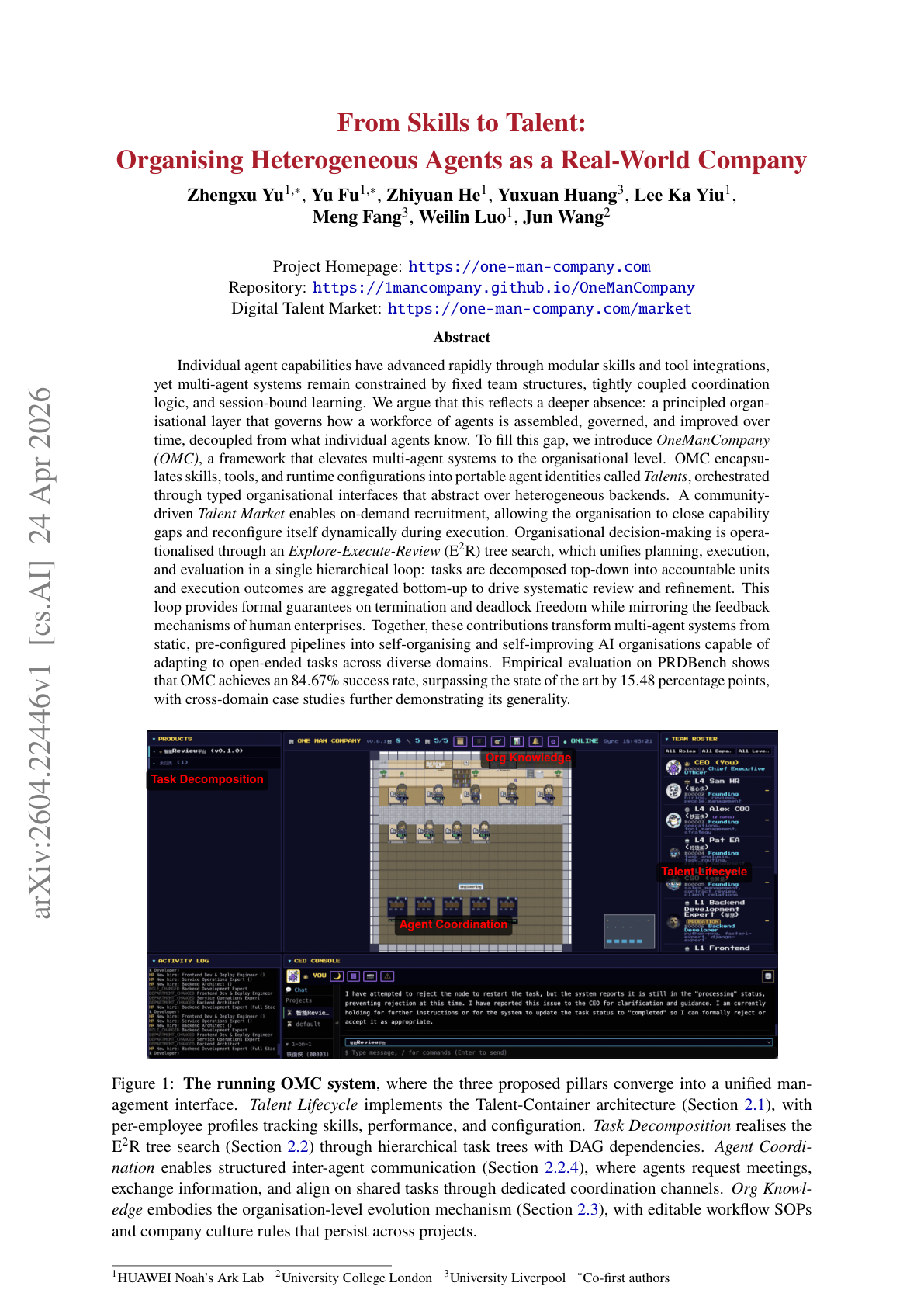
If you are building multi-agent systems, you are probably wiring static org charts. This paper argues they should look more like a labor market. OneManCompany (OMC) replaces fixed teams with "Talents," portable agent identities that bundle skills and tools, and a "Talent Market" where agents get recruited dynamically per task. An Explore-Execute-Review tree search decomposes work hierarchically and aggregates results back up. On PRDBench, OMC reaches 84.67% success, +15.5 points over prior SOTA, and the framework generalizes across the case studies the authors run.
Ask this paper
Talents as portable identities: A Talent bundles a skill set, tool access, and behavioral priors into a reusable agent identity. Talents can be hired into any task without rewiring the orchestration graph, which removes most of the brittleness in pre-wired multi-agent pipelines.
Dynamic recruitment via Talent Market: Tasks post requirements, and the market matches Talents to roles based on capability fit and current load. This replaces the standard "design a team for every workflow" pattern with on-demand assembly that adapts as the task population shifts.
Explore-Execute-Review tree search: Work is decomposed top-down into subtasks, executed in parallel by recruited Talents, then reviewed and aggregated up the tree. The structure naturally supports retries, branching, and cross-checking without manual coordination logic.
Why it matters: Pre-wired multi-agent pipelines break the moment tasks drift outside their design envelope. Treating agents as a recruitable workforce gets you self-organization and continuous improvement by default, which is what open-ended agent systems need.