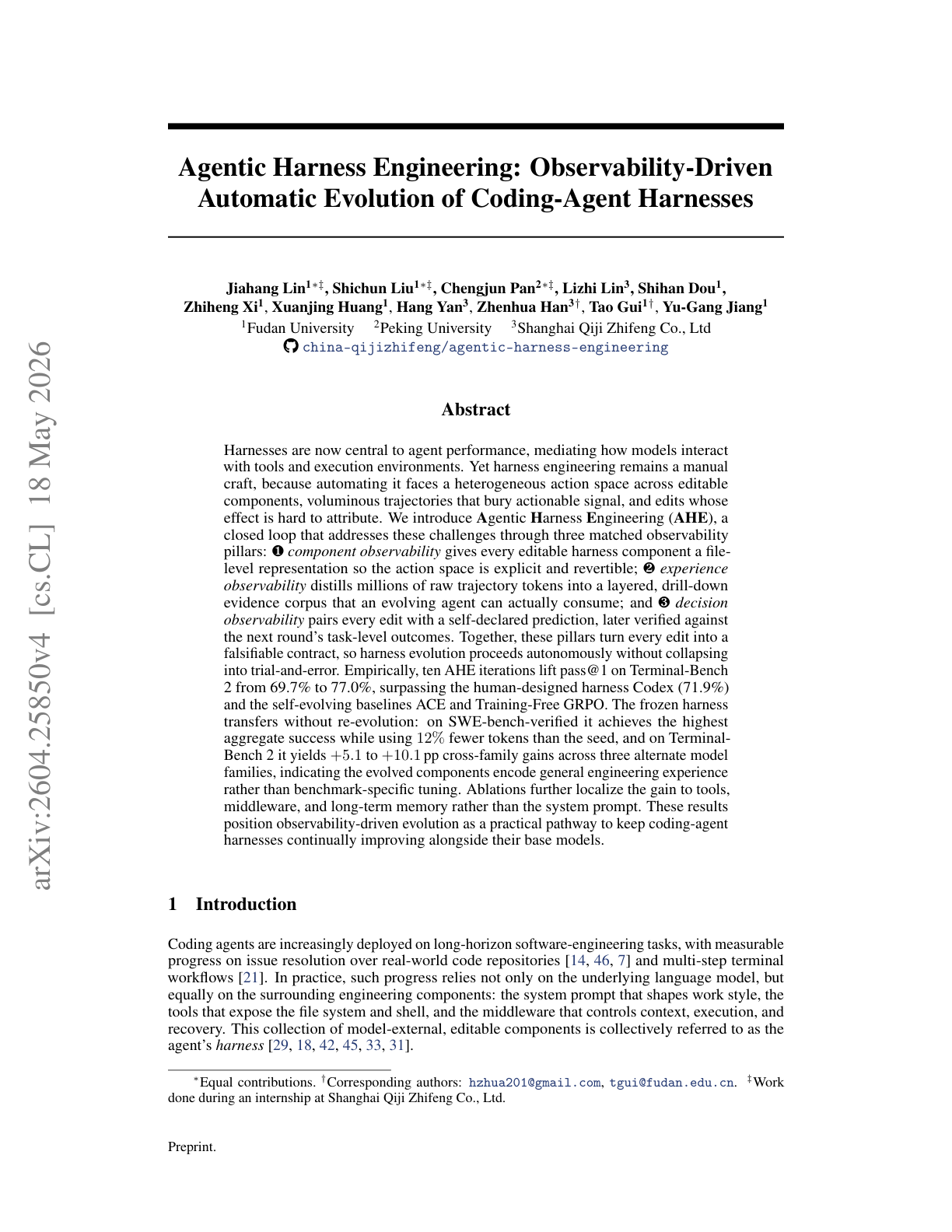
Agentic Harness Engineering
Most coding-agent harnesses are still tuned by hand or kept alive through brittle trial-and-error self-evolution. This paper introduces Agentic Harness Engineering (AHE), a framework that makes harness evolution observable and falsifiable. AHE separates the system into three layers: components stored as revertible files, experience condensed from millions of trajectory tokens into structured evidence, and decisions written as predictions that get checked against task outcomes. Every edit becomes a contract you can verify or revert.
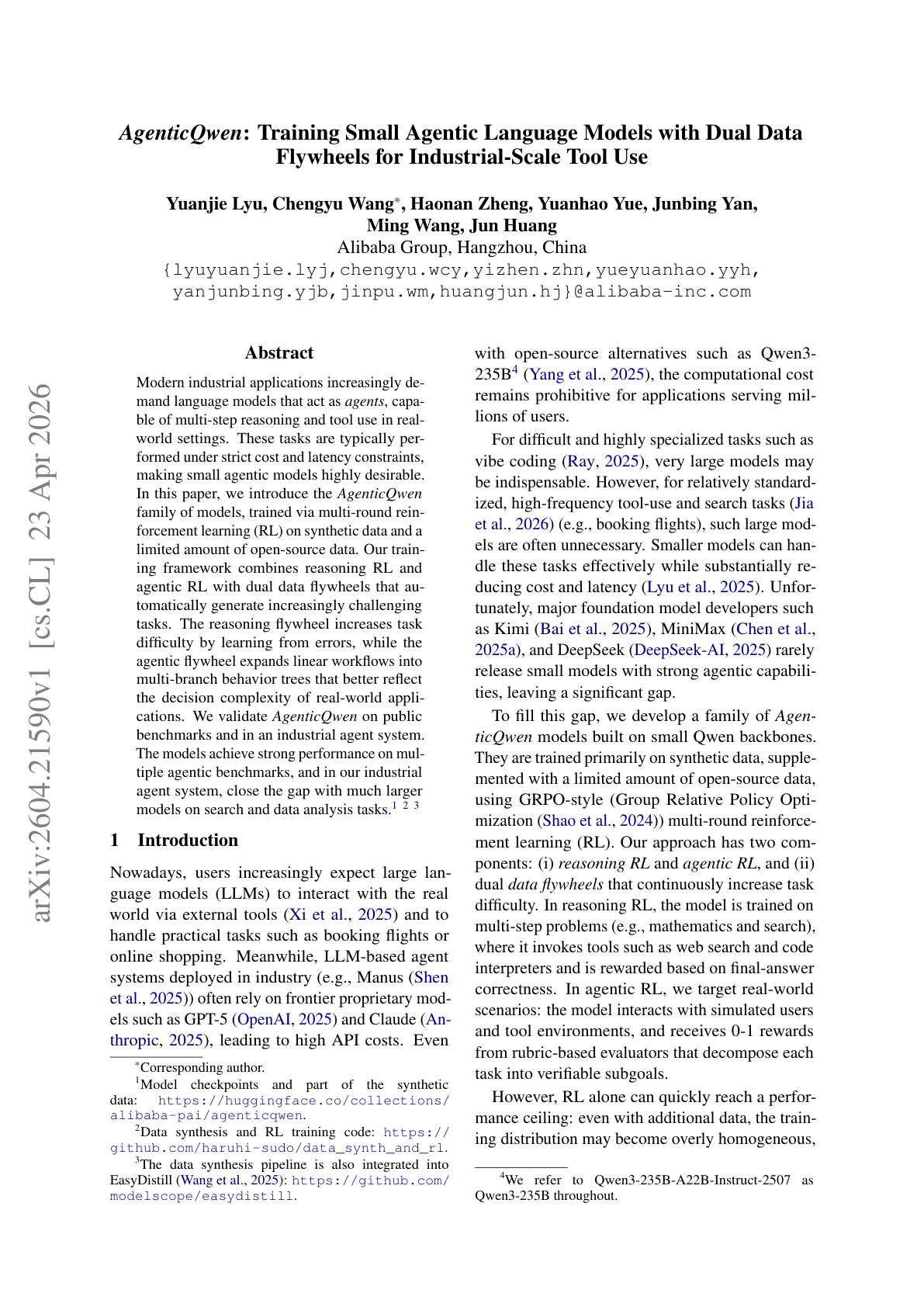
AgenticQwen-30B-A3B
Alibaba shows that a 30B MoE model with only 3B active parameters can match Qwen3-235B on real tool-use workloads. AgenticQwen-30B-A3B scores 50.2 average on TAU-2 plus BFCL-V4 Multi-Turn, while AgenticQwen-8B scores 47.4. Both more than double their vanilla Qwen baselines and close most of the gap to a 235B model. The recipe is built around two reinforcement learning flywheels that run in parallel, with simulated users actively trying to mislead the agent.
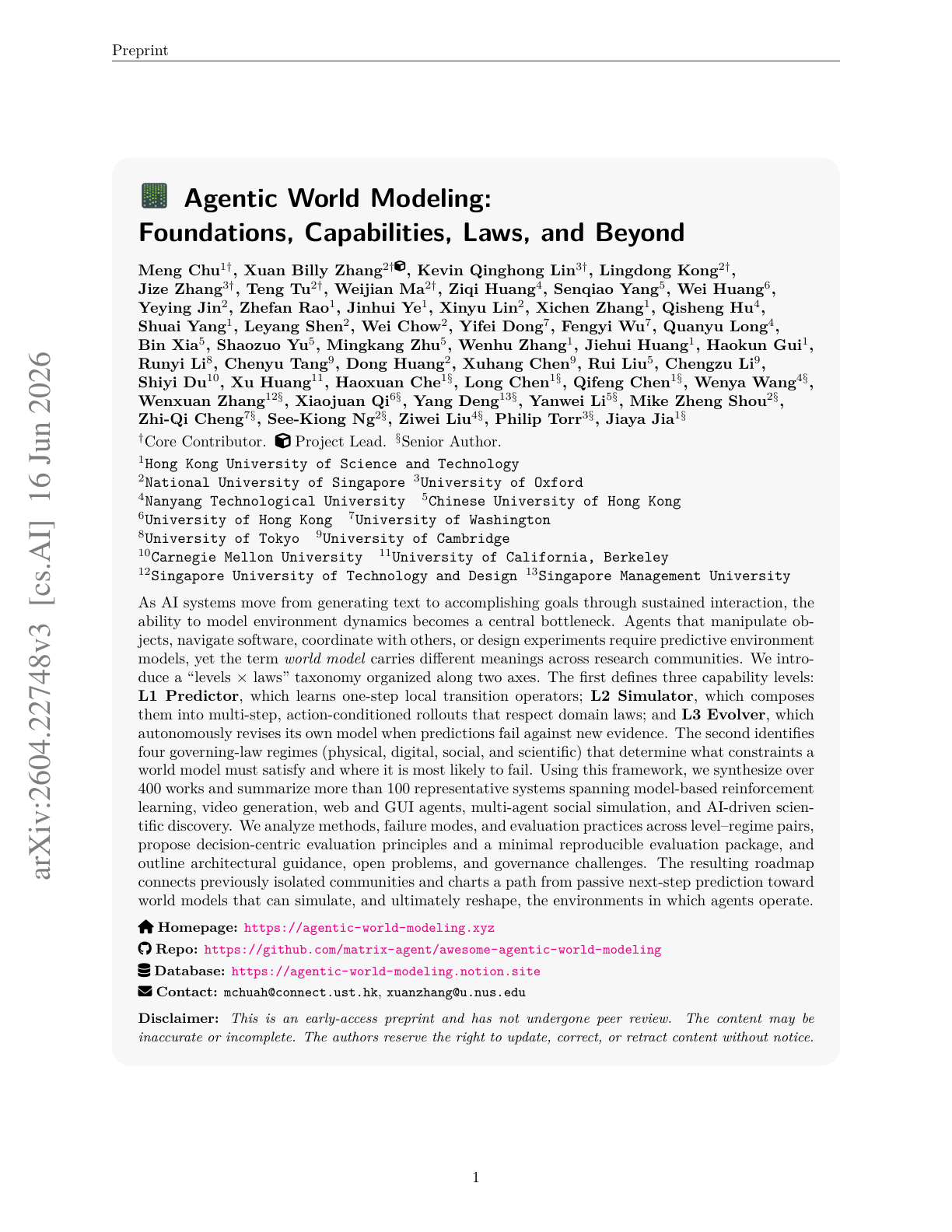
Agentic World Modeling
A massive 40-author survey lands the cleanest taxonomy of world models in agent research released so far. The paper proposes a "levels by laws" framework spanning three capability levels and four law regimes, then synthesizes 400+ works and 100+ representative systems across model-based RL, video generation, web and GUI agents, multi-agent simulation, and scientific discovery. As agents shift from chatbots to goal-accomplishers, the bottleneck moves from language to environment, and this is the first paper that gives builders a shared vocabulary across communities that have been working in isolation.
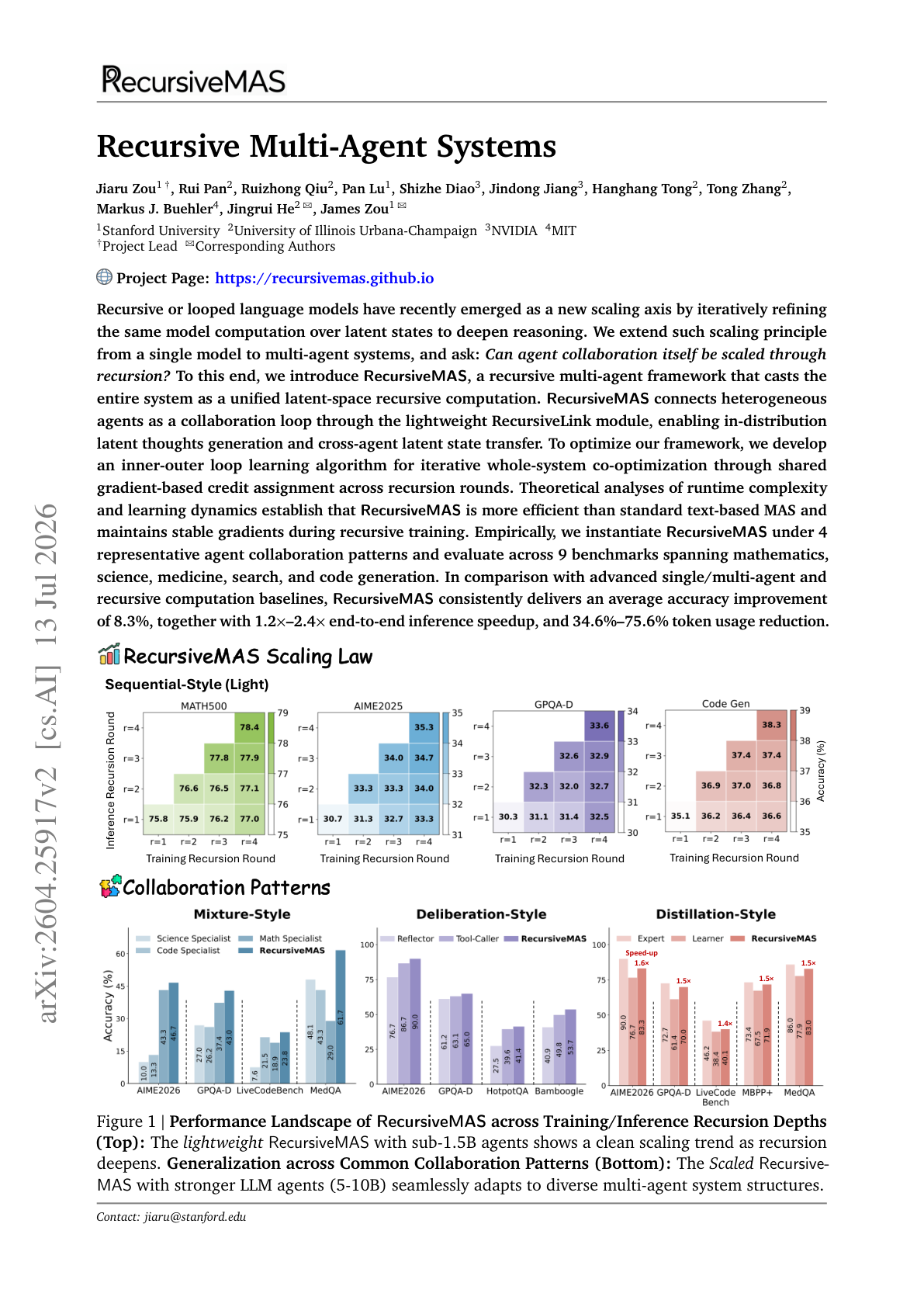
RecursiveMAS
Multi-agent systems usually pass full text messages between agents at every step, which causes token bloat, latency, and context dilution that all grow with team size. RecursiveMAS asks a different question: what if agents collaborated through recursive computation in a shared latent space instead of through text? The system treats a multi-agent team as a recursive computation where each agent acts like an RLM layer, iteratively passing latent representations to the next and forming a looped interaction process. Less talking, more thinking.
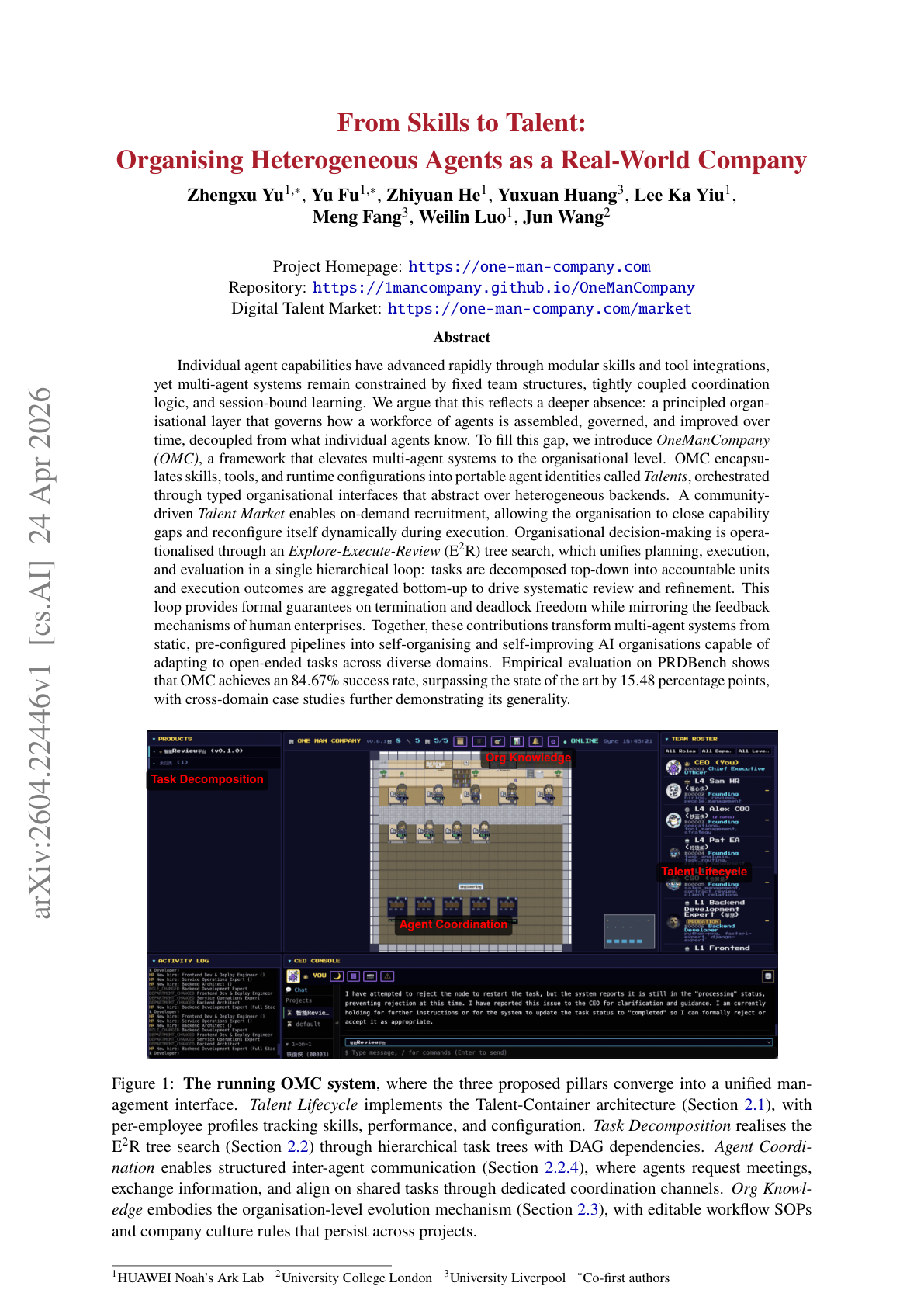
OneManCompany
If you are building multi-agent systems, you are probably wiring static org charts. This paper argues they should look more like a labor market. OneManCompany (OMC) replaces fixed teams with "Talents," portable agent identities that bundle skills and tools, and a "Talent Market" where agents get recruited dynamically per task. An Explore-Execute-Review tree search decomposes work hierarchically and aggregates results back up. On PRDBench, OMC reaches 84.67% success, +15.5 points over prior SOTA, and the framework generalizes across the case studies the authors run.
From Skill Text to Skill Structure
SKILL.md files entangle invocation interface, execution flow, and tool side effects in a single blob of natural language. That makes downstream discovery and risk review brittle as skill registries scale. This paper proposes SSL, a three-layer typed JSON representation drawn from Schank and Abelson's classical work on scripts, MOPs, and conceptual dependency. An LLM-based normalizer converts existing SKILL.md files into the structure, so adoption does not require rewriting registries by hand.
Latent Agents
Multi-agent debate makes models reason better. It also burns tokens generating long transcripts before any answer comes out. Latent Agents distills the entire debate into a single LLM through a two-stage fine-tuning pipeline: the model first learns debate structure, then internalizes it through dynamic reward scheduling and length clipping. The internalized model matches or beats explicit multi-agent debate while using up to 93% fewer tokens, which makes debate-quality reasoning practical at production scale.
OCR-Memory
Most agent memory systems compress trajectories into text summaries and hope the model remembers what matters, which is exactly where the information loss hides. OCR-Memory renders the agent's interaction history as images with indexed visual anchors, then retrieves via a locate-and-transcribe pipeline: the model scans visual memory, predicts the index of the relevant region, and the original text is fetched verbatim from a database. Older trajectories are stored as low-resolution thumbnails with active-recall up-sampling, and the method reaches SOTA on Mind2Web and AppWorld under strict context limits.
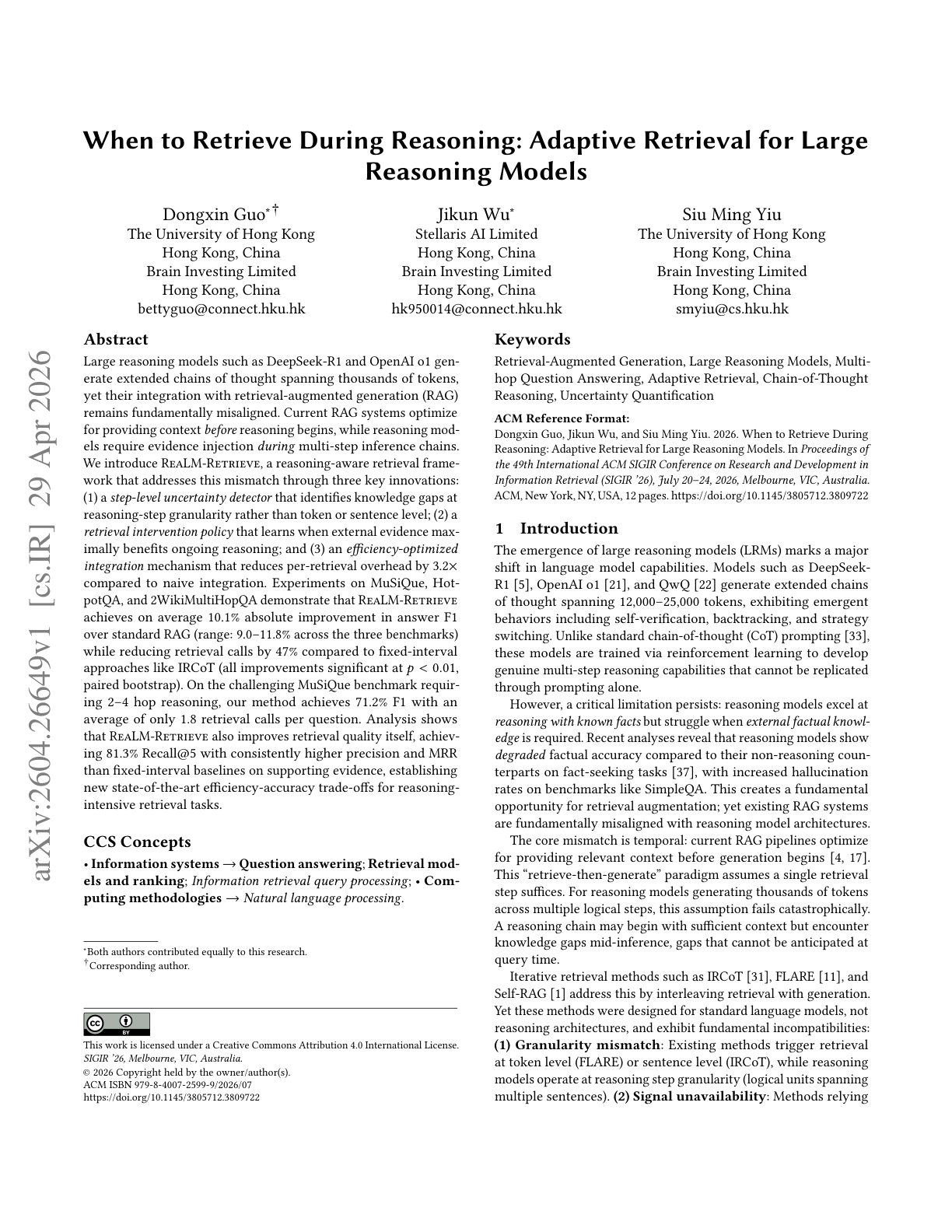
When to Retrieve During Reasoning
Most RAG systems retrieve once, before the model starts reasoning. Large reasoning models like o1 and R1 do not work that way. They generate 12k to 25k token chains of thought and hit knowledge gaps mid-inference, long after the retrieval window closed. ReaLM-Retrieve is a reasoning-aware retrieval framework that injects evidence during multi-step inference, detects uncertainty at reasoning-step granularity, and learns a policy for when external evidence actually helps. It achieves +10.1% absolute F1 over standard RAG across MuSiQue, HotpotQA, and 2WikiMultiHopQA, with 47% fewer retrieval calls than fixed-interval IRCoT, and hits 71.2% F1 on 2-4 hop MuSiQue with only 1.8 retrieval calls per question.
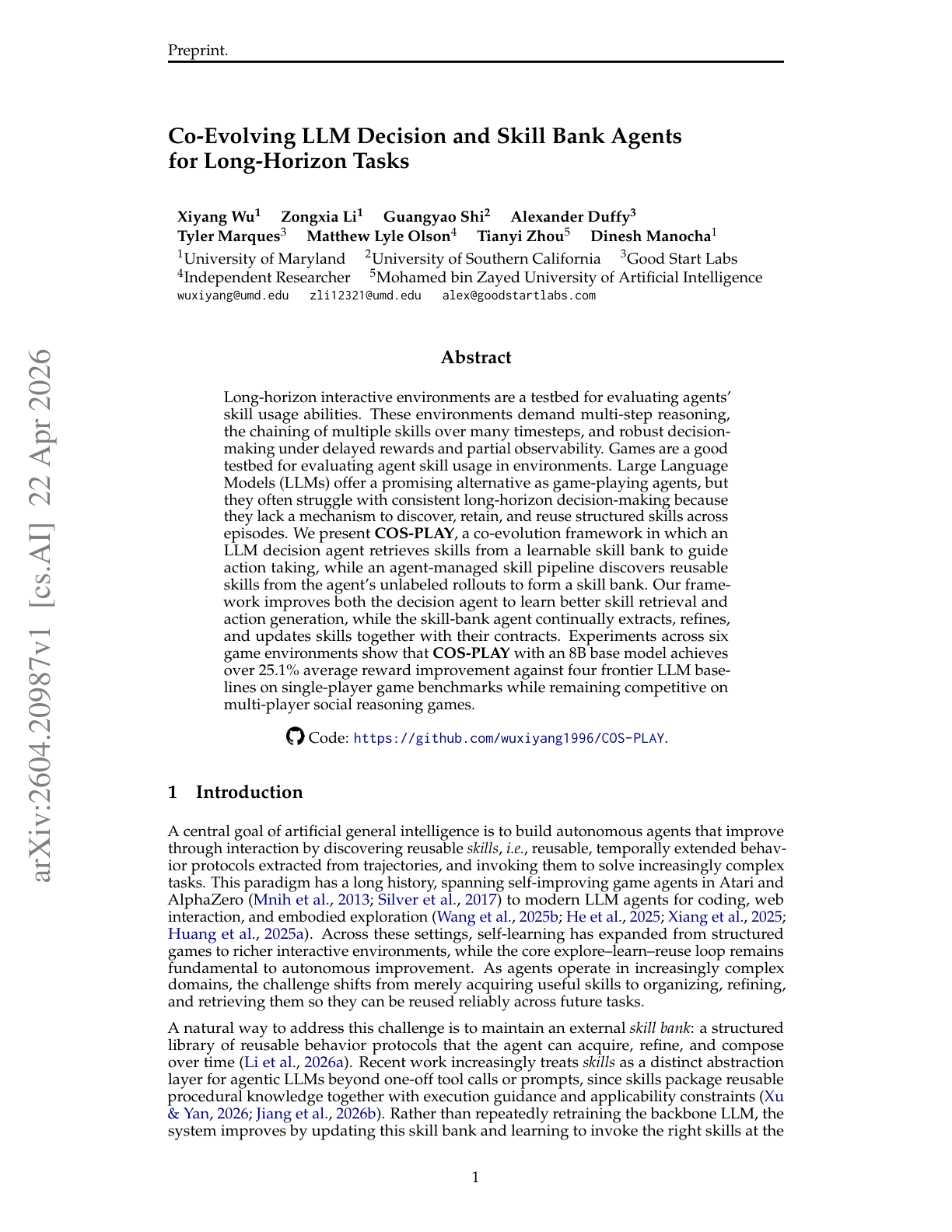
Co-evolving Decisions and Skills
Long-horizon agents fail in two ways: the decision-maker cannot decompose well, or the skill library goes stale. This paper introduces a co-evolution framework where an LLM decision agent and a dynamic skill bank improve each other through iterative refinement. The decision agent picks and chains skills, performance feedback updates both the policy and the skills, and new skills emerge by generalizing successful sequences instead of being hand-coded upfront. Most long-horizon agent stacks treat skills and decision-making as separate optimization problems, which is why they plateau. Co-evolution gives you adaptive planning and a growing library of reusable behaviors from a single loop, which is what you actually want when task structure is not predetermined: robotics, game agents, and complex planning.