RecursiveMAS
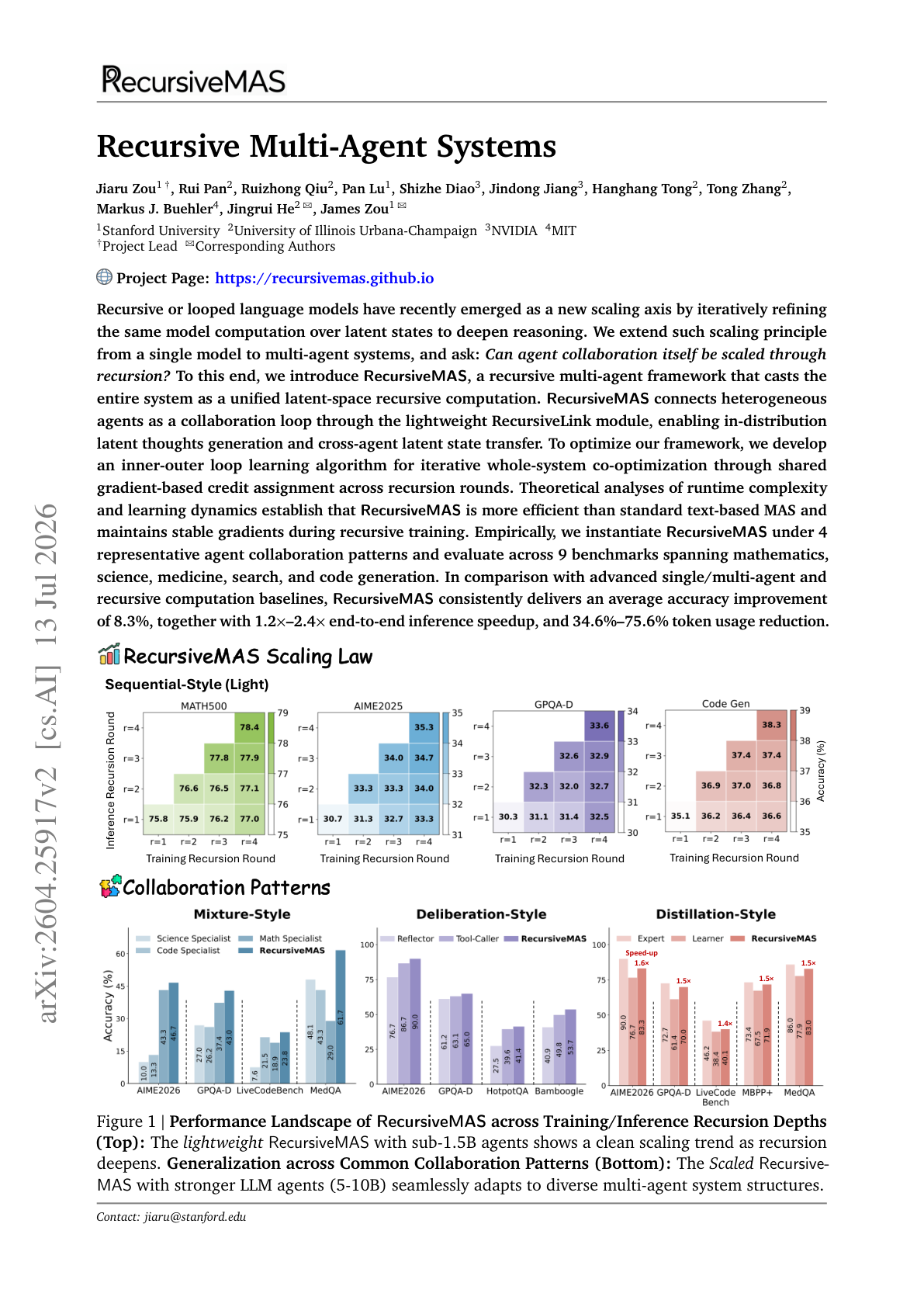
Multi-agent systems usually pass full text messages between agents at every step, which causes token bloat, latency, and context dilution that all grow with team size. RecursiveMAS asks a different question: what if agents collaborated through recursive computation in a shared latent space instead of through text? The system treats a multi-agent team as a recursive computation where each agent acts like an RLM layer, iteratively passing latent representations to the next and forming a looped interaction process. Less talking, more thinking.
Ask this paper
RecursiveLink for latent communication: A RecursiveLink module generates latent thoughts and transfers state directly between heterogeneous agents, replacing natural-language messages with internal representations. The change removes the cost of re-encoding and re-parsing text on every coordination step.
Inner-outer loop learning: The training algorithm uses an inner loop for per-step latent updates and an outer loop for team-level credit assignment, with shared gradient-based updates across agents. This makes joint optimization tractable instead of relying on hand-tuned communication protocols.
Strong gains across 9 benchmarks: Across math, science, medicine, search, and code generation, RecursiveMAS delivers 8.3% average accuracy gain over baselines, 1.2x to 2.4x end-to-end inference speedup, and 34.6% to 75.6% reduction in token usage. The efficiency story is at least as important as the accuracy story.
A path past the agent communication tax: If agent-to-agent communication is the next real bottleneck, latent-space recursion is one of the cleaner ways to scale collaboration. Teams running multi-agent systems at scale should treat this as a serious design alternative, not a research curiosity.