PlanGPT
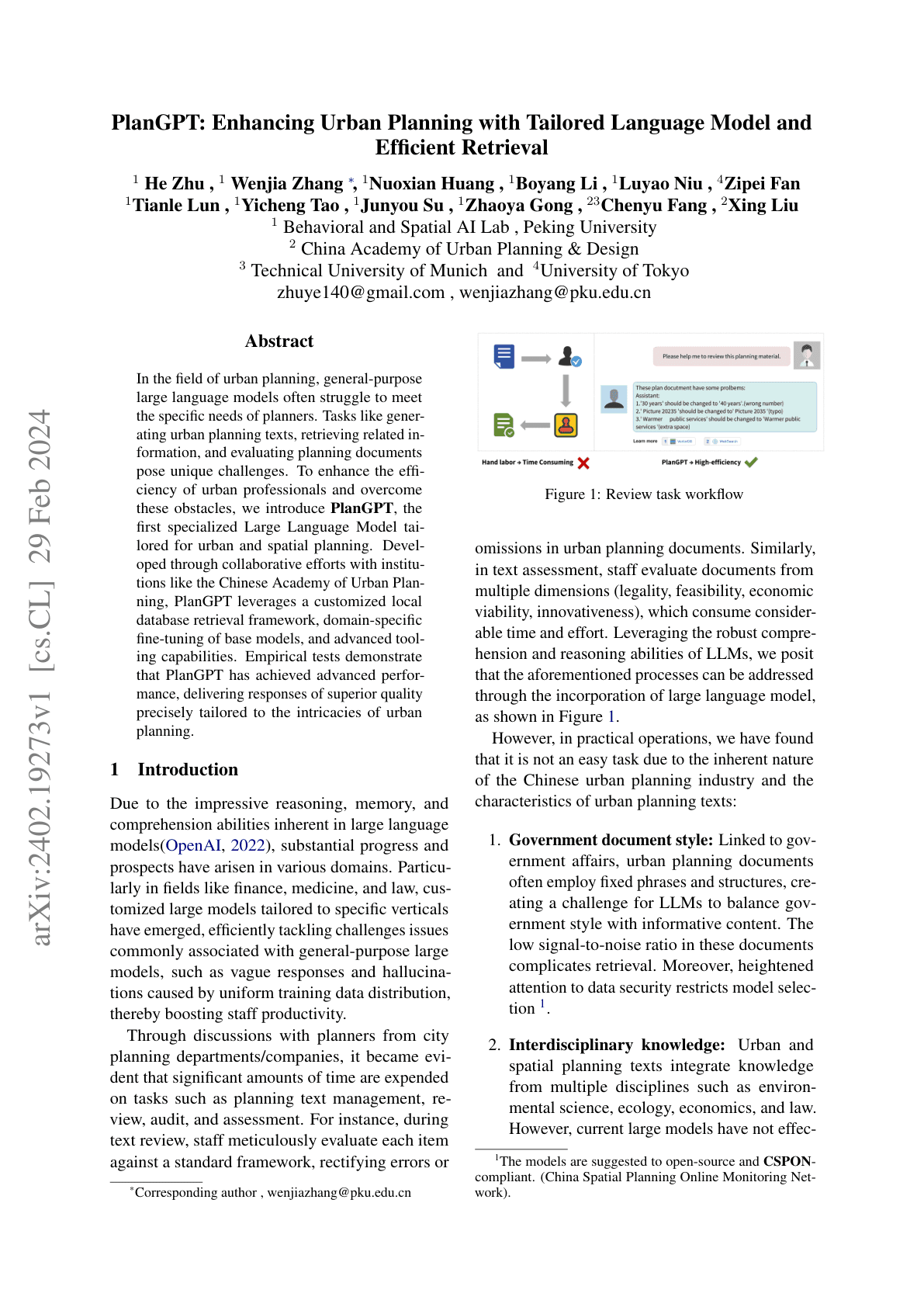
PlanGPT is a domain-specialized LLM framework for urban and spatial planning, built in collaboration with the Chinese Academy of Urban Planning.
Ask this paper
Domain fine-tuning: Continually fine-tunes a base LLM on a curated corpus of planning documents to lift performance on planning-specific language and terminology.
Custom local retrieval: Pairs the model with a local-database retrieval framework so that answers can cite authoritative sources instead of relying purely on parametric memory.
Advanced tooling: Integrates domain-specific tools (document templates, code execution, GIS-style utilities) to cover the end-to-end planning workflow rather than just QA.
Generalizable recipe: Although built for urban planning, the paper doubles as a practical template for any domain-specific LLM project - covering retrieval, fine-tuning, and tooling together.
Abstract
In the field of urban planning, general-purpose large language models often struggle to meet the specific needs of planners. Tasks like generating urban planning texts, retrieving related information, and evaluating planning documents pose unique challenges. To enhance the efficiency of urban professionals and overcome these obstacles, we introduce PlanGPT, the first specialized Large Language Model tailored for urban and spatial planning. Developed through collaborative efforts with institutions like the Chinese Academy of Urban Planning, PlanGPT leverages a customized local database retrieval framework, domain-specific fine-tuning of base models, and advanced tooling capabilities. Empirical tests demonstrate that PlanGPT has achieved advanced performance, delivering responses of superior quality precisely tailored to the intricacies of urban planning.