The Era of 1-bit LLMs (BitNet b1.58)
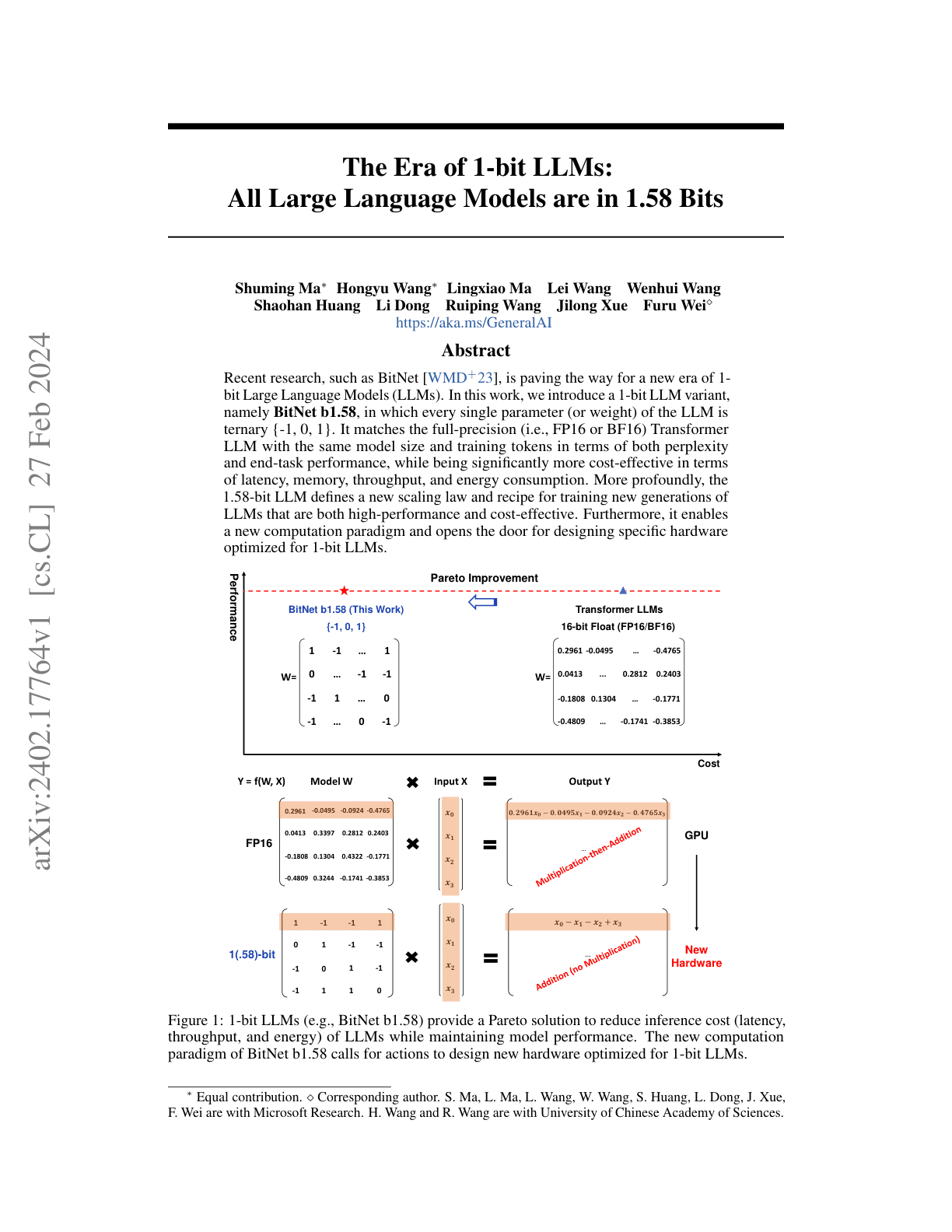
Microsoft's BitNet b1.58 shows that restricting every weight to the ternary set {-1, 0, 1} can match full-precision FP16 transformers on perplexity and downstream tasks at the same parameter count.
Ask this paper
Ternary weights: All linear-layer weights are quantized to {-1, 0, 1}, giving an effective bit-width of log2(3) ≈ 1.58 bits per weight while still permitting meaningful sparsity via the 0 value.
Parity with FP16: At matched parameter and token budgets, BitNet b1.58 matches FP16 baselines in both perplexity and zero-shot accuracy - a result that was not previously demonstrated at 3B+ scale.
Efficiency gains: Dramatic wins in latency, memory footprint, throughput, and energy consumption compared to FP16 transformers, especially at longer sequence lengths.
Hardware co-design: The paper lays out a new scaling law for 1-bit LLMs and argues for specialized hardware tailored to ternary compute - positioning this as a potential inflection point in LLM deployment.
Abstract
Recent research, such as BitNet, is paving the way for a new era of 1-bit Large Language Models (LLMs). In this work, we introduce a 1-bit LLM variant, namely BitNet b1.58, in which every single parameter (or weight) of the LLM is ternary {-1, 0, 1}. It matches the full-precision (i.e., FP16 or BF16) Transformer LLM with the same model size and training tokens in terms of both perplexity and end-task performance, while being significantly more cost-effective in terms of latency, memory, throughput, and energy consumption. More profoundly, the 1.58-bit LLM defines a new scaling law and recipe for training new generations of LLMs that are both high-performance and cost-effective. Furthermore, it enables a new computation paradigm and opens the door for designing specific hardware optimized for 1-bit LLMs.