ReasonFlux
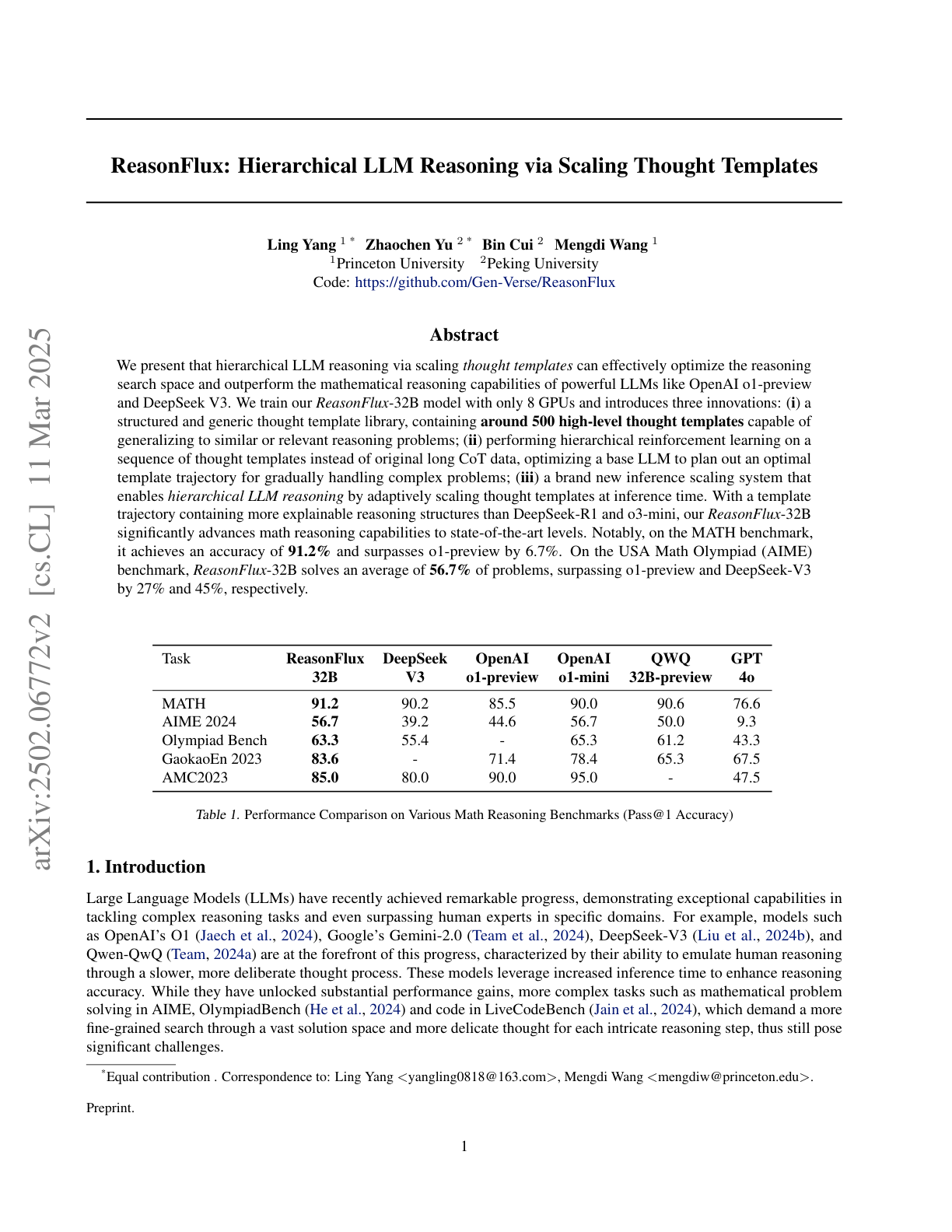
The ReasonFlux framework is introduced as an efficient way to fine-tune LLMs for complex reasoning, using hierarchical thought processes. Highlights include:
Ask this paper
Thought template library: Rather than having a model learn long CoT solutions from scratch, ReasonFlux provides a library of ~500 reusable “thought templates” – high-level reasoning steps that can be composed to solve problems. These might be generic strategies like “split the problem into cases” or “verify the solution,” applicable across tasks.
Hierarchical planning via RL: The model is trained (with only 8 GPUs for a 32B model) to plan a sequence of these templates to tackle a problem, using hierarchical reinforcement learning. This way, it learns to orchestrate complex reasoning by chaining templates, instead of generating every reasoning step token-by-token.
Inference-time adaptation: A novel inference strategy allows the model to adjust the granularity of its reasoning on the fly, scaling the template sequence based on difficulty. This means the model can dynamically decide to use more detailed templates for hard problems and fewer for easy ones, optimizing both accuracy and speed.
State-of-the-art results: ReasonFlux achieved high scores on math reasoning benchmarks – for example, 91.2% on MATH, outperforming OpenAI’s reference model by 6.7%, and solved 56.7% of problems on the AIME Olympiad, vastly surpassing previous models. This demonstrates that smart fine-tuning with structured reasoning steps can yield big gains even without massive compute.