ReContext
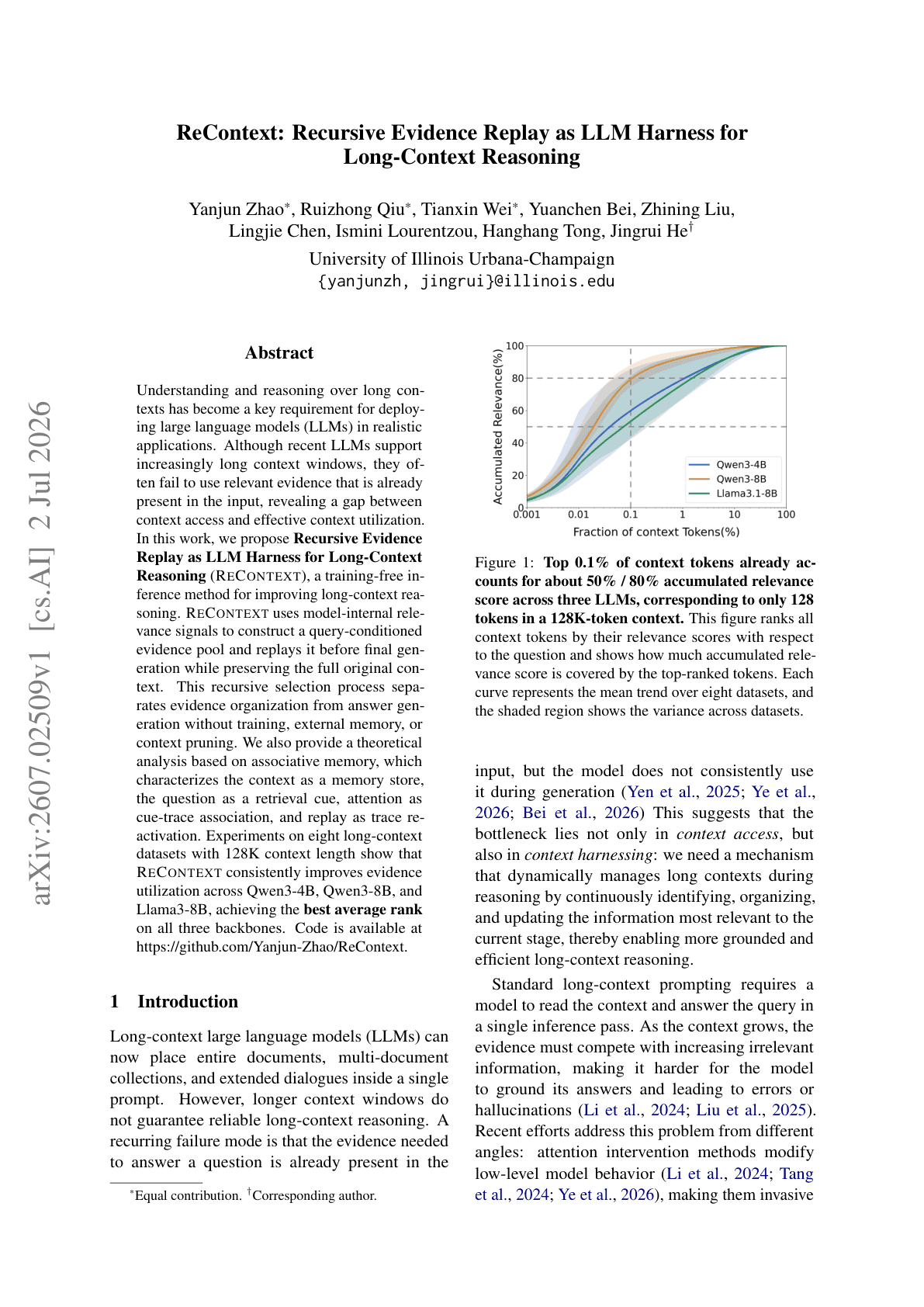
Models now support 128K context windows yet still fail to use evidence already sitting in the prompt. ReContext is a training-free inference harness for long-context reasoning that uses model-internal relevance signals to build a query-conditioned evidence pool, then replays it right before final generation while preserving the full original context.
Ask this paper
Memory framing of context: It treats the context as a memory store, the question as a retrieval cue, attention as cue-trace association, and replay as trace reactivation, a clean cognitive analogy that drives the design.
No training, no pruning: There is no fine-tuning, no external memory, and no pruning of the original context, so the method drops into existing models without changing weights or losing information.
Consistent gains across backbones: Across eight 128K long-context datasets it improves evidence utilization on Qwen3-4B, Qwen3-8B, and Llama3-8B, taking the best average rank on all three, with public code.
Why it matters: It targets the real long-context failure, using evidence that is already present, and fixes it at inference time, a cheap and general lever for reasoning over long prompts.
Abstract
Understanding and reasoning over long contexts has become a key requirement for deploying large language models (LLMs) in realistic applications. Although recent LLMs support increasingly long context windows, they often fail to use relevant evidence that is already present in the input, revealing a gap between context access and effective context utilization. In this work, we propose Recursive Evidence Replay as LLM Harness for Long-Context Reasoning (RECONTEXT), a training-free inference method for improving long-context reasoning. RECONTEXT uses model-internal relevance signals to construct a query-conditioned evidence pool and replays it before final generation while preserving the full original context. This recursive selection process separates evidence organization from answer generation without training, external memory, or context pruning. We also provide a theoretical analysis based on associative memory, which characterizes the context as a memory store, the question as a retrieval cue, attention as cue-trace association, and replay as trace reactivation. Experiments on eight long-context datasets with 128K context length show that RECONTEXT consistently improves evidence utilization across Qwen3-4B, Qwen3-8B, and Llama3-8B, achieving the best average rank on all three backbones. Code is available at https://github.com/Yanjun-Zhao/ReContext.