Reducing Hallucination in Structured Outputs via RAG
This paper deploys a compact RAG pipeline - small retriever plus small LM - for an enterprise workflow-generation task and shows it reduces hallucination while improving out-of-domain generalization vs a baseline LLM.
Ask this paper
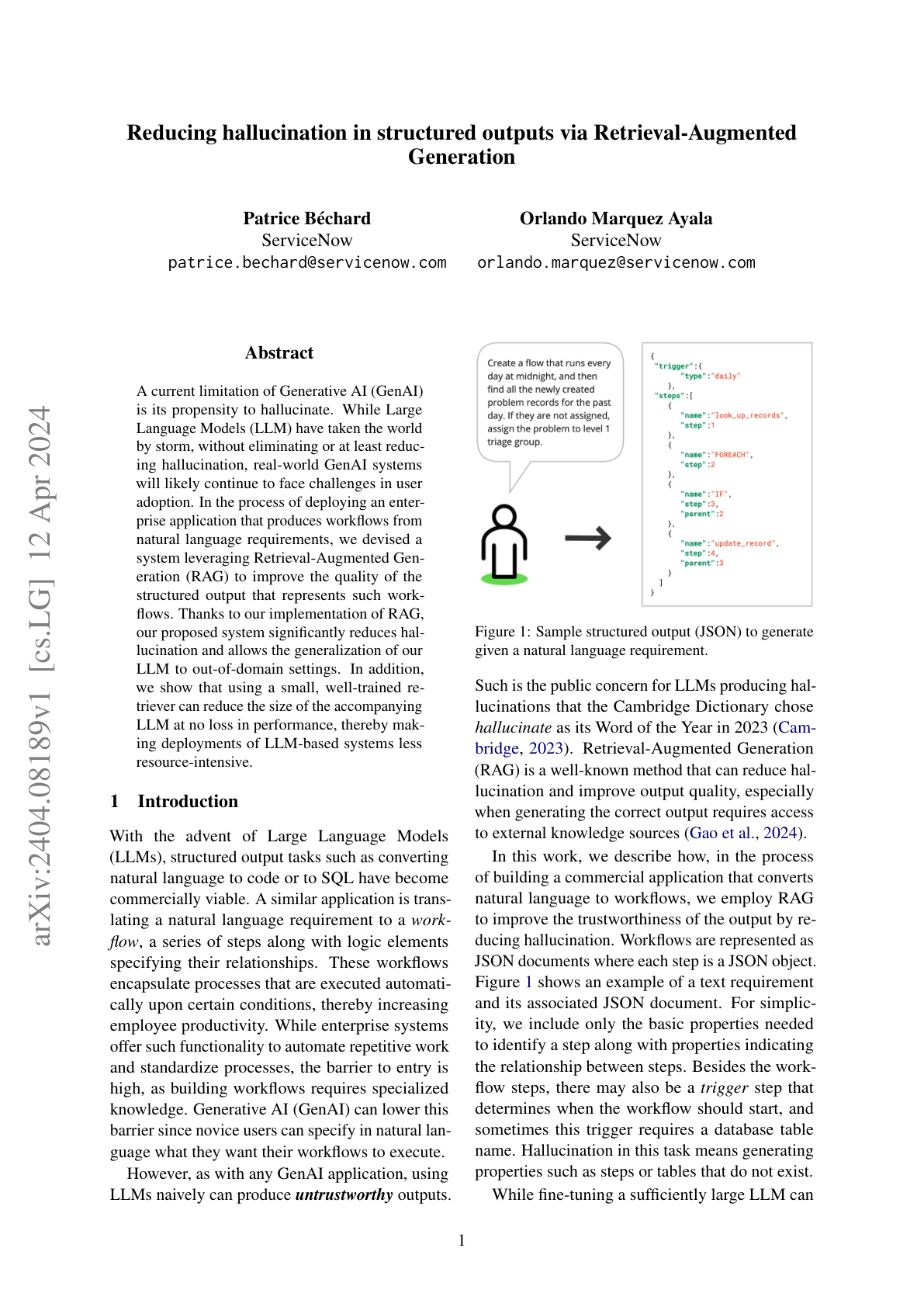
Target setting: A production system that turns natural-language requirements into executable workflows, where hallucinated fields or missing steps break the downstream pipeline.
Small retriever + small LM: Instead of a massive generator, the authors train a specialized retriever encoder and pair it with a much smaller LM, cutting compute and memory without losing output quality.
Hallucination and generalization gains: The RAG-augmented small system reduces factual errors in the structured output and generalizes better to out-of-domain inputs than the baseline LM alone.
Deployment implication: The setup shows that high-quality structured generation does not require frontier-sized LLMs - a disciplined retriever + small LM can be cheaper to run and easier to productionize.