Rethinking Reflection in Pre-Training
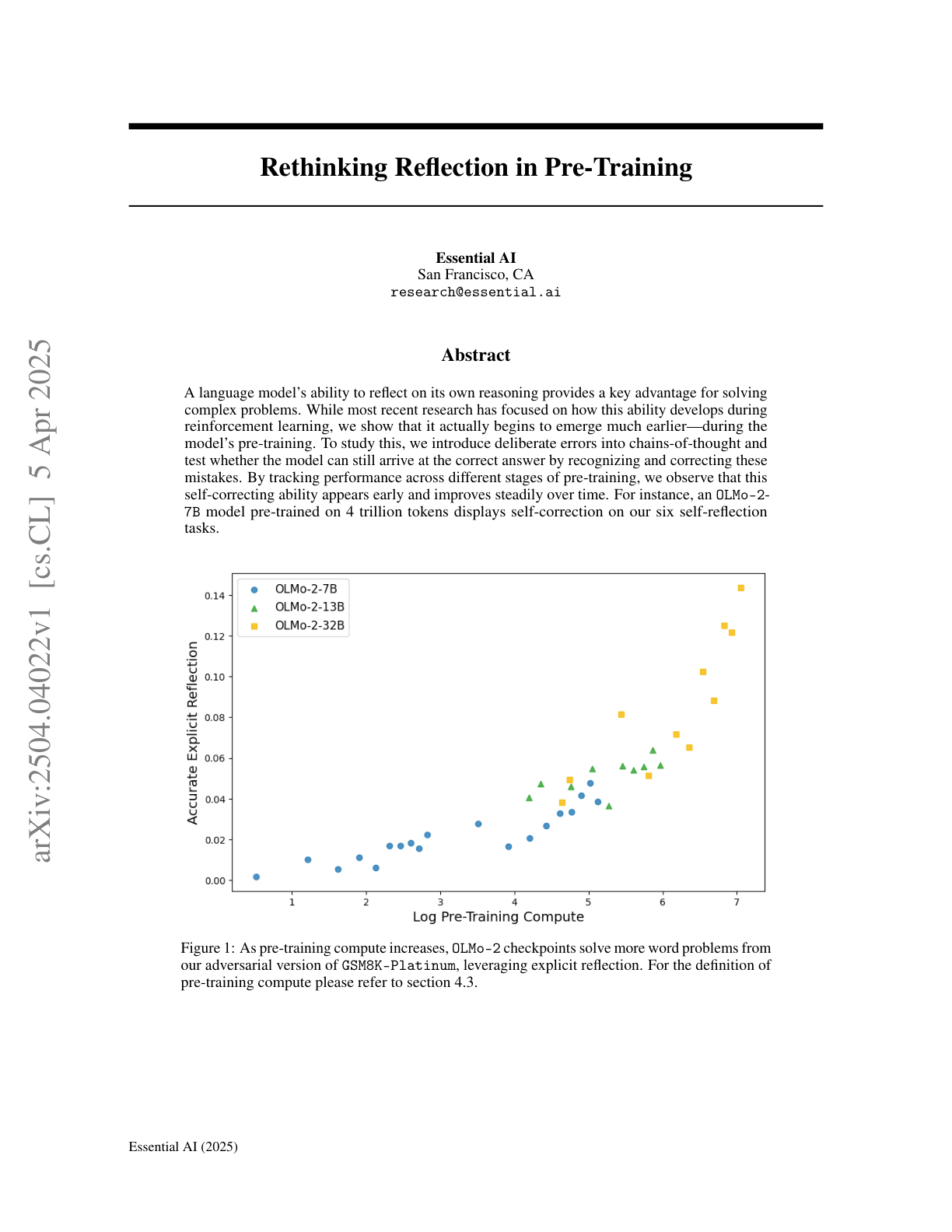
Reflection — the ability of LLMs to identify and correct their own reasoning — has often been attributed to reinforcement learning or fine-tuning. This paper argues otherwise: reflection emerges during pre-training. The authors introduce adversarial reasoning tasks to show that self-reflection and correction capabilities steadily improve as compute increases, even in the absence of supervised post-training. Key contributions:
Ask this paper
Propose two kinds of reflection:
Build six adversarial datasets (GSM8K, TriviaQA, CruxEval, BBH) to test reflection across math, coding, logic, and knowledge domains. On GSM8K-Platinum, explicit reflection rates grow from ~10% to 60% with increasing pre-training tokens.
Demonstrate that simple triggers like “Wait,” reliably induce reflection.
Evaluate 40 OLMo-2 and Qwen2.5 checkpoints, finding a strong correlation between pre-training compute and both accuracy and reflection rate. Why it matters:
Reflection is a precursor to reasoning and can develop before RLHF or test-time decoding strategies.
Implication: We can instill advanced reasoning traits with better pre-training data and scale, rather than relying entirely on post-training tricks.
They also show a trade-off: more training compute reduces the need for expensive test-time compute like long CoT traces.