SAGA
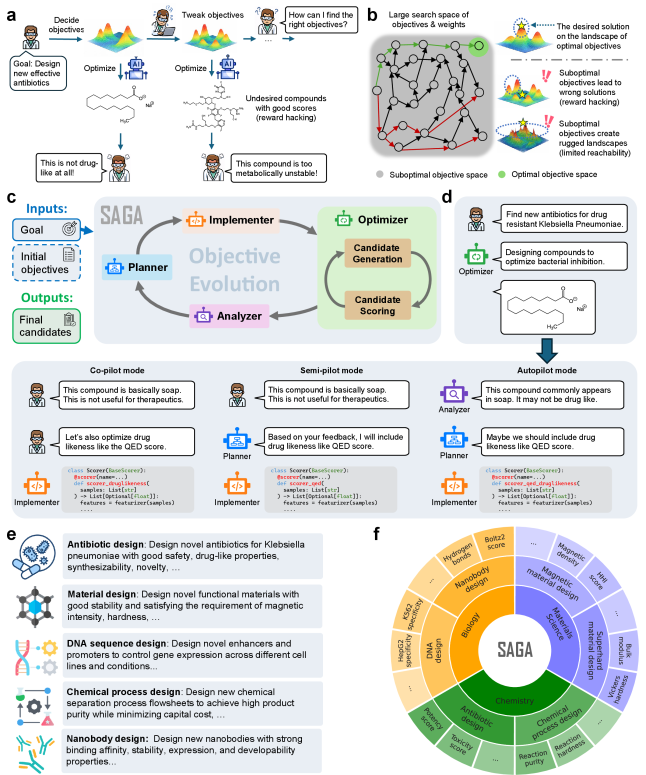
SAGA (Scientific Autonomous Goal-evolving Agent) introduces a framework for automating objective function design in AI-driven scientific discovery. Rather than optimizing fixed objectives specified by scientists, SAGA dynamically reformulates research goals throughout the discovery process to avoid reward hacking issues. - **Bi-level architecture:** SAGA employs an outer loop where LLM agents analyze optimization outcomes and propose refined objectives, while an inner loop performs solution optimization. This enables systematic exploration of objective trade-offs that remain invisible in traditional fixed-objective approaches. - **Three automation modes:** The framework offers co-pilot (human collaboration on analysis and planning), semi-pilot (human feedback to analyzer only), and autopilot (fully automated) modes for flexible human-AI interaction. - **Diverse scientific applications:** SAGA was validated across antibiotic design for K. pneumoniae, inorganic materials design (permanent magnets, superhard materials), functional DNA sequence design, and chemical process flowsheets. - **Strong performance:** In antibiotic design, SAGA achieved drug-like molecules with high predicted activity while baselines either failed to optimize activity or produced chemically invalid structures. For materials, SAGA found 15 novel stable structures within 200 DFT calculations, outperforming MatterGen. In DNA design, SAGA improved MPRA specificity by at least 48% over baselines.
Ask this paper
Bi-level architecture: SAGA employs an outer loop where LLM agents analyze optimization outcomes and propose refined objectives, while an inner loop performs solution optimization. This enables systematic exploration of objective trade-offs that remain invisible in traditional fixed-objective approaches.
Three automation modes: The framework offers co-pilot (human collaboration on analysis and planning), semi-pilot (human feedback to analyzer only), and autopilot (fully automated) modes for flexible human-AI interaction.
Diverse scientific applications: SAGA was validated across antibiotic design for K. pneumoniae, inorganic materials design (permanent magnets, superhard materials), functional DNA sequence design, and chemical process flowsheets.
Strong performance: In antibiotic design, SAGA achieved drug-like molecules with high predicted activity while baselines either failed to optimize activity or produced chemically invalid structures. For materials, SAGA found 15 novel stable structures within 200 DFT calculations, outperforming MatterGen. In DNA design, SAGA improved MPRA specificity by at least 48% over baselines.
Abstract
There has been unprecedented interest in developing agents that expand the boundary of scientific discovery, primarily by optimizing quantitative objective functions specified by scientists. However, for grand challenges in science , these objectives are only imperfect proxies. We argue that automating objective function design is a central, yet unmet requirement for scientific discovery agents. In this work, we introduce the Scientific Autonomous Goal-evolving Agent (SAGA) to amend this challenge. SAGA employs a bi-level architecture in which an outer loop of LLM agents analyzes optimization outcomes, proposes new objectives, and converts them into computable scoring functions, while an inner loop performs solution optimization under the current objectives. This bi-level design enables systematic exploration of the space of objectives and their trade-offs, rather than treating them as fixed inputs. We demonstrate the framework through a broad spectrum of applications, including antibiotic design, inorganic materials design, functional DNA sequence design, and chemical process design, showing that automating objective formulation can substantially improve the effectiveness of scientific discovery agents.