Scaling Reasoning in Diffusion LLMs via RL
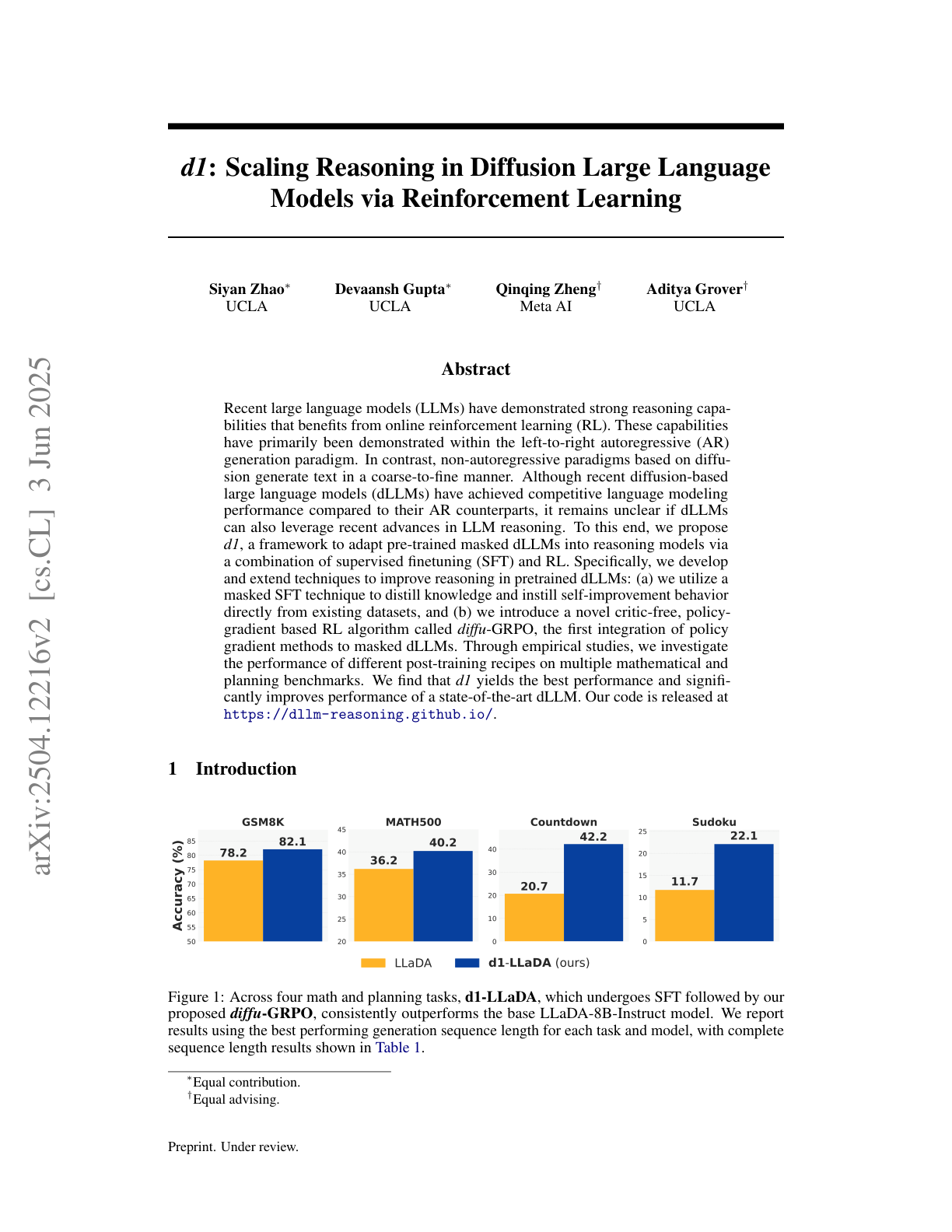
Proposes d1, a two‑stage recipe that equips masked diffusion LLMs with strong step‑by‑step reasoning.
Ask this paper
Two‑stage pipeline (SFT → diffu‑GRPO) – d1 first applies supervised fine‑tuning on the 1 k‑example s1K dataset and then runs task‑specific RL with the new diffu‑GRPO objective, yielding larger gains than either stage alone.
diffu‑GRPO: RL for masked dLLMs – Extends GRPO to diffusion LLMs via (i) a mean‑field sequence‑log‑prob approximation and (ii) a one‑step per‑token log‑prob estimator with random prompt masking, enabling many gradient updates from a single generation.
Consistent gains on four reasoning benchmarks – On GSM8K, MATH500, Countdown, and Sudoku, diffu‑GRPO beats SFT, and the full d1‑LLaDA variant attains the best scores (e.g., 81.1 % GSM8K & 38.6 % MATH500 at 256 tokens, +5–12 pp over baseline).
Competitive among 7‑8 B models – d1‑LLaDA outperforms DeepSeek‑7B, Mistral‑7B and Llama‑3‑8B on GSM8K and ranks second on MATH500 in the same size class.
Longer decoding unlocks “aha moments” – At 512‑token generation, the model shows self‑verification/backtracking; effective‑token usage grows smoothly, echoing test‑time compute scaling trends.
Random masking speeds RL – Ablations show that random prompt masking during diffu‑GRPO accelerates convergence and boosts correctness relative to fixed masking, with fewer online generations needed.