SocioVerse
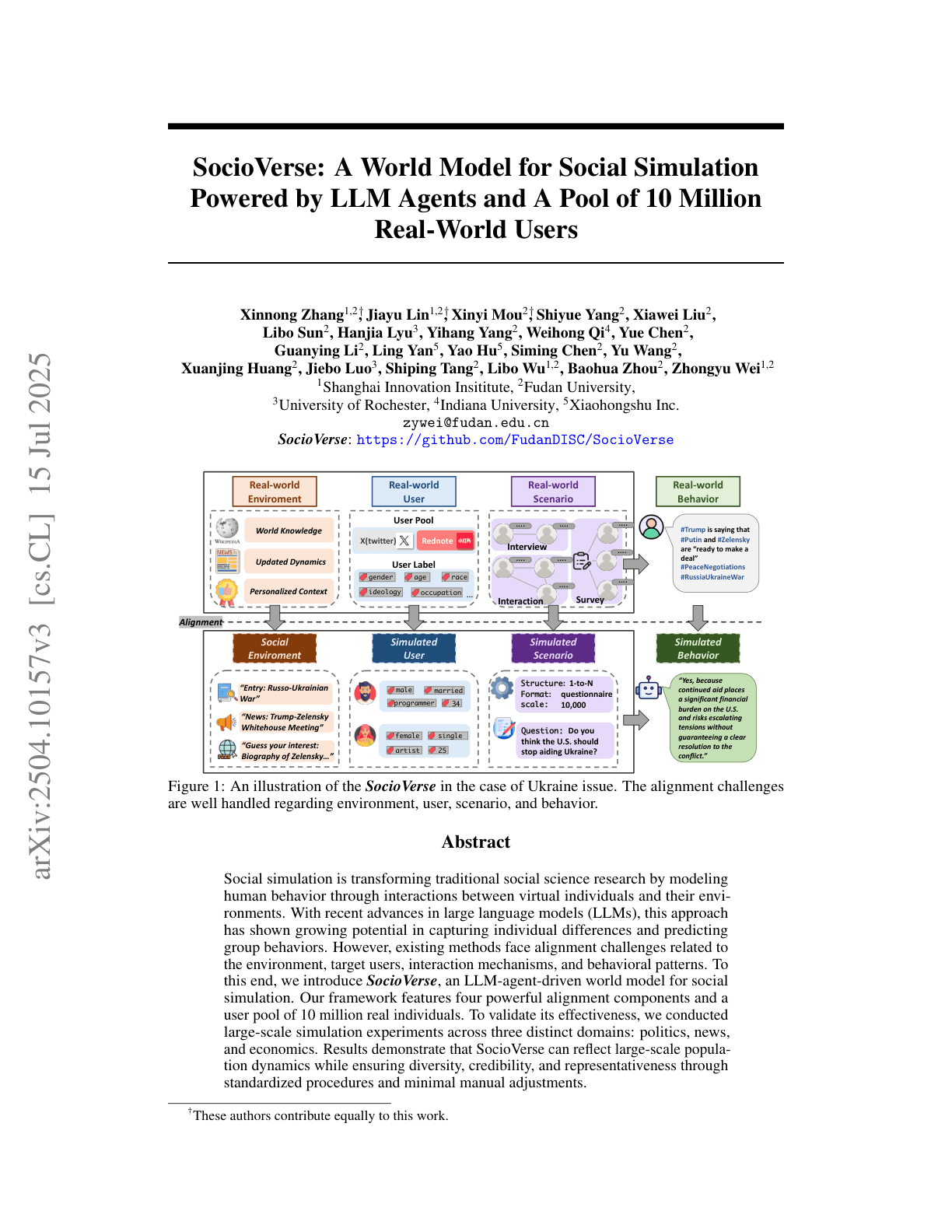
Researchers from Fudan University and collaborators propose SocioVerse, a large-scale world model for social simulation using LLM agents aligned with real-world user behavior. Key ideas include:
Ask this paper
Four-fold alignment framework – SocioVerse tackles major challenges in aligning simulated environments with reality across four dimensions:
Three representative simulations – SocioVerse showcases its generalizability through:
Impressive empirical accuracy –
Ablation insights – Removing prior demographic distribution and user knowledge severely degrades election prediction accuracy (Acc drops from 0.80 → 0.60), highlighting the value of realistic population modelingpapersoftheweek.
Toward trustworthy virtual societies – SocioVerse not only standardizes scalable social simulations but also provides a sandbox for testing sociopolitical hypotheses (e.g., fairness, policy change), bridging AI agent systems with traditional social science.
Abstract
Social simulation is transforming traditional social science research by modeling human behavior through interactions between virtual individuals and their environments. With recent advances in large language models (LLMs), this approach has shown growing potential in capturing individual differences and predicting group behaviors. However, existing methods face alignment challenges related to the environment, target users, interaction mechanisms, and behavioral patterns. To this end, we introduce SocioVerse, an LLM-agent-driven world model for social simulation. Our framework features four powerful alignment components and a user pool of 10 million real individuals. To validate its effectiveness, we conducted large-scale simulation experiments across three distinct domains: politics, news, and economics. Results demonstrate that SocioVerse can reflect large-scale population dynamics while ensuring diversity, credibility, and representativeness through standardized procedures and minimal manual adjustments.