GUI-R1
Researchers from the National University of Singapore and the Chinese Academy of Sciences introduce GUI-R1, a reinforcement learning (RL) framework aimed at improving graphical user interface (GUI) agents through unified action-space modeling. Key insights include:
Scaling Reasoning in Diffusion LLMs via RL
Proposes d1, a two‑stage recipe that equips masked diffusion LLMs with strong step‑by‑step reasoning.
Enhancing Non-Reasoning Models with Reasoning Models
Researchers explore how to distill reasoning-intensive outputs (answers and explanations) from top-tier LLMs into more lightweight models that don’t explicitly reason step by step. By fine-tuning smaller models on the high-quality final answers (and optionally summarized thinking traces) from advanced reasoning models, they demonstrate consistent performance boosts across multiple benchmarks.
AgentA/B
AgentA/B is a fully automated A/B testing framework that replaces live human traffic with large-scale LLM-based agents. These agents simulate realistic, intention-driven user behaviors on actual web environments, enabling faster, cheaper, and risk-free UX evaluations — even on real websites like Amazon. Key Insights:
Reasoning Models Can Be Effective Without Thinking
This paper challenges the necessity of long chain-of-thought (CoT) reasoning in LLMs by introducing a simple prompting method called NoThinking, which bypasses explicit "thinking" steps. Surprisingly, NoThinking performs comparably to or better than traditional reasoning under comparable or even lower compute budgets, especially when paired with parallel decoding and best-of-N selection. Key Insights:
SocioVerse
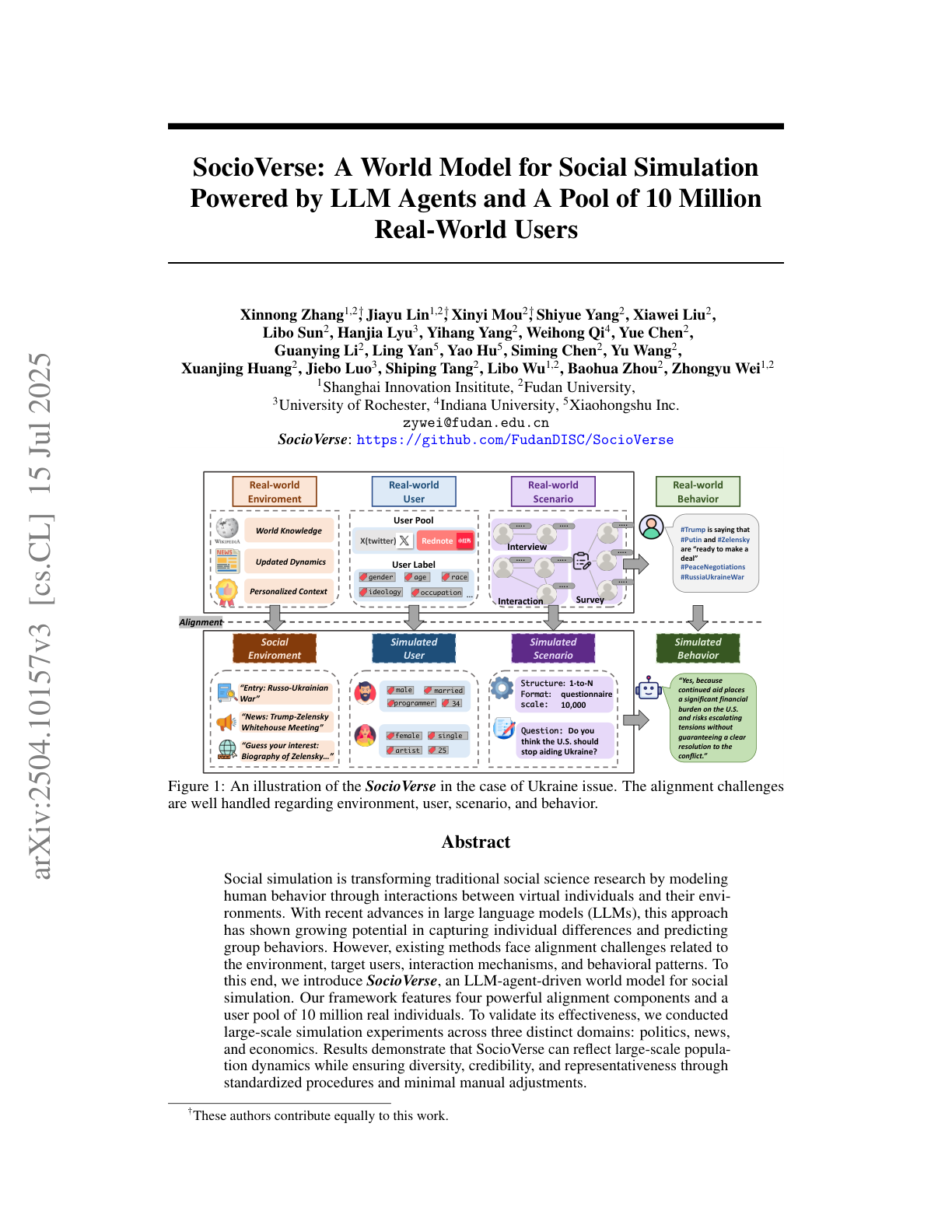
Researchers from Fudan University and collaborators propose SocioVerse, a large-scale world model for social simulation using LLM agents aligned with real-world user behavior. Key ideas include:
DocAgent
Researchers from Meta AI present DocAgent, a tool‑integrated, dependency‑aware framework that turns large, complex codebases into well‑written docstrings. Key ideas include:
SWE-PolyBench
SWE-PolyBench is a new multi-language benchmark for evaluating coding agents on real-world software tasks across Java, JavaScript, TypeScript, and Python. It introduces execution-based assessments, syntax tree metrics, and reveals that current agents struggle with complex tasks and show inconsistent performance across languages.
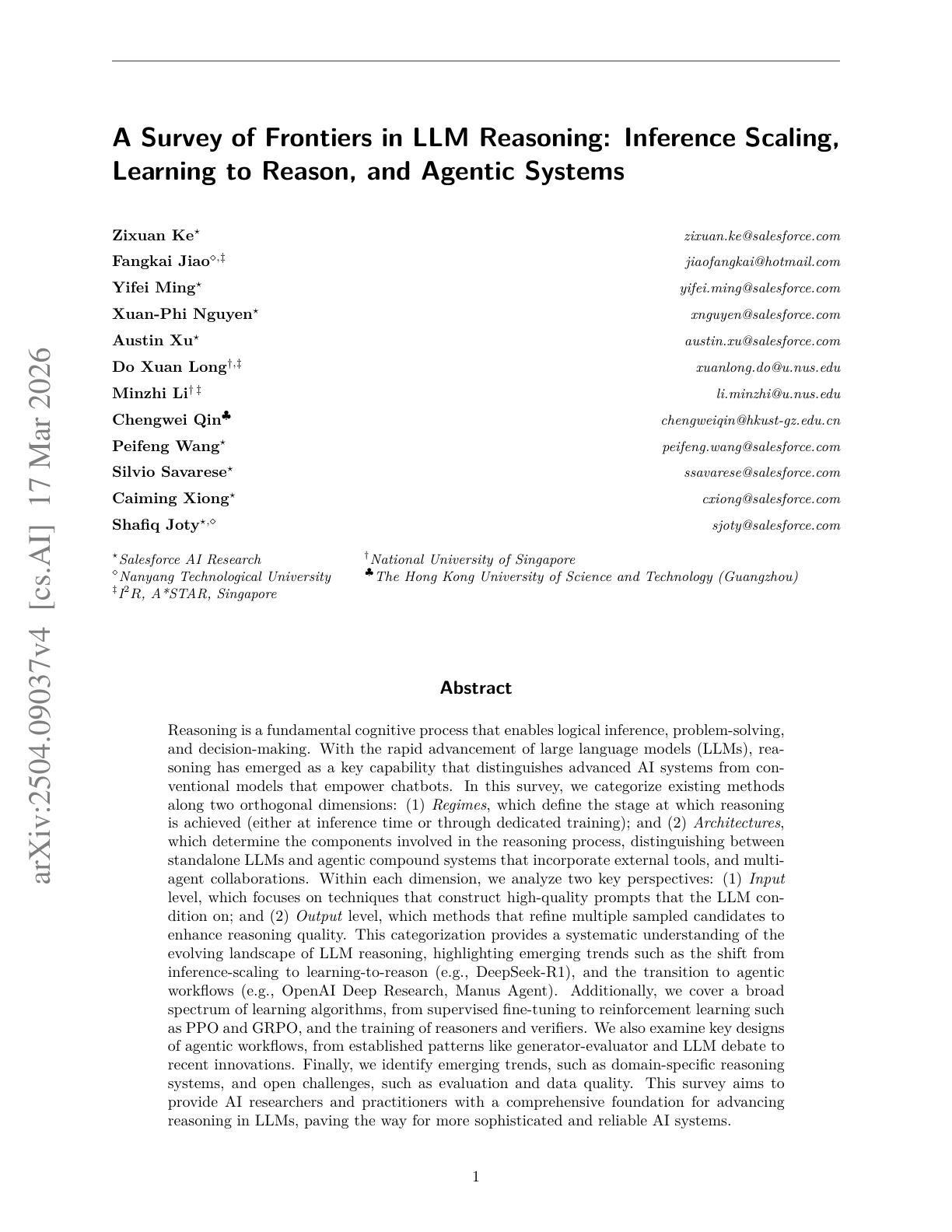
A Survey of Frontiers in LLM Reasoning
This survey categorizes LLM reasoning methods by when reasoning occurs (inference-time vs. training) and the system's architecture (standalone vs. agentic or multi-agent). It highlights trends like learning-to-reason (e.g., DeepSeek-R1) and agentic workflows (e.g., OpenAI Deep Research), covering prompt engineering, output refinement, and learning strategies such as PPO and verifier training.
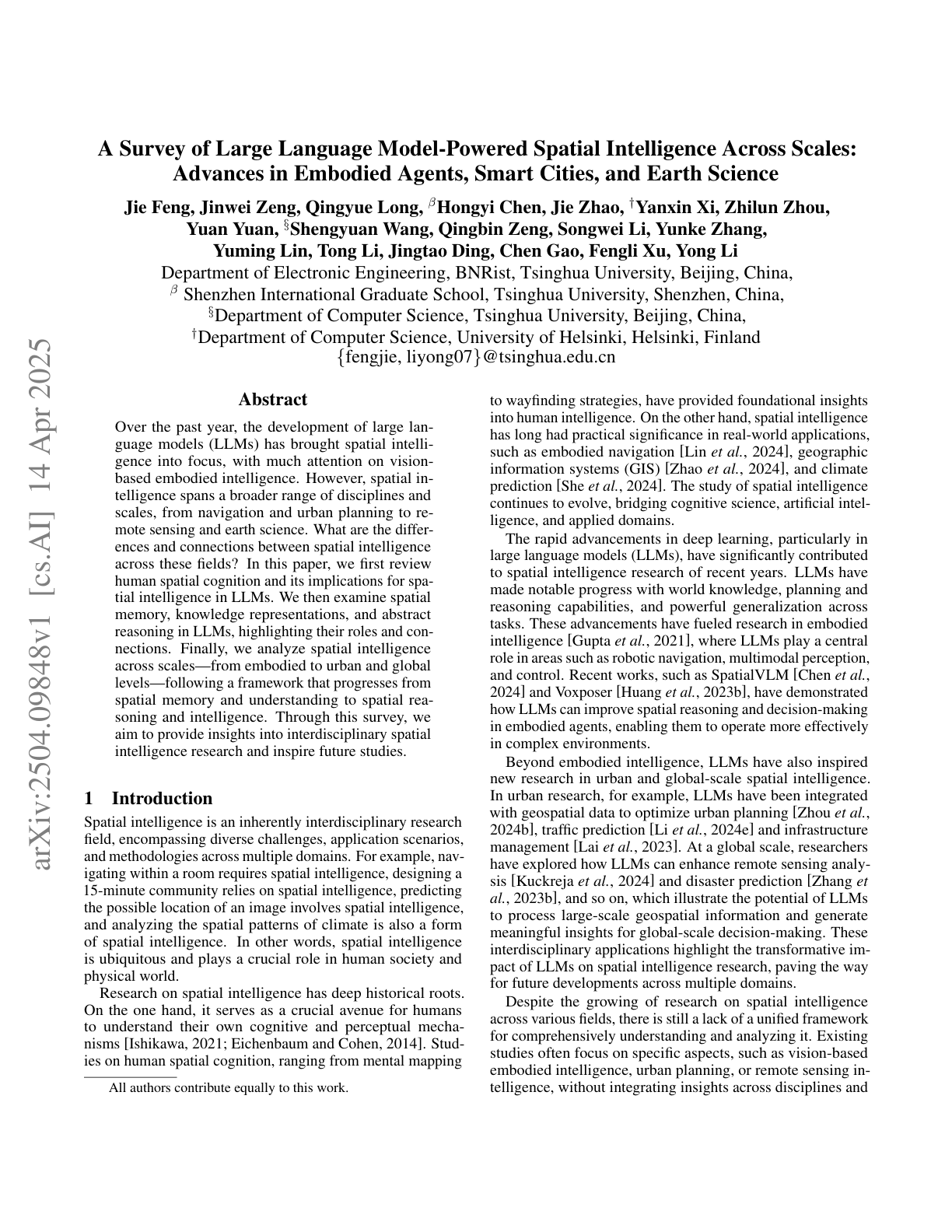
Advances in Embodied Agents, Smart Cities, and Earth Science
This paper surveys how spatial intelligence manifests across disciplines—from embodied agents to urban and global systems—by connecting human spatial cognition with how LLMs handle spatial memory, representations, and reasoning. It offers a unifying framework to bridge research in AI, robotics, urban planning, and earth science, highlighting LLMs’ evolving spatial capabilities and their interdisciplinary potential.