Seer: Fast RL for LLMs
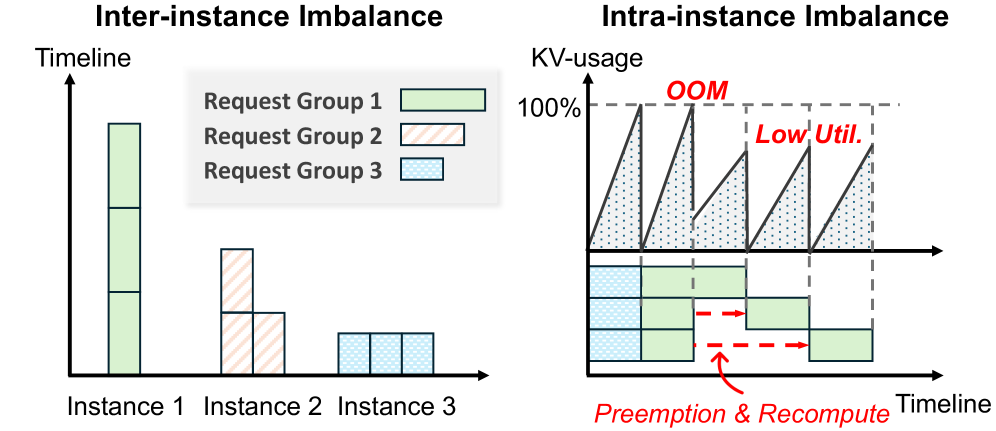
Researchers introduce Seer, a system addressing performance bottlenecks in synchronous reinforcement learning for LLMs by optimizing the rollout phase that dominates end-to-end iteration time. Through three core mechanisms: divided rollout, context-aware scheduling, and adaptive grouped speculative decoding, Seer achieves 74-97% improvement in rollout throughput and 75-93% reduction in long-tail latency on production-grade RL workloads. - **Divided rollout with dynamic load balancing:** The system implements intelligent workload distribution across compute resources to address fundamental imbalance issues in the rollout phase. This mechanism prevents bottlenecks by dynamically adjusting how generation tasks are allocated, ensuring more even resource utilization across the cluster during policy rollout operations. - **Context-aware scheduling exploiting prompt patterns:** Seer identifies and exploits previously overlooked similarities in output lengths and generation patterns among requests sharing identical prompts. By grouping and scheduling similar requests together, the system reduces redundant computation and improves cache efficiency, leading to significant throughput gains without requiring algorithmic complexity. - **Adaptive grouped speculative decoding:** The approach optimizes token generation through intelligent batching strategies that predict and verify tokens in groups rather than individually. This technique accelerates the generation process by reducing sequential dependencies while maintaining output quality, contributing to the dramatic latency reductions observed in production deployments.
Ask this paper
Divided rollout with dynamic load balancing: The system implements intelligent workload distribution across compute resources to address fundamental imbalance issues in the rollout phase. This mechanism prevents bottlenecks by dynamically adjusting how generation tasks are allocated, ensuring more even resource utilization across the cluster during policy rollout operations.
Context-aware scheduling exploiting prompt patterns: Seer identifies and exploits previously overlooked similarities in output lengths and generation patterns among requests sharing identical prompts. By grouping and scheduling similar requests together, the system reduces redundant computation and improves cache efficiency, leading to significant throughput gains without requiring algorithmic complexity.
Adaptive grouped speculative decoding: The approach optimizes token generation through intelligent batching strategies that predict and verify tokens in groups rather than individually. This technique accelerates the generation process by reducing sequential dependencies while maintaining output quality, contributing to the dramatic latency reductions observed in production deployments.
Abstract
Reinforcement Learning (RL) has become critical for advancing modern Large Language Models (LLMs), yet existing synchronous RL systems face severe performance bottlenecks. The rollout phase, which dominates end-to-end iteration time, suffers from substantial long-tail latency and poor resource utilization due to inherent workload imbalance. We present Seer, a novel online context learning system that addresses these challenges by exploiting previously overlooked similarities in output lengths and generation patterns among requests sharing the same prompt. Seer introduces three key techniques: divided rollout for dynamic load balancing, context-aware scheduling, and adaptive grouped speculative decoding. Together, these mechanisms substantially reduce long-tail latency and improve resource efficiency during rollout. Evaluations on production-grade RL workloads demonstrate that Seer improves end-to-end rollout throughput by 74% to 97% and reduces long-tail latency by 75% to 93% compared to state-of-the-art synchronous RL systems, significantly accelerating RL training iterations.