Self-Taught Optimizer (STOP)
Proposes recursively self-improving code generation where an LLM-scaffolded program improves itself.
Ask this paper
Seed improver: A "seed improver" program first improves an input program to return the best solution found - a self-improvement scaffold built on GPT-4.
Recursive improvement: The seed improver is itself tasked with improving itself, producing the first concrete demonstration of recursive self-improvement in LLM code generation.
GPT-4 capable: Shows that GPT-4 models can write code that modifies itself iteratively, producing measurably better scaffolds than the initial seed.
Foundational work: An early, influential demonstration of the LLM-as-code-modifier pattern that would reappear across 2024 in agent and tool-use research.
Abstract
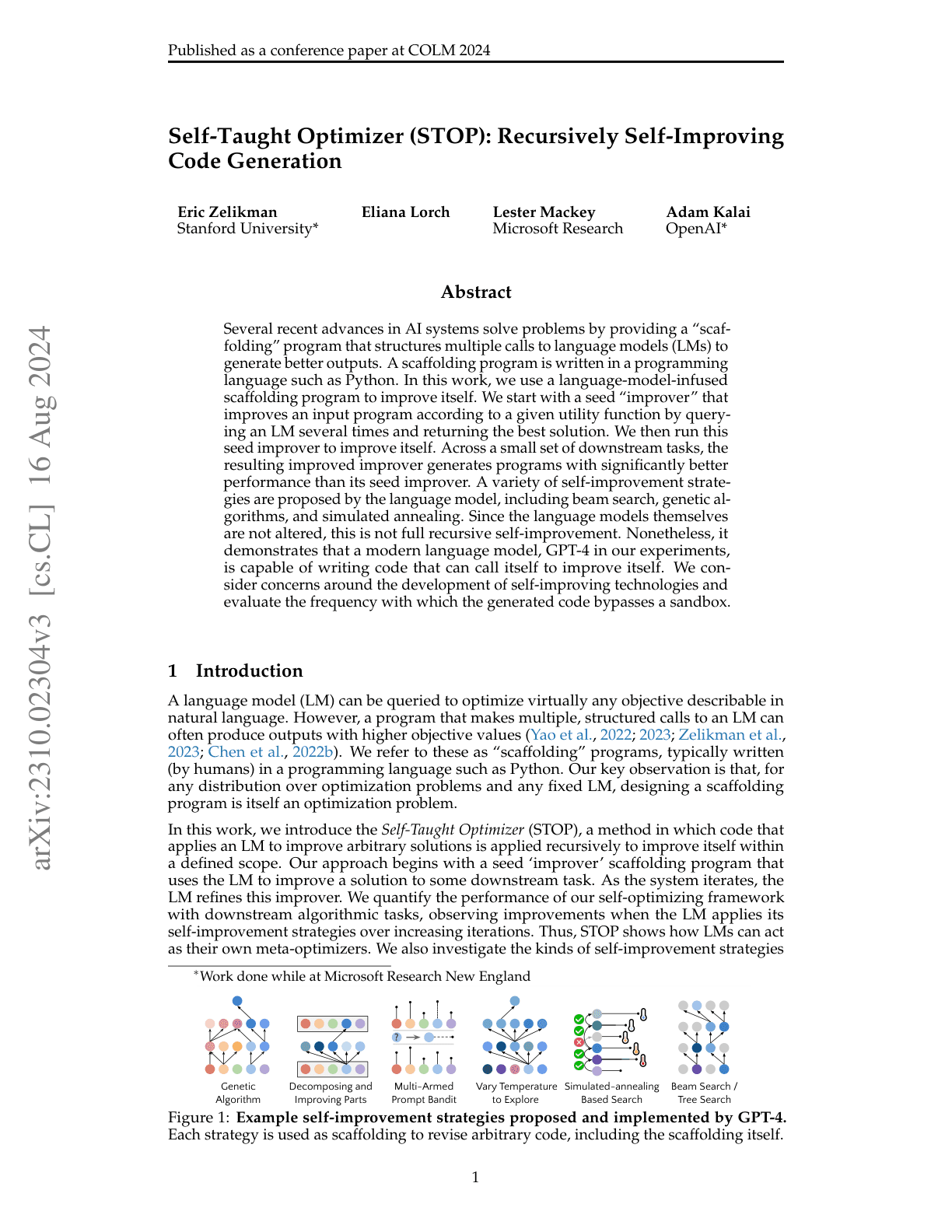
Several recent advances in AI systems solve problems by providing a "scaffolding" program that structures multiple calls to language models (LMs) to generate better outputs. A scaffolding program is written in a programming language such as Python. In this work, we use a language-model-infused scaffolding program to improve itself. We start with a seed "improver" that improves an input program according to a given utility function by querying an LM several times and returning the best solution. We then run this seed improver to improve itself. Across a small set of downstream tasks, the resulting improved improver generates programs with significantly better performance than its seed improver. A variety of self-improvement strategies are proposed by the language model, including beam search, genetic algorithms, and simulated annealing. Since the language models themselves are not altered, this is not full recursive self-improvement. Nonetheless, it demonstrates that a modern language model, GPT-4 in our experiments, is capable of writing code that can call itself to improve itself. We consider concerns around the development of self-improving technologies and evaluate the frequency with which the generated code bypasses a sandbox.