The Dawn of LMMs (GPT-4V Deep Dive)
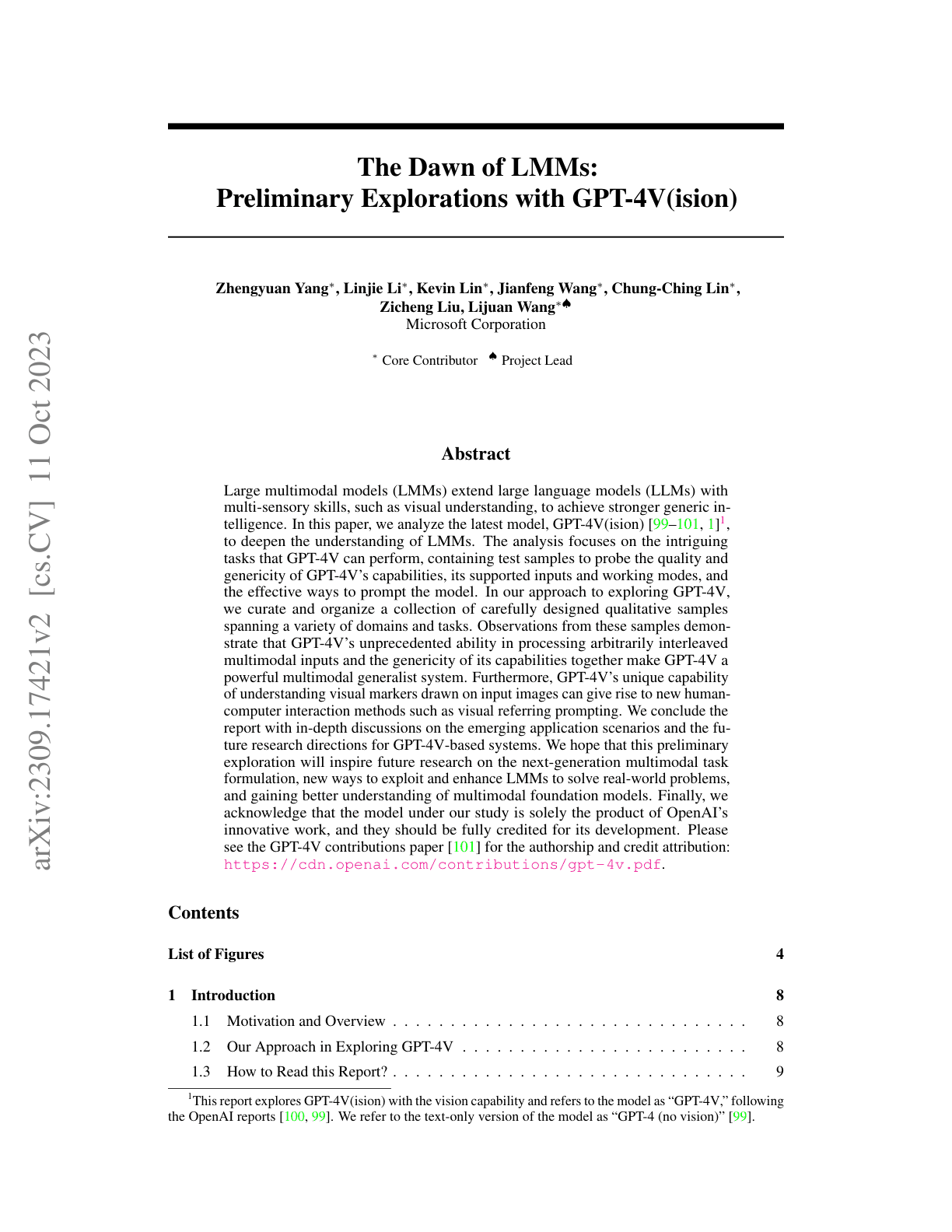
Microsoft's exhaustive 166-page analysis of GPT-4V's capabilities and limitations.
Ask this paper
Comprehensive task coverage: Probes GPT-4V across visual reasoning, code, OCR, document understanding, multimodal commonsense, and agent-style tasks.
Working input modes: Catalogs the diverse input patterns GPT-4V supports - single images, multi-image reasoning, image-text interleaving, sketches, and handwritten input.
Capability frontier: Demonstrates emergent capabilities like reading diagrams, interpreting medical imaging, and extracting structured information from complex visuals.
Open issues: Identifies persistent weaknesses including hallucination, fine-grained spatial reasoning, and consistency across related queries - a reference for what was still broken at the start of the GPT-4V era.
Abstract
Large multimodal models (LMMs) extend large language models (LLMs) with multi-sensory skills, such as visual understanding, to achieve stronger generic intelligence. In this paper, we analyze the latest model, GPT-4V(ision), to deepen the understanding of LMMs. The analysis focuses on the intriguing tasks that GPT-4V can perform, containing test samples to probe the quality and genericity of GPT-4V's capabilities, its supported inputs and working modes, and the effective ways to prompt the model. In our approach to exploring GPT-4V, we curate and organize a collection of carefully designed qualitative samples spanning a variety of domains and tasks. Observations from these samples demonstrate that GPT-4V's unprecedented ability in processing arbitrarily interleaved multimodal inputs and the genericity of its capabilities together make GPT-4V a powerful multimodal generalist system. Furthermore, GPT-4V's unique capability of understanding visual markers drawn on input images can give rise to new human-computer interaction methods such as visual referring prompting. We conclude the report with in-depth discussions on the emerging application scenarios and the future research directions for GPT-4V-based systems. We hope that this preliminary exploration will inspire future research on the next-generation multimodal task formulation, new ways to exploit and enhance LMMs to solve real-world problems, and gaining better understanding of multimodal foundation models. Finally, we acknowledge that the model under our study is solely the product of OpenAI's innovative work, and they should be fully credited for its development. Please see the GPT-4V contributions paper for the authorship and credit attribution: https://cdn.openai.com/contributions/gpt-4v.pdf