Sora Overview
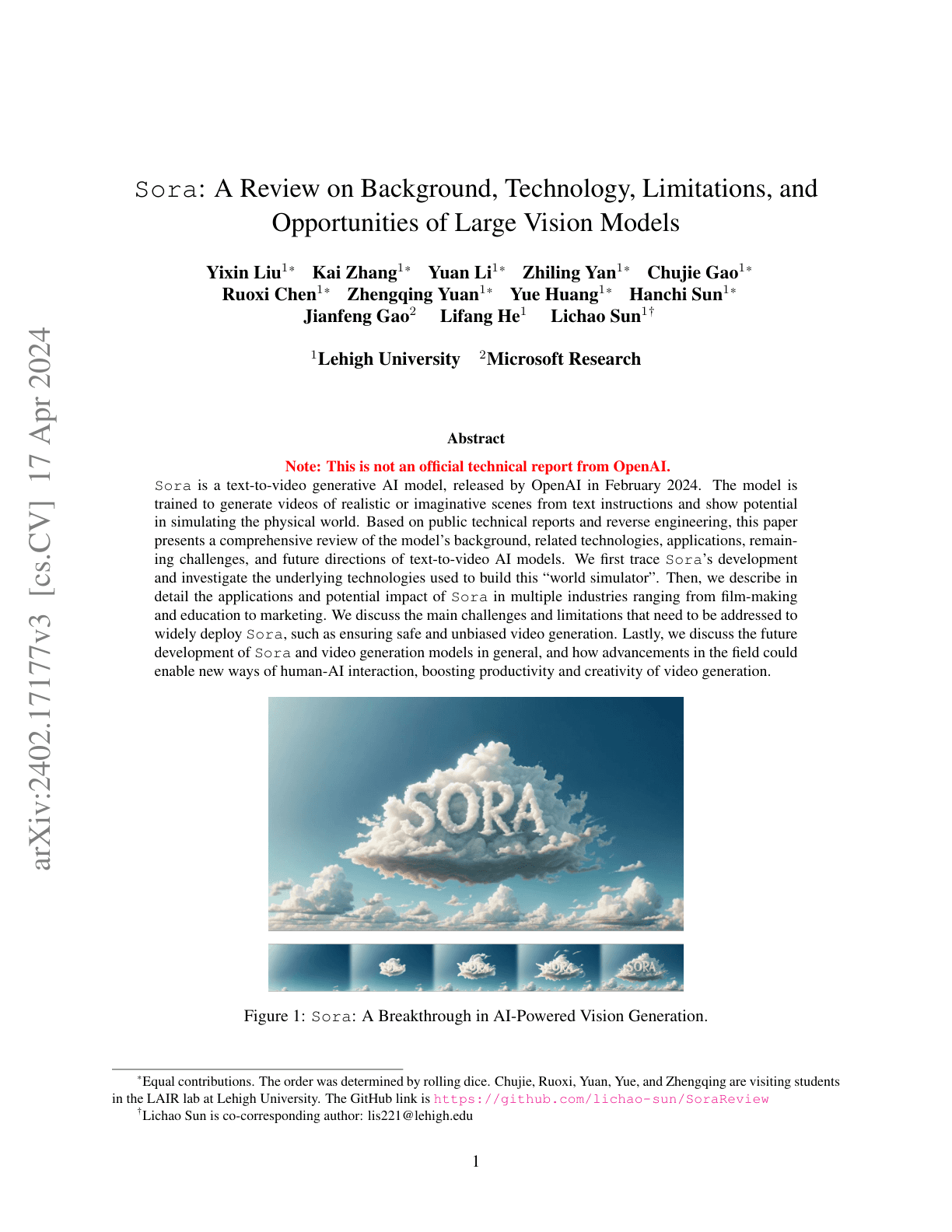
A comprehensive academic review of OpenAI's Sora, tracing the technical ingredients behind the text-to-video "world simulator" and the opportunities/limitations for the next wave of large vision models.
Ask this paper
Technical lineage: Maps Sora back to diffusion-transformer architectures, patchified video tokens, and large-scale joint text-video pretraining, synthesizing the publicly available technical signals.
Capabilities and applications: Catalogs the tasks Sora enables across filmmaking, education, and marketing, including long-duration generation, multi-shot continuity, and physics-plausible object interaction.
Limitations: Flags known failure modes - simulation artifacts, physical inconsistencies, object permanence errors - as well as safety concerns around misuse and bias.
Open directions: Identifies research problems such as efficient long-video training, grounded 3D/world modeling, and standardized evaluation for generative video.
Abstract
Sora is a text-to-video generative AI model, released by OpenAI in February 2024. The model is trained to generate videos of realistic or imaginative scenes from text instructions and show potential in simulating the physical world. Based on public technical reports and reverse engineering, this paper presents a comprehensive review of the model's background, related technologies, applications, remaining challenges, and future directions of text-to-video AI models. We first trace Sora's development and investigate the underlying technologies used to build this "world simulator". Then, we describe in detail the applications and potential impact of Sora in multiple industries ranging from film-making and education to marketing. We discuss the main challenges and limitations that need to be addressed to widely deploy Sora, such as ensuring safe and unbiased video generation. Lastly, we discuss the future development of Sora and video generation models in general, and how advancements in the field could enable new ways of human-AI interaction, boosting productivity and creativity of video generation.