SWE-Agent
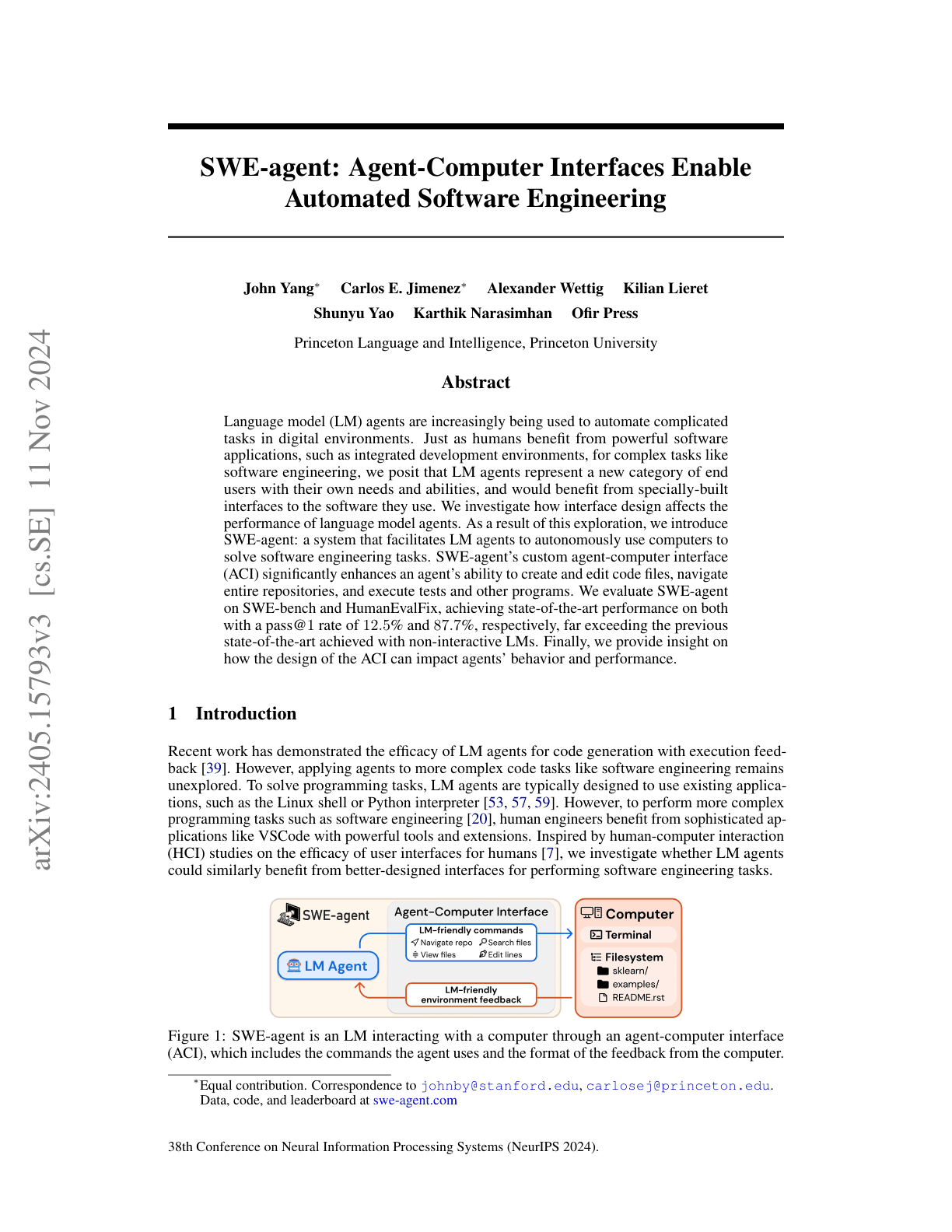
Princeton's SWE-agent pairs a language model with a custom agent-computer interface (ACI) that exposes file navigation, editing, and test execution as discrete tools, letting the agent autonomously resolve real GitHub issues.
Ask this paper
Agent-computer interface: The ACI replaces raw shell access with carefully designed commands (scrolling viewers, structured editors, test runners) that make it easier for an LLM to plan multi-step code changes.
SWE-bench results: SWE-agent resolves 12.29% of SWE-bench issues end-to-end on the full test set, matching Devin's reported accuracy while being fully open-source.
HumanEvalFix: On HumanEvalFix the same agent reaches an 87.7% pass rate, showing the ACI generalizes beyond large-repo bug fixing to smaller self-contained tasks.
Interface-over-model lesson: The gains come primarily from interface design rather than model changes, reinforcing that agent capability depends heavily on how tools are exposed to the LLM.
Abstract
Language model (LM) agents are increasingly being used to automate complicated tasks in digital environments. Just as humans benefit from powerful software applications, such as integrated development environments, for complex tasks like software engineering, we posit that LM agents represent a new category of end users with their own needs and abilities, and would benefit from specially-built interfaces to the software they use. We investigate how interface design affects the performance of language model agents. As a result of this exploration, we introduce SWE-agent: a system that facilitates LM agents to autonomously use computers to solve software engineering tasks. SWE-agent's custom agent-computer interface (ACI) significantly enhances an agent's ability to create and edit code files, navigate entire repositories, and execute tests and other programs. We evaluate SWE-agent on SWE-bench and HumanEvalFix, achieving state-of-the-art performance on both with a pass@1 rate of 12.5% and 87.7%, respectively, far exceeding the previous state-of-the-art achieved with non-interactive LMs. Finally, we provide insight on how the design of the ACI can impact agents' behavior and performance.