Visualization-of-Thought
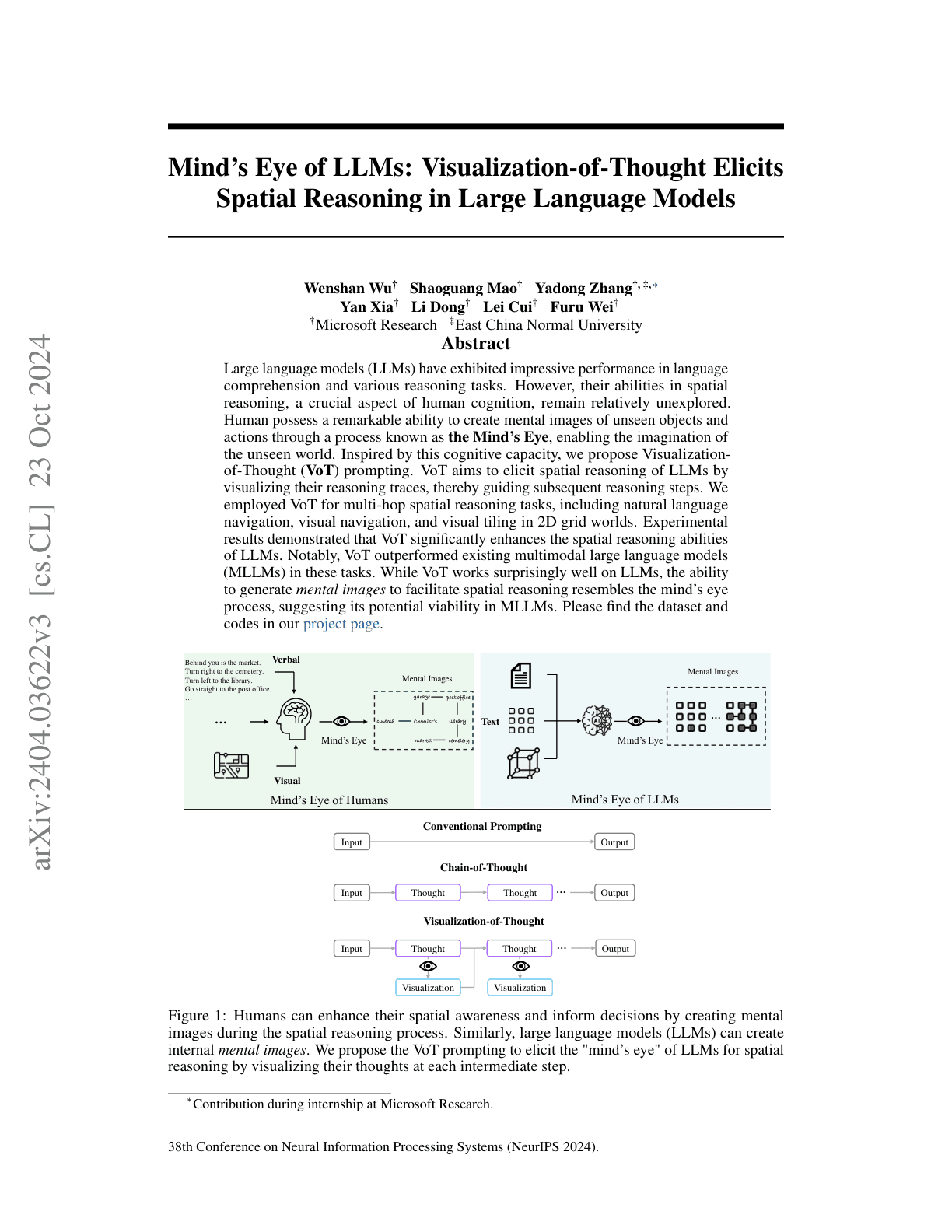
Microsoft's Visualization-of-Thought (VoT) prompts LLMs to emit intermediate "mental images" of their reasoning state, lifting spatial-reasoning accuracy on grid-world tasks and beating multimodal baselines that actually see images.
Ask this paper
Mental-imagery prompting: The model renders each reasoning step as an ASCII/grid-style visualization, which is then fed back in to constrain subsequent steps, echoing human mental imagery.
Benchmarks: VoT is evaluated on natural-language navigation, visual navigation, and visual tiling in 2D grid worlds, targeting multi-hop spatial reasoning.
Beats multimodal LLMs: Text-only LLMs with VoT outperform contemporary multimodal LLMs on the same tasks, showing explicit state visualization can substitute for actual image tokens.
NeurIPS 2024: The method was accepted to NeurIPS 2024 and positions mental imagery as a general-purpose tool for strengthening reasoning in otherwise text-only models.
Abstract
Large language models (LLMs) have exhibited impressive performance in language comprehension and various reasoning tasks. However, their abilities in spatial reasoning, a crucial aspect of human cognition, remain relatively unexplored. Human possess a remarkable ability to create mental images of unseen objects and actions through a process known as the Mind's Eye, enabling the imagination of the unseen world. Inspired by this cognitive capacity, we propose Visualization-of-Thought (VoT) prompting. VoT aims to elicit spatial reasoning of LLMs by visualizing their reasoning traces, thereby guiding subsequent reasoning steps. We employed VoT for multi-hop spatial reasoning tasks, including natural language navigation, visual navigation, and visual tiling in 2D grid worlds. Experimental results demonstrated that VoT significantly enhances the spatial reasoning abilities of LLMs. Notably, VoT outperformed existing multimodal large language models (MLLMs) in these tasks. While VoT works surprisingly well on LLMs, the ability to generate mental images to facilitate spatial reasoning resembles the mind's eye process, suggesting its potential viability in MLLMs. Please find the dataset and codes at https://microsoft.github.io/visualization-of-thought