Symbol tuning
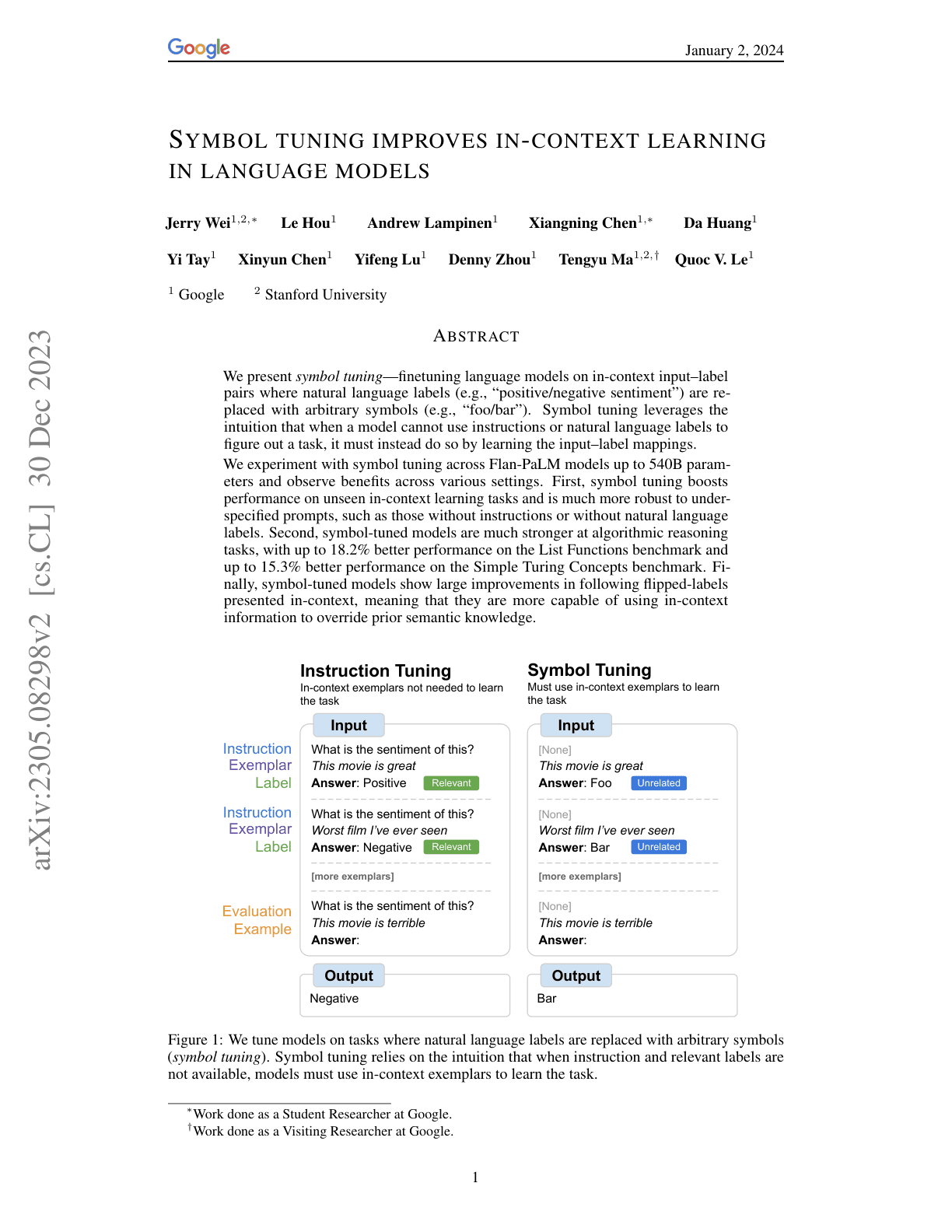
Fine-tunes LMs on in-context input-label pairs with natural-language labels replaced by arbitrary symbols.
Ask this paper
Symbolic abstraction: Replacing semantic labels with random symbols forces the model to rely on the demonstrations rather than label priors.
ICL improvements: Boosts performance on unseen in-context learning tasks where the model must infer label semantics from examples.
Algorithmic reasoning: Particularly improves algorithmic reasoning tasks that require following abstract patterns.
ICL mechanism insight: Provides evidence about how ICL works and how to train models that better generalize the mechanism.
Abstract
We present symbol tuning - finetuning language models on in-context input-label pairs where natural language labels (e.g., "positive/negative sentiment") are replaced with arbitrary symbols (e.g., "foo/bar"). Symbol tuning leverages the intuition that when a model cannot use instructions or natural language labels to figure out a task, it must instead do so by learning the input-label mappings. We experiment with symbol tuning across Flan-PaLM models up to 540B parameters and observe benefits across various settings. First, symbol tuning boosts performance on unseen in-context learning tasks and is much more robust to underspecified prompts, such as those without instructions or without natural language labels. Second, symbol-tuned models are much stronger at algorithmic reasoning tasks, with up to 18.2% better performance on the List Functions benchmark and up to 15.3% better performance on the Simple Turing Concepts benchmark. Finally, symbol-tuned models show large improvements in following flipped-labels presented in-context, meaning that they are more capable of using in-context information to override prior semantic knowledge.