Synthesizing Text-to-SQL Data from Weak and Strong LLMs
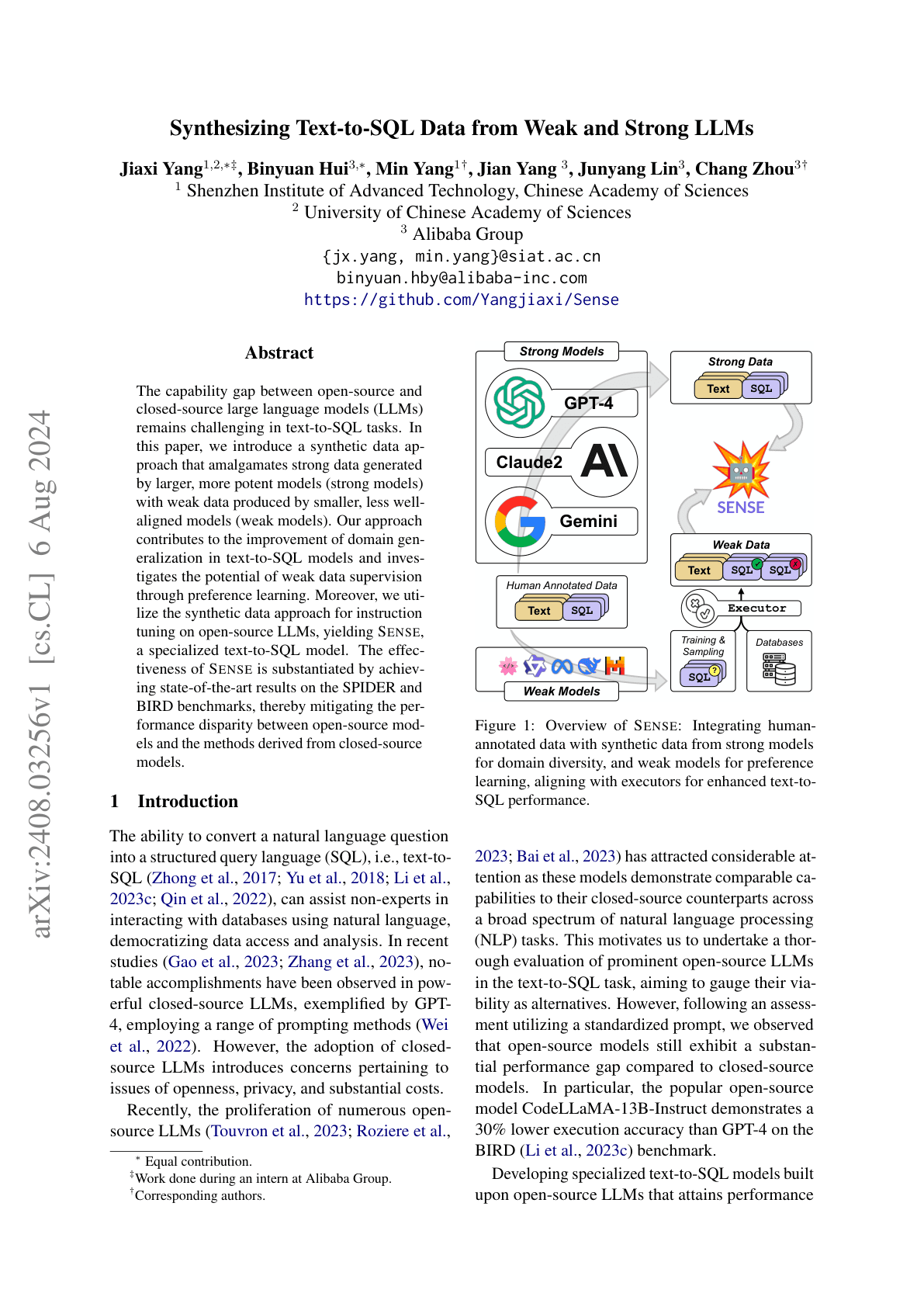
proposes integrated synthetic data to build a highly specialized SoTA text-to-SQL model called SENSE; the synthetic data from strong models enhances data diversity while valuable erroneous data from weaker models combined with an executor to learn from execution feedback; preference learning is used to instruction-tune LLMs to learn from both correct and incorrect samples; SENSE achieves state-of-the-art results on the SPIDER and BIRD benchmarks, which bridges the performance gap between open-source models and methods that use closed-source models.
Ask this paper
Abstract
The capability gap between open-source and closed-source large language models (LLMs) remains a challenge in text-to-SQL tasks. In this paper, we introduce a synthetic data approach that combines data produced by larger, more powerful models (strong models) with error information data generated by smaller, not well-aligned models (weak models). The method not only enhances the domain generalization of text-to-SQL models but also explores the potential of error data supervision through preference learning. Furthermore, we employ the synthetic data approach for instruction tuning on open-source LLMs, resulting SENSE, a specialized text-to-SQL model. The effectiveness of SENSE is demonstrated through state-of-the-art results on the SPIDER and BIRD benchmarks, bridging the performance gap between open-source models and methods prompted by closed-source models.