Textbooks Are All You Need II (phi-1.5)
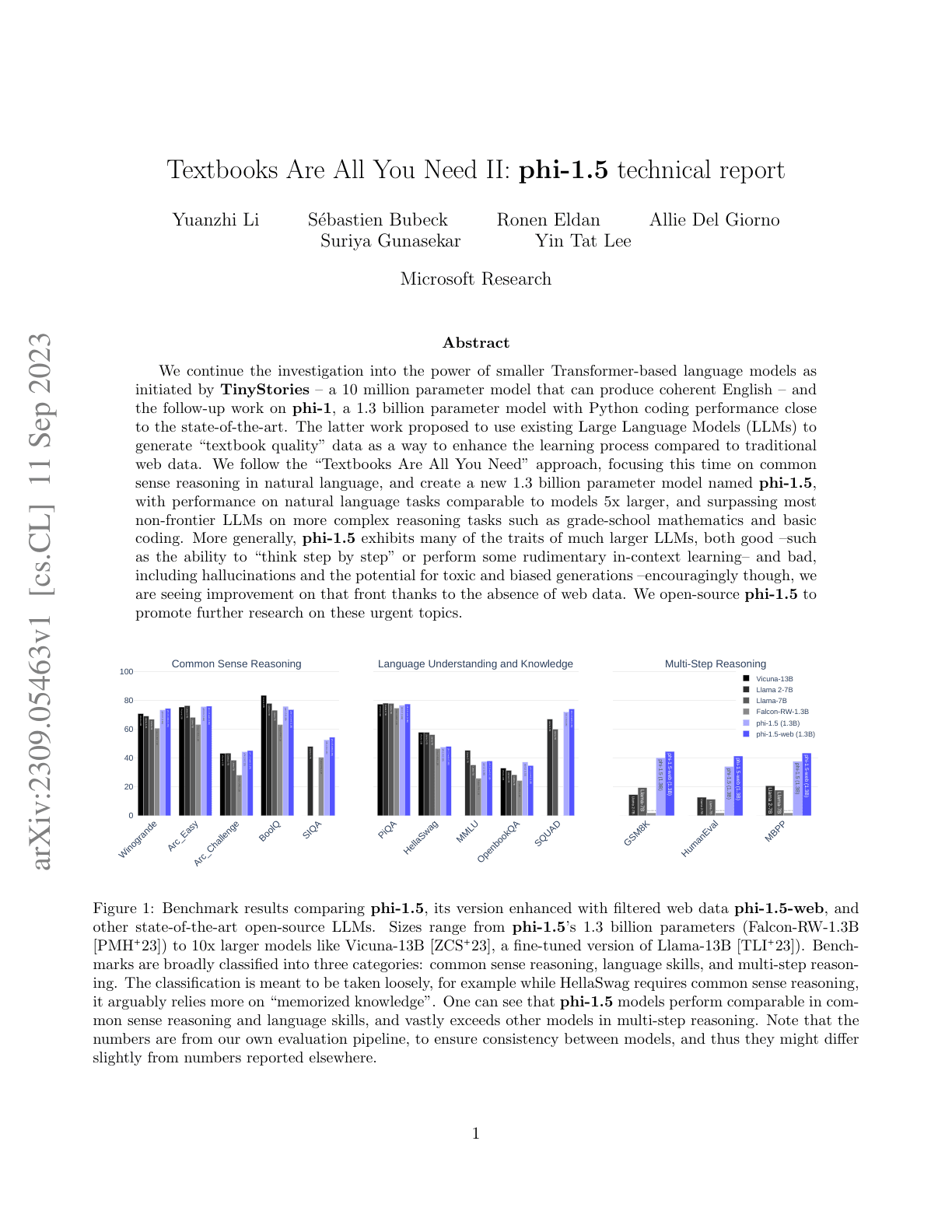
Microsoft's phi-1.5 demonstrates that a 1.3B model trained on "textbook-quality" synthetic data rivals much larger models on reasoning.
Ask this paper
Small but capable: A 1.3B parameter model trained on only 30B tokens competes or outperforms much larger open models on reasoning tasks.
Synthetic textbook data: Training data consists of AI-generated "textbook-quality" content, deliberately curated for pedagogical clarity rather than web breadth.
Data quality dominates: Suggests that data quality and pedagogical structure matter more for reasoning emergence than raw parameter count - a provocative counter to pure-scaling narratives.
Phi-family kickoff: Establishes the recipe that the phi-2, phi-3, and phi-4 releases would refine, popularizing synthetic-data-heavy small LLM training.
Abstract
We continue the investigation into the power of smaller Transformer-based language models as initiated by \textbf{TinyStories} -- a 10 million parameter model that can produce coherent English -- and the follow-up work on \textbf{phi-1}, a 1.3 billion parameter model with Python coding performance close to the state-of-the-art. The latter work proposed to use existing Large Language Models (LLMs) to generate ``textbook quality" data as a way to enhance the learning process compared to traditional web data. We follow the ``Textbooks Are All You Need" approach, focusing this time on common sense reasoning in natural language, and create a new 1.3 billion parameter model named \textbf{phi-1.5}, with performance on natural language tasks comparable to models 5x larger, and surpassing most non-frontier LLMs on more complex reasoning tasks such as grade-school mathematics and basic coding. More generally, \textbf{phi-1.5} exhibits many of the traits of much larger LLMs, both good -- such as the ability to ``think step by step" or perform some rudimentary in-context learning -- and bad, including hallucinations and the potential for toxic and biased generations -- encouragingly though, we are seeing improvement on that front thanks to the absence of web data. We open-source \textbf{phi-1.5} to promote further research on these urgent topics.