EMO: Emote Portrait Alive
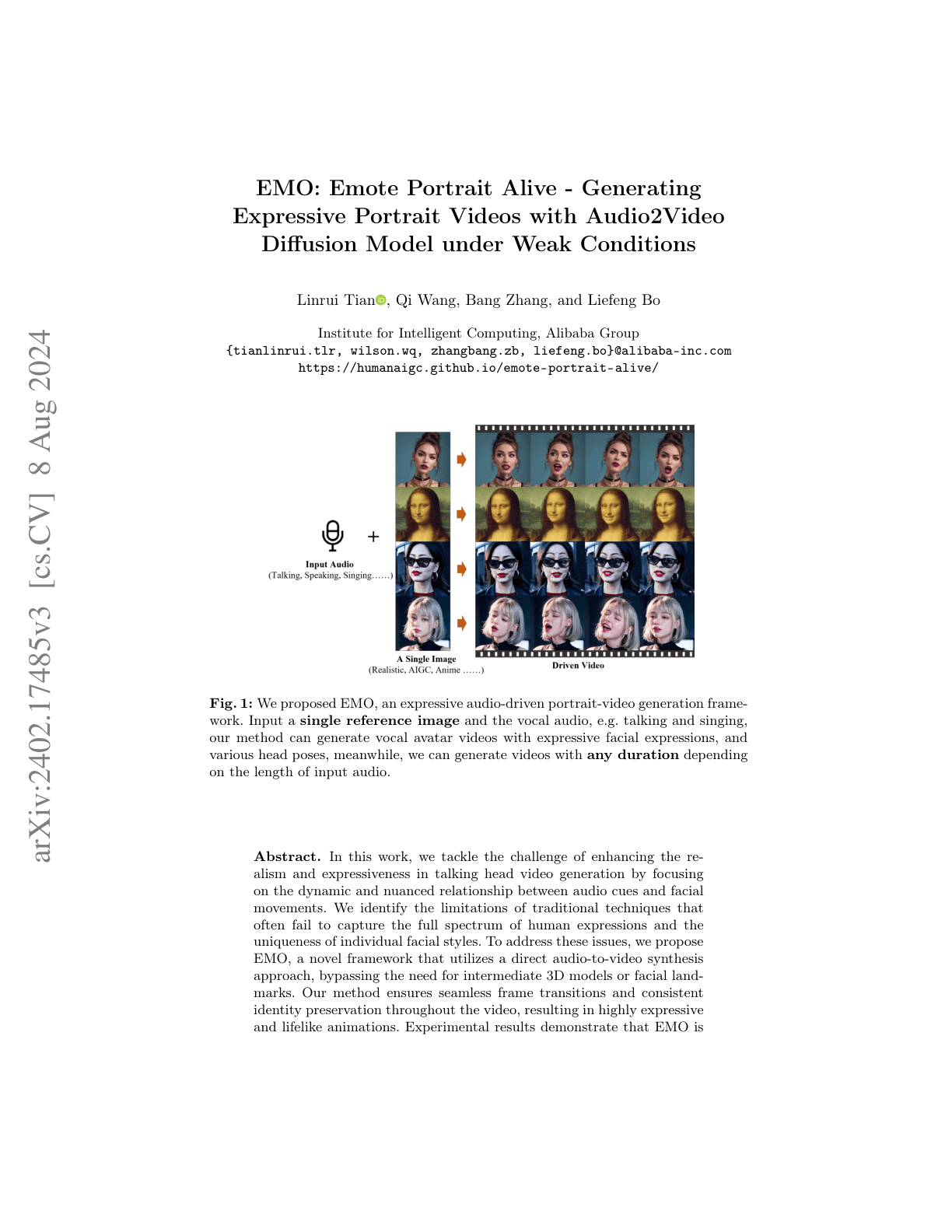
Alibaba's EMO synthesizes expressive talking-head videos directly from audio, bypassing the intermediate 3D models or facial landmarks used by prior approaches.
Ask this paper
Audio2Video diffusion: A single diffusion model maps an audio waveform and a reference portrait directly to a video, letting subtle prosody drive facial motion without a handcrafted intermediate representation.
Speaking and singing: Produces convincing lip-sync and expressive facial motion for both speech and singing across varied styles, handling long-duration audio stably.
Identity preservation: Reports strong identity preservation and seamless frame transitions, outperforming prior methods on expressiveness and realism metrics.
Implications: Shows that eliminating the 3D/landmark intermediate stage - previously thought essential for controllable portraits - can actually improve fidelity and expressiveness for talking-head generation.
Abstract
In this work, we tackle the challenge of enhancing the realism and expressiveness in talking head video generation by focusing on the dynamic and nuanced relationship between audio cues and facial movements. We identify the limitations of traditional techniques that often fail to capture the full spectrum of human expressions and the uniqueness of individual facial styles. To address these issues, we propose EMO, a novel framework that utilizes a direct audio-to-video synthesis approach, bypassing the need for intermediate 3D models or facial landmarks. Our method ensures seamless frame transitions and consistent identity preservation throughout the video, resulting in highly expressive and lifelike animations. Experimental results demonsrate that EMO is able to produce not only convincing speaking videos but also singing videos in various styles, significantly outperforming existing state-of-the-art methodologies in terms of expressiveness and realism.