The Universal Verifier for Agent Benchmarks
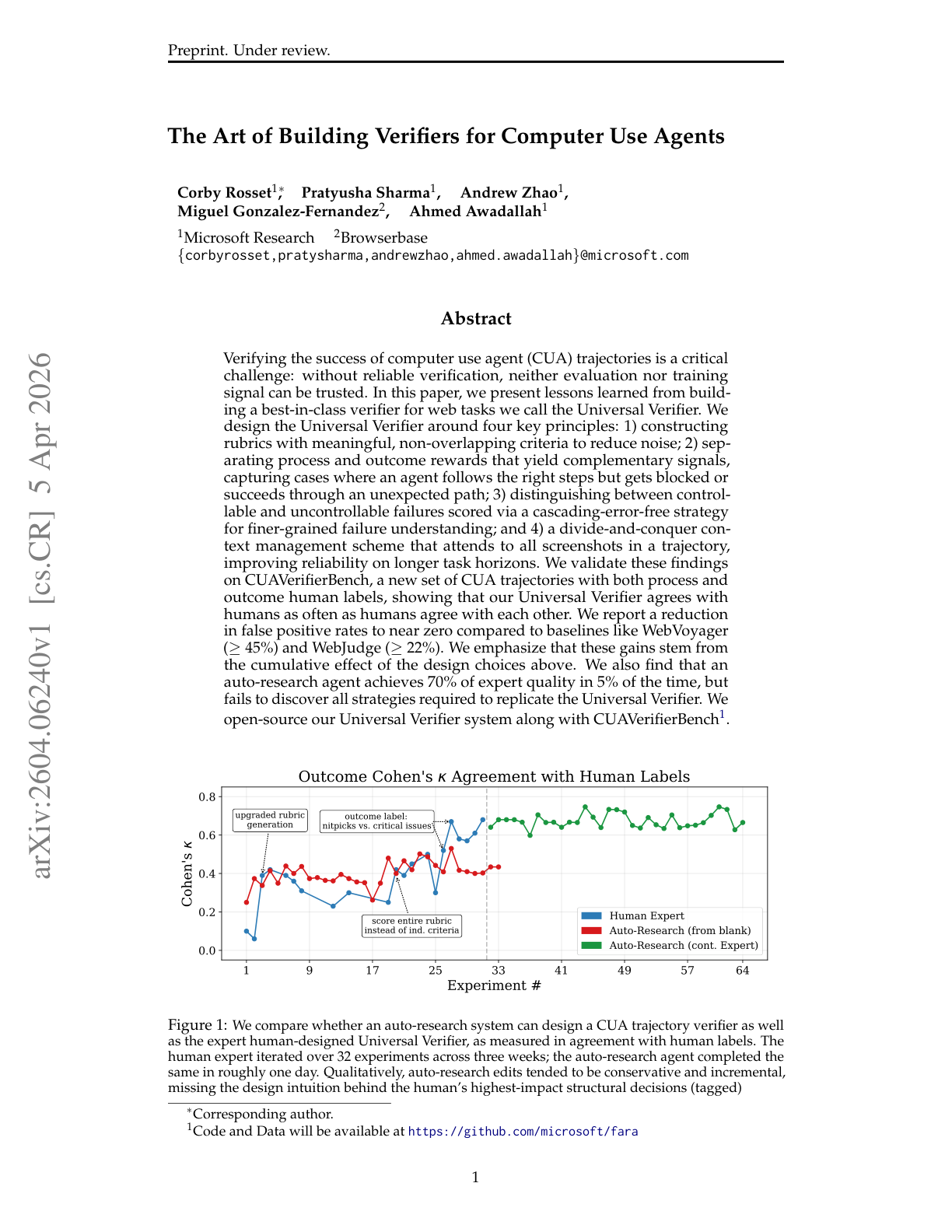
Every agent benchmark has the same hidden problem: how do you know the agent actually succeeded? Microsoft researchers introduce the Universal Verifier, built on four design principles for reliable evaluation of computer-use agent trajectories. The verifier reduces false positive rates to near zero, down from 45%+ with WebVoyager and 22%+ with WebJudge.
Ask this paper
Four design principles: The verifier is built on non-overlapping rubric criteria to reduce noise, separate process and outcome rewards for complementary signals, cascading error-free assessment that distinguishes controllable from uncontrollable failures, and divide-and-conquer context management that attends to all screenshots in a trajectory.
Near-zero false positives: Current verifiers suffer from alarmingly high false positive rates that corrupt both benchmark scores and training data. The Universal Verifier achieves agreement with human judges that matches inter-human agreement rates, making it reliable enough for both evaluation and RL reward signal generation.
Cumulative design gains: No single design choice dominates the performance improvement. The authors demonstrate that gains result from the cumulative effect of all four principles working together, with each contributing meaningful improvements that compound rather than any one serving as a silver bullet.
Limits of automated research: An interesting meta-finding: the team used an auto-research agent to replicate the verifier design process. The agent reached 70% of expert verifier quality in 5% of the time but could not discover the structural design decisions that drove the biggest gains, suggesting human insight remains essential for system-level design.