Neural Computers
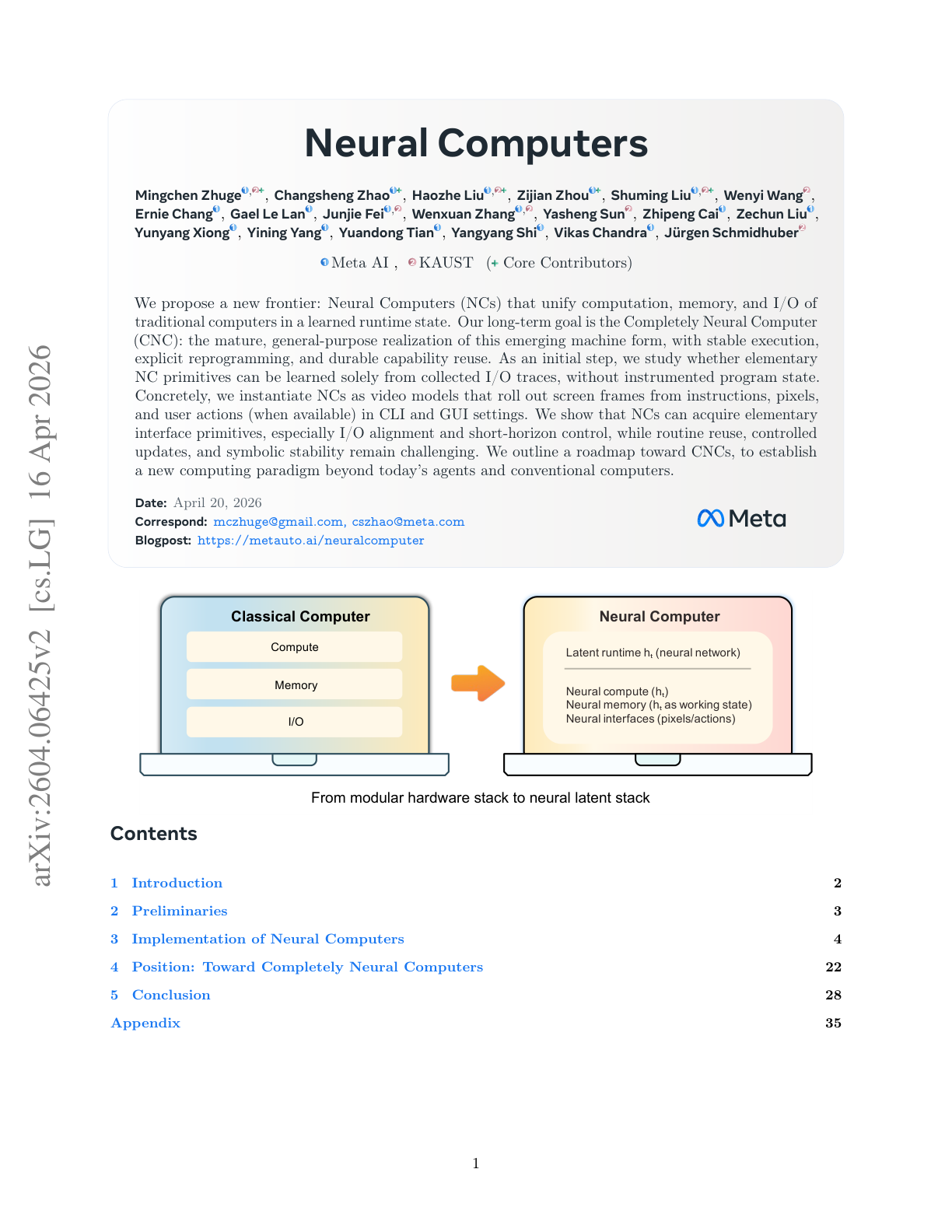
Researchers from Meta AI and KAUST propose Neural Computers (NCs), an emerging machine form that unifies computation, memory, and I/O in a single learned runtime state. Unlike conventional computers that execute explicit programs, agents that act over external environments, or world models that learn dynamics, NCs aim to make the model itself the running computer, establishing a new computing paradigm.
Ask this paper
From hardware stack to neural latent stack: Classical computers separate compute, memory, and I/O into modular hardware layers. Neural Computers collapse all three into a single latent runtime state carried by a neural network. The model’s hidden state serves simultaneously as working memory, computational substrate, and interface layer, removing the boundary between program and execution environment.
Video models as prototype substrate: The team instantiates NCs as video models that generate screen frames from instructions, pixel inputs, and user actions. Two prototypes cover command-line interfaces (NCCLIGen, which renders and executes terminal workflows) and graphical desktops (NCGUIWorld, which learns pointer dynamics and menu interactions), both trained without access to internal program state.
Early runtime primitives emerge: The prototypes demonstrate that learned runtimes can acquire I/O alignment and short-horizon control directly from raw interface traces. CLI models execute short command chains with structurally accurate output rendering, while GUI models learn coherent click feedback and window transitions in controlled settings.
Roadmap toward Completely Neural Computers: The long-term target is the CNC: a system that is Turing complete, universally programmable, and behavior-consistent unless explicitly reprogrammed. Key open challenges include routine reuse across sessions, controlled capability updates without catastrophic forgetting, and stable symbolic processing for long-horizon reasoning.