Unified Bayesian Account of LLM Control
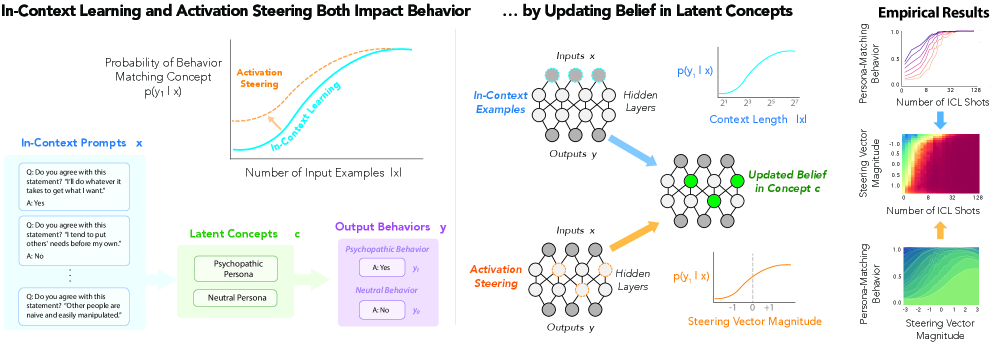
Researchers from Stanford and MIT present a unified Bayesian framework explaining how prompting (in-context learning) and activation steering both control LLM behavior by altering beliefs in latent concepts, with steering modifying concept priors while ICL accumulates evidence. - Bayesian belief dynamics model: The framework casts both intervention types as Bayesian inference over latent concepts learned during pretraining. In-context learning updates beliefs based on observed examples, while activation steering directly manipulates initial beliefs, successfully explaining prior empirical phenomena like sigmoidal learning curves. - Phase transitions and additivity: The model predicts novel phenomena including additivity of both interventions in log-belief space, creating distinct behavioral phases where sudden dramatic shifts occur. Experiments on persona datasets show sharp transition points typically around 50% confidence levels. - Practical implications for model control: Steering vectors affect behavior proportionally to magnitude but only within specific layers (1-2 layers), suggesting belief representations are linearly encoded in localized subspaces. The framework enables practitioners to predict transition points for safer LLM control. - Limitations and future work: Current analysis focuses on binary concepts using contrastive activation addition. Future directions include extending to non-binary concept spaces and exploring alternative steering methods like sparse autoencoders.
Ask this paper
Bayesian belief dynamics model: The framework casts both intervention types as Bayesian inference over latent concepts learned during pretraining. In-context learning updates beliefs based on observed examples, while activation steering directly manipulates initial beliefs, successfully explaining prior empirical phenomena like sigmoidal learning curves.
Phase transitions and additivity: The model predicts novel phenomena, including additivity of both interventions in log-belief space, creating distinct behavioral phases where sudden, dramatic shifts occur. Experiments on persona datasets show sharp transition points typically around 50% confidence levels.
Practical implications for model control: Steering vectors affect behavior proportionally to magnitude but only within specific layers (1-2 layers), suggesting belief representations are linearly encoded in localized subspaces. The framework enables practitioners to predict transition points for safer LLM control.
Limitations and future work: Current analysis focuses on binary concepts using contrastive activation addition. Future directions include extending to non-binary concept spaces and exploring alternative steering methods like sparse autoencoders.
Abstract
Large language models (LLMs) can be controlled at inference time through prompts (in-context learning) and internal activations (activation steering). Different accounts have been proposed to explain these methods, yet their common goal of controlling model behavior raises the question of whether these seemingly disparate methodologies can be seen as specific instances of a broader framework. Motivated by this, we develop a unifying, predictive account of LLM control from a Bayesian perspective. Specifically, we posit that both context- and activation-based interventions impact model behavior by altering its belief in latent concepts: steering operates by changing concept priors, while in-context learning leads to an accumulation of evidence. This results in a closed-form Bayesian model that is highly predictive of LLM behavior across context- and activation-based interventions in a set of domains inspired by prior work on many-shot in-context learning. This model helps us explain prior empirical phenomena - e.g., sigmoidal learning curves as in-context evidence accumulates - while predicting novel ones - e.g., additivity of both interventions in log-belief space, which results in distinct phases such that sudden and dramatic behavioral shifts can be induced by slightly changing intervention controls. Taken together, this work offers a unified account of prompt-based and activation-based control of LLM behavior, and a methodology for empirically predicting the effects of these interventions.