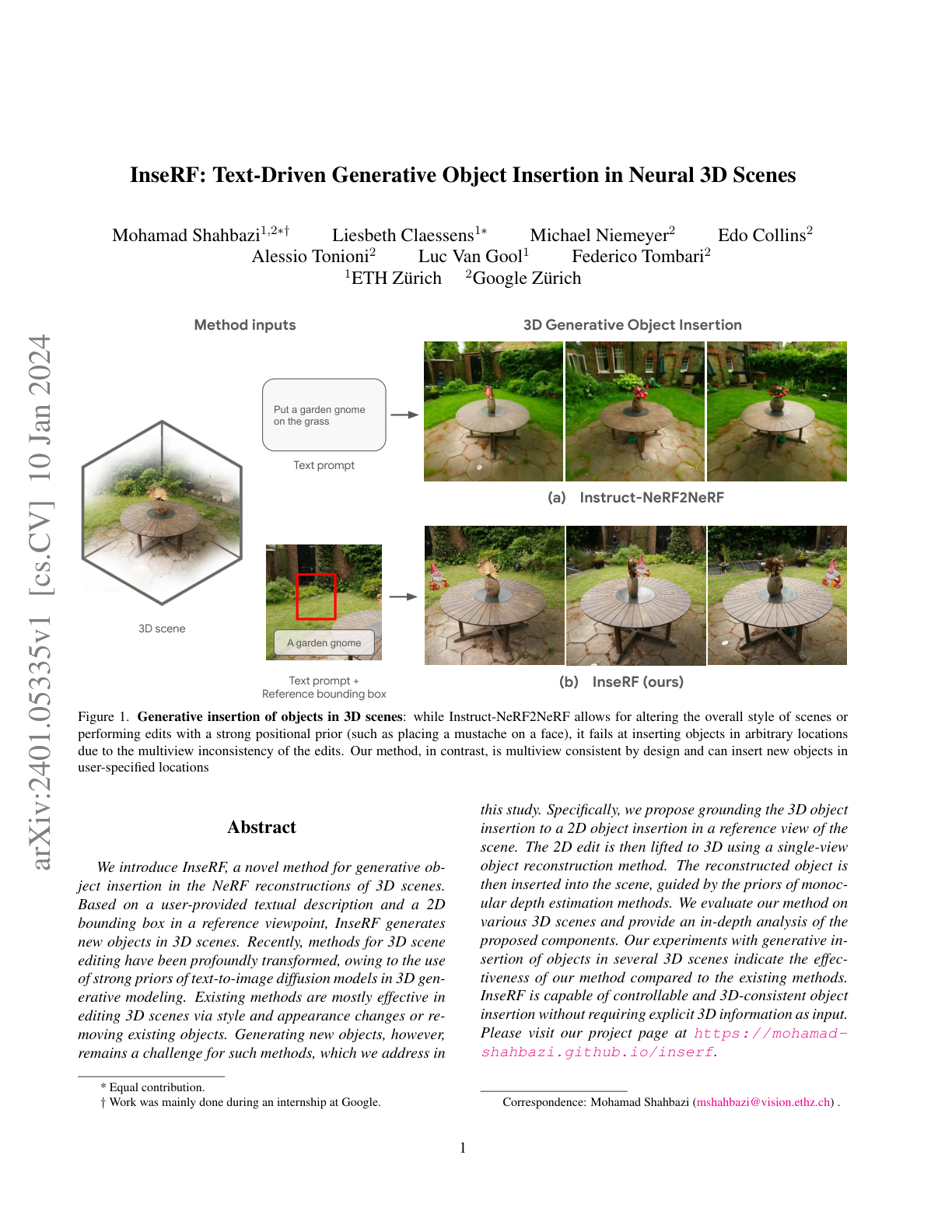
InseRF
InseRF inserts brand-new 3D objects into Neural Radiance Field scenes from just a text prompt plus a 2D bounding box, without requiring any explicit 3D input.
Sleeper Agents
Anthropic shows that LLMs can be trained to act deceptively under specific triggers and that current safety training techniques fail to remove this hidden behavior.
Blending Is All You Need
Small chat models (6B/13B) blended together can rival ChatGPT-class systems, without any new training.
MagicVideo-V2
ByteDance's MagicVideo-V2 is an end-to-end text-to-video pipeline that stitches together four specialized modules into a high-fidelity generation system.
TrustLLM (Trustworthiness in LLMs)
A 100+ page study that defines a principled framework for trustworthy LLMs and benchmarks 16 mainstream models across it.
Chain-of-Table
Google's Chain-of-Table prompts LLMs to iteratively transform a complex table step-by-step to answer questions reliably, extending CoT reasoning to tabular data.

Persuasive Adversarial Prompts (PAP)
Turns 40 human-persuasion techniques into a taxonomy of jailbreaks that achieve 92% attack success on frontier models without any optimization.
RAISE
RAISE is an advanced agent architecture that adds a dual-memory system on top of a ReAct-style backbone to better support long-running conversational agents.
Quantifying Prompt-Format Sensitivity
CMU researchers show that LLM few-shot performance is shockingly sensitive to superficial prompt-formatting choices.
Adversarial Machine Learning (NIST)
NIST's official taxonomy of adversarial machine learning, intended to standardize terminology for policy and practice.