GPT-4o
a new model with multimodal reasoning capabilities with real-time support across audio, vision, and text; it can accept as input any combination of text, audio, image, and video to generate combinations of text, audio, and image outputs; it’s reported to match GPT-4 Turbo performance while being 50% much faster and cheaper via APIs.
Gemini 1.5 Flash
a lightweight transformer decoder model with a 2M context window with multimodal capabilities; it is designed for efficiency and yields the fastest output generation of all models on several evaluated languages; overall, Gemini 1.5 Flash performs uniformly better compared to Gemini 1.0 Pro and even performs at a similar level to 1.0 Ultra on several benchmarks.

Veo
Google Deepmind’s most capable video generation model generates high-quality, 1080p resolution videos beyond 1 minute; it supports masked editing on videos and can also generate videos with an input image along with text; the model can extend video clips to 60 seconds and more while keeping consistency with its latent diffusion transformer.
Chameleon
a family of token-based mixed-modal models for generating images and text in any arbitrary sequence; reports state-of-the-art performance in image captioning and outperforms Llama 2 in text-only tasks and is also competitive with Mixtral 8x7B and Gemini-Pro; exceeds the performance of Gemini Pro and GPT-4V on a new long-form mixed-modal generation evaluation.
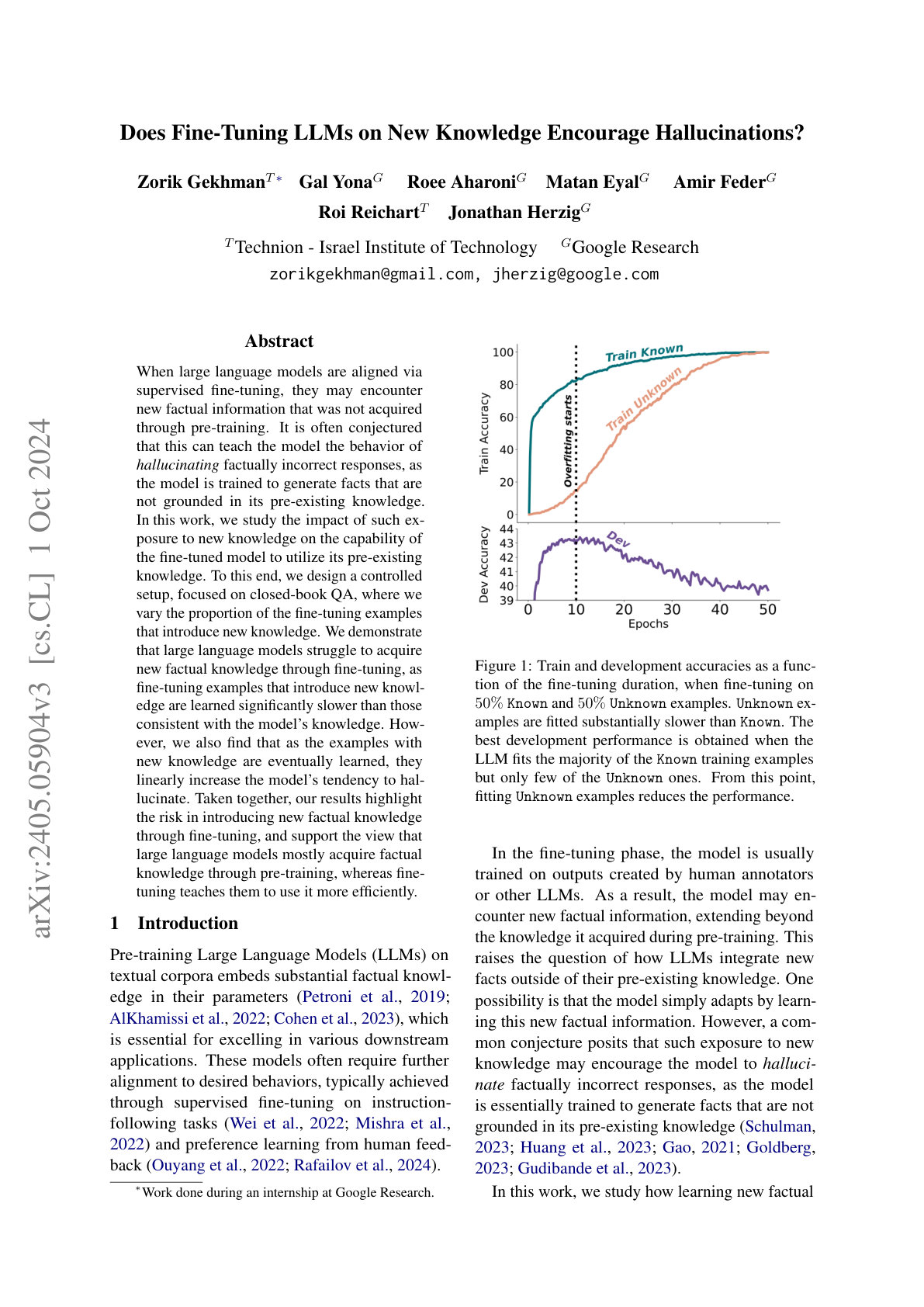
Fine-tuning and Hallucinations
studies the impact of fine-tuning on new knowledge on the hallucination tendencies of LLMs; the setup includes fine-tuning examples that include new knowledge; shows that LLMs struggle to acquire new factual knowledge via fine-tuning; also finds that as new knowledge is learned it increases the model’s tendency to hallucinate.
Zero-shot Tokenizer Transfer
trains a hypernetwork taking a tokenizer as input and predicting the corresponding embeddings; it demonstrates generalization to new tokenizers both with encoder and decoder LLMs; reports that the method achieves performance close to the original models' performance in cross-lingual and coding tasks while reducing the length of the tokenized sequence.
WavCraft
leverages LLMs to connect task-specific models for audio content creation and editing; decomposes users' instructions into several tasks and tackles each task collaboratively with the particular module; it can enable users to interact and produce audio content without explicit commands
RLHF Workflow
provides an easily reproducible recipe for online iterative RLHF; discusses theoretical insights and algorithmic principles of online iterative RLHF and practical implementation.
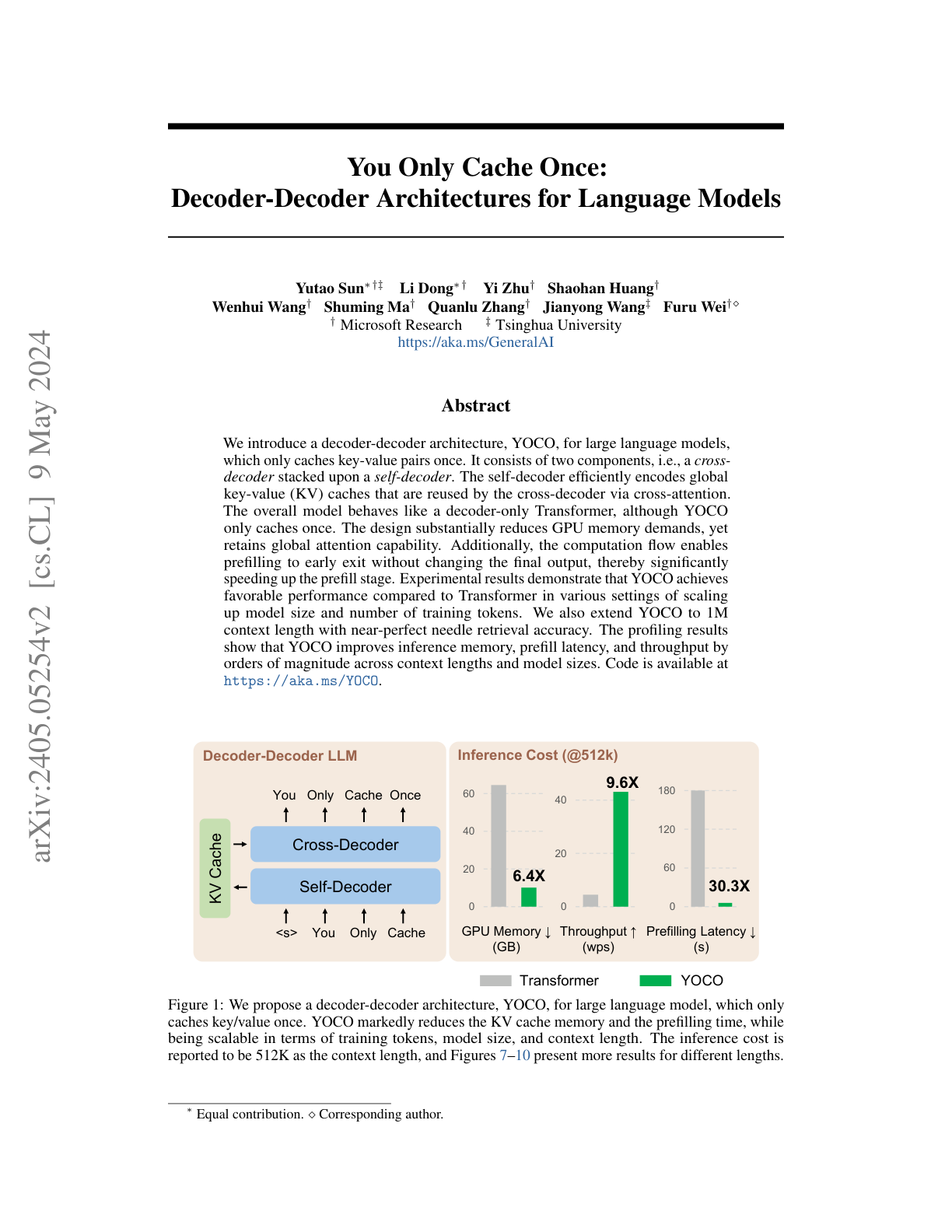
You Only Cache Once
a decoder-decoder LLM architecture that only caches key-value pairs once; it involves a cross-decoder stacked upon a self-decoder which efficiently encodes global key-value caches and the cross-encoder reuses the cache via cross-attention; this leads to a significant reduction in GPU memory use without sacrificing capabilities; achieves comparable performance to Transformer in various settings of scaling up model size and number of training token.
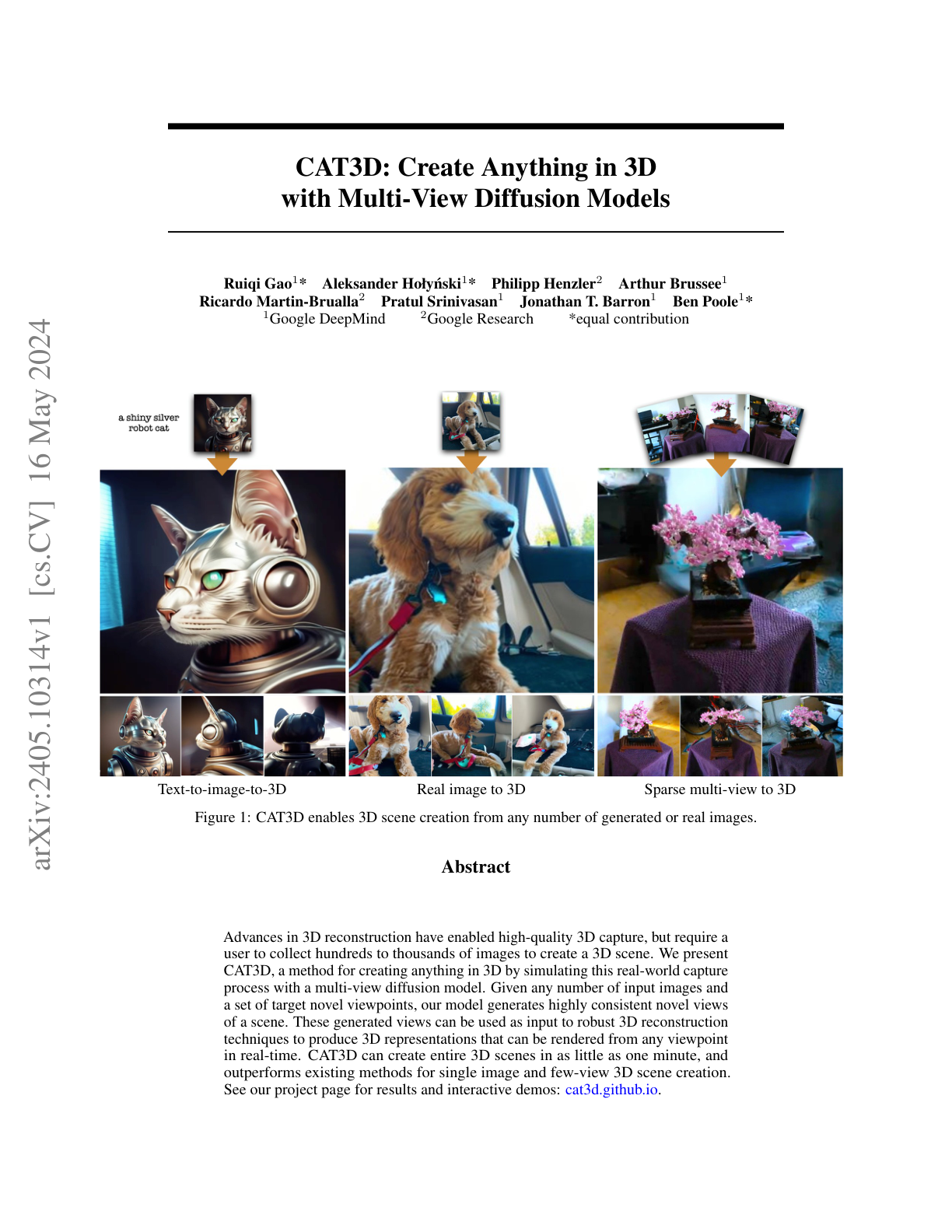
CAT3D
presents a method for creating anything in 3D by simulating the real-world capture process using a multi-view diffusion model; it can generate consistent novel views of a scene which can be used as input to 3D reconstruction techniques to produce 3D representation rendered in real-time; the scene from CAT3D can be generated in less than one minute and is reported to outperform existing methods on single image and few-view 3D scene creation tasks.