Extracting Interpretable Features from Claude 3 Sonnet
presents an effective method to extract millions of abstract features from an LLM that represent specific concepts; these concepts could represent people, places, programming abstractions, emotion, and more; reports that some of the discovered features are directly related to the safety aspects of the model; finds features directly related to security vulnerabilities and backdoors in code, bias, deception, sycophancy; and dangerous/criminal content, and more; these features are also used to intuititively steer the model’s output.
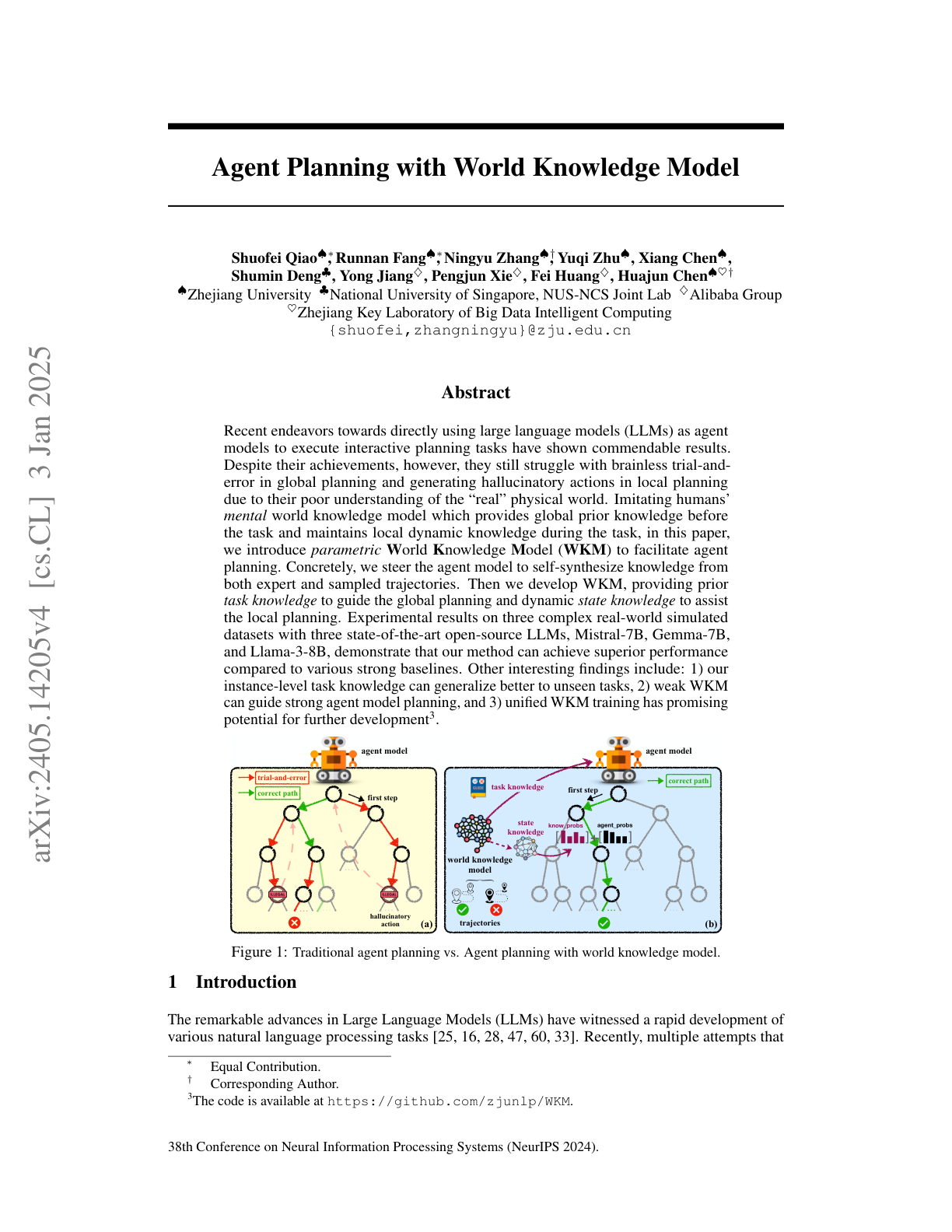
Agent Planning with World Knowledge Model
introduces a parametric world knowledge model to facilitate agent planning; the agent model can self-synthesize knowledge from expert and sampled trajectories; this is used to train the world knowledge model; prior task knowledge is used to guide global planning and dynamic state knowledge is used to guide the local planning; demonstrates superior performance compared to various strong baselines when adopting open-source LLMs like Mistral-7B and Gemma-7B.
Risks and Opportunities of Open-Source Generative AI
analyzes the risks and opportunities of open-source generative AI models; argues that the overall benefits of open-source generative AI outweigh its risks.
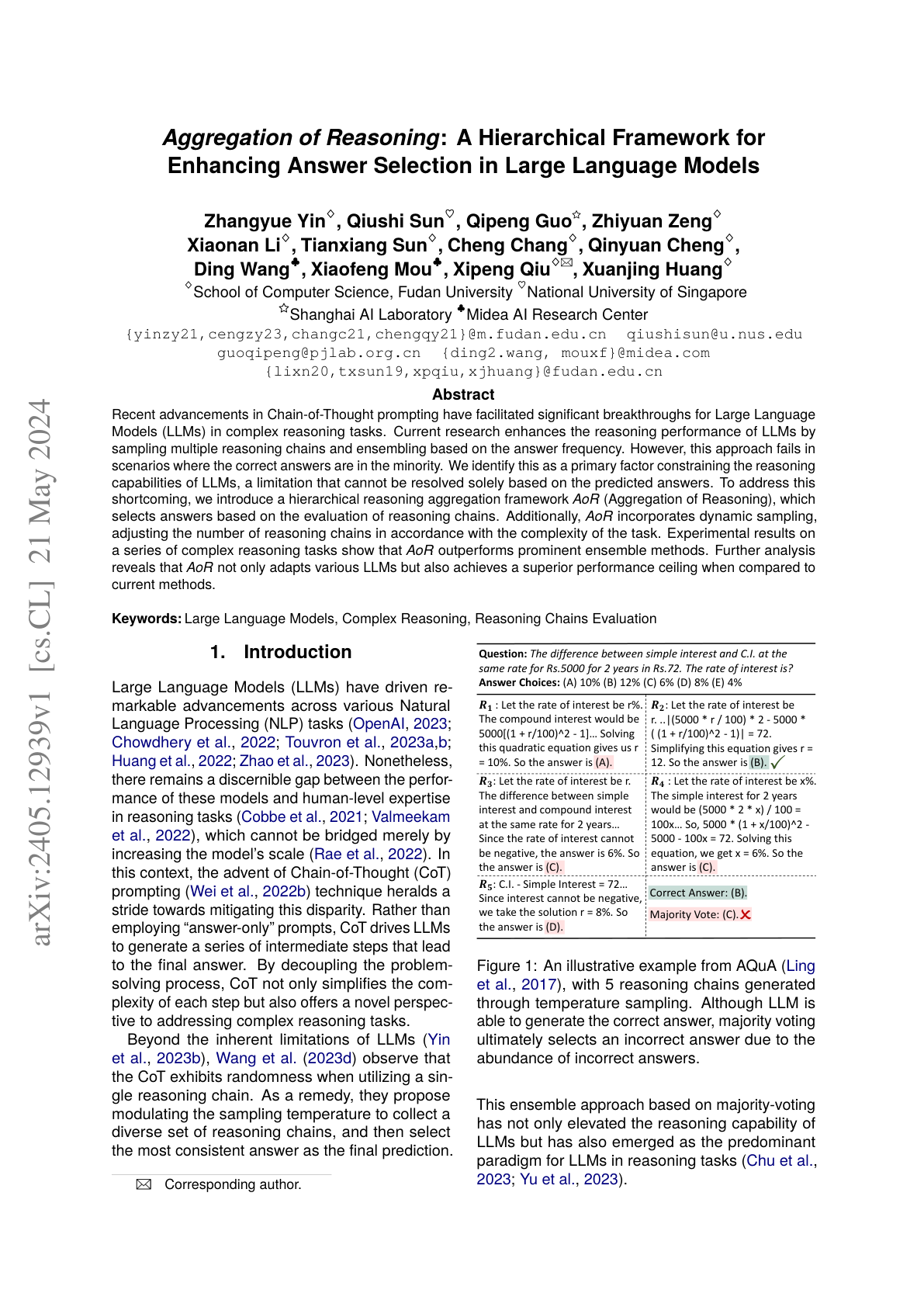
Enhancing Answer Selection in LLMs
proposes a hierarchical reasoning aggregation framework for improving the reasoning capabilities of LLMs; the approach, called Aggregation of Reasoning (AoR), selects answers based on the evaluation of reasoning chains; AoR uses dynamic sampling to adjust the number of reasoning chains with respect to the task complexity; it uses results from the evaluation phase to determine whether to sample additional reasoning chains; a known flaw of majority voting is that it fails in scenarios where the correct answer is in the minority; AoR focuses on evaluating the reasoning chains to improve the selection of the final answer; AoR outperforms various prominent ensemble methods and can be used with various LLMs to improve performance on complex reasoning tasks.
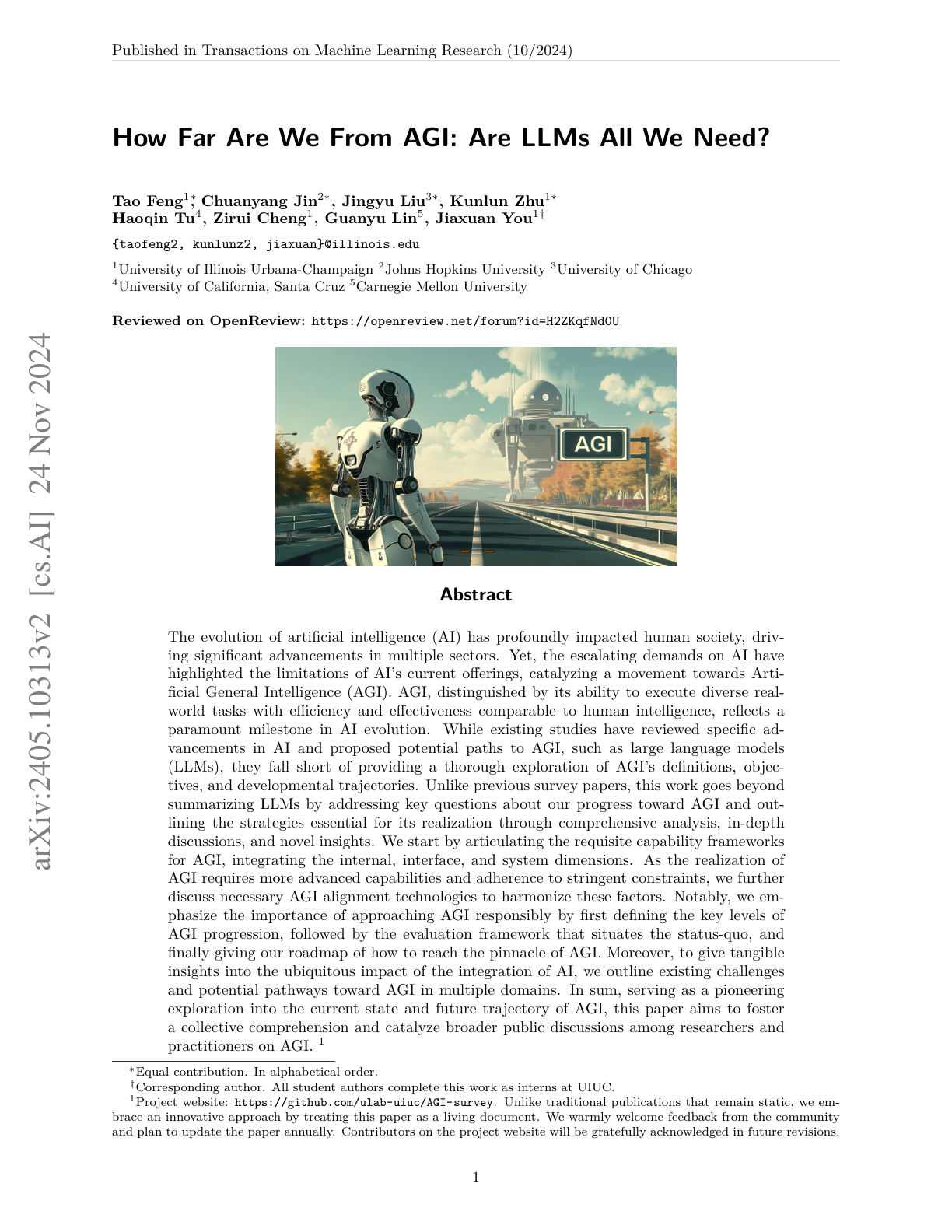
How Far Are We From AGI
presents an opinion paper addressing important questions to understand the proximity to artificial general intelligence (AGI); it provides a summary of strategies necessary to achieve AGI which includes a detailed survey, discussion, and original perspectives.
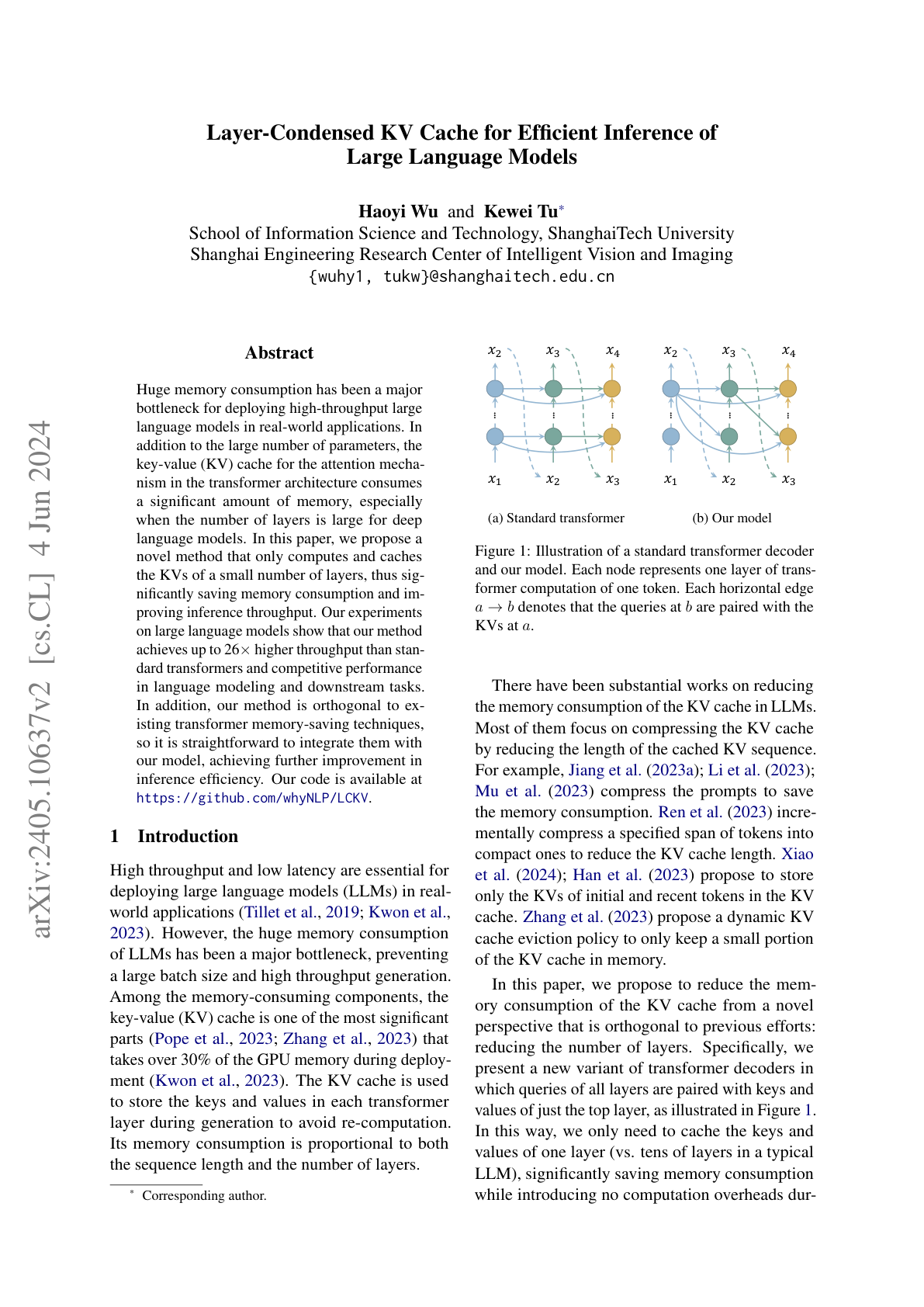
Efficient Inference of LLMs
proposes a layer-condensed KV cache to achieve efficient inference in LLMs; only computes and caches the key-values (KVs) of a small number of layers which leads to saving memory consumption and improved inference throughput; can achieve up to 26x higher throughput than baseline transformers while maintaining satisfactory performance.
Guide for Evaluating LLMs
provides guidance and lessons for evaluating large language models; discusses challenges and best practices, along with the introduction of an open-source library for evaluating LLMs.
Scientific Applications of LLMs
presents INDUS, a comprehensive suite of LLMs for Earth science, biology, physics, planetary sciences, and more; includes an encoder model, embedding model, and small distilled models.
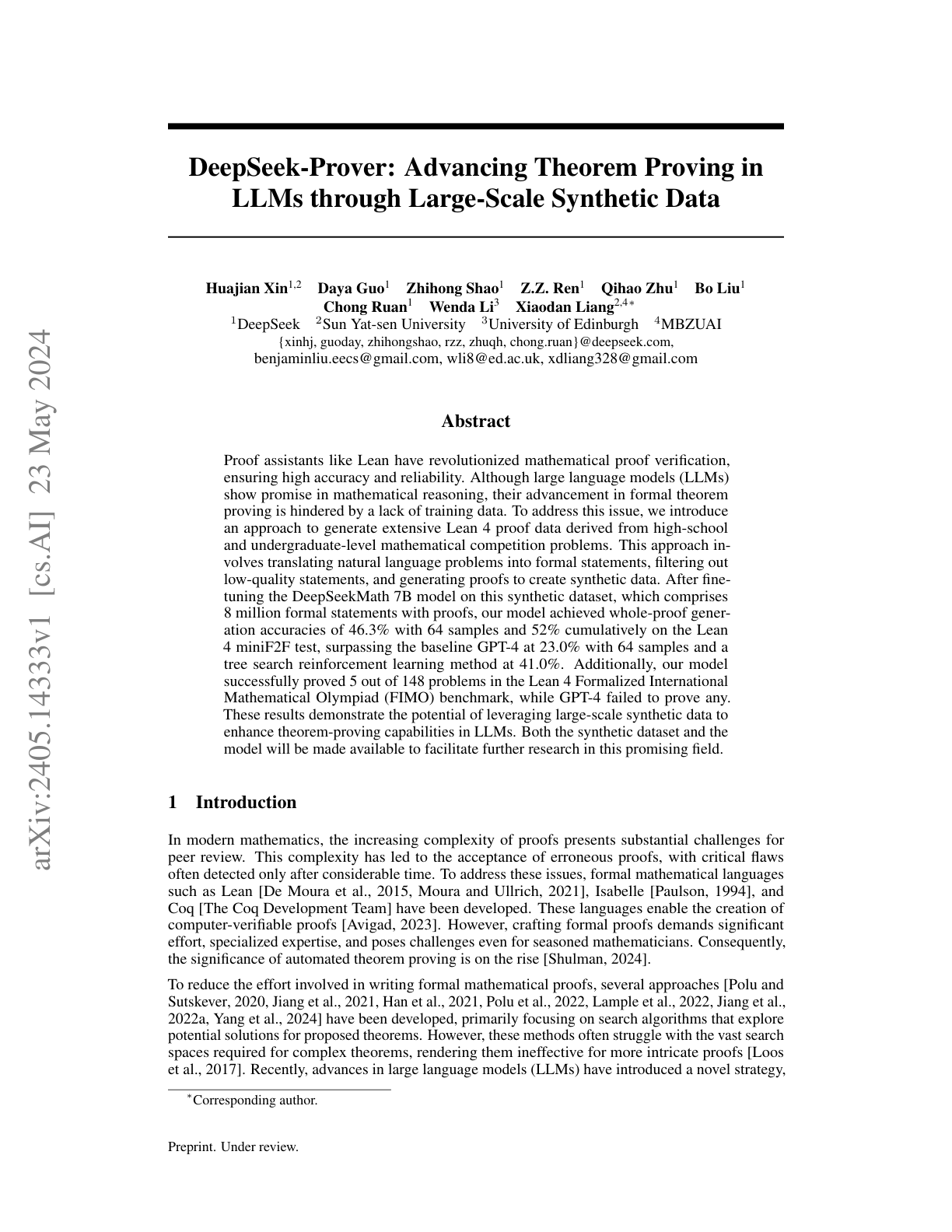
DeepSeek-Prover
introduces an approach to generate Lean 4 proof data from high-school and undergraduate-level mathematical competition problems; it uses the synthetic data, comprising of 8 million formal statements and proofs, to fine-tune a DeepSeekMath 7B model; achieves whole-proof generation accuracies of 46.3% with 64 samples and 52% cumulatively on the Lean 4 miniF2F test; this surpasses the baseline GPT-4 (23.0%) with 64 samples and a tree search RL method (41.0%).
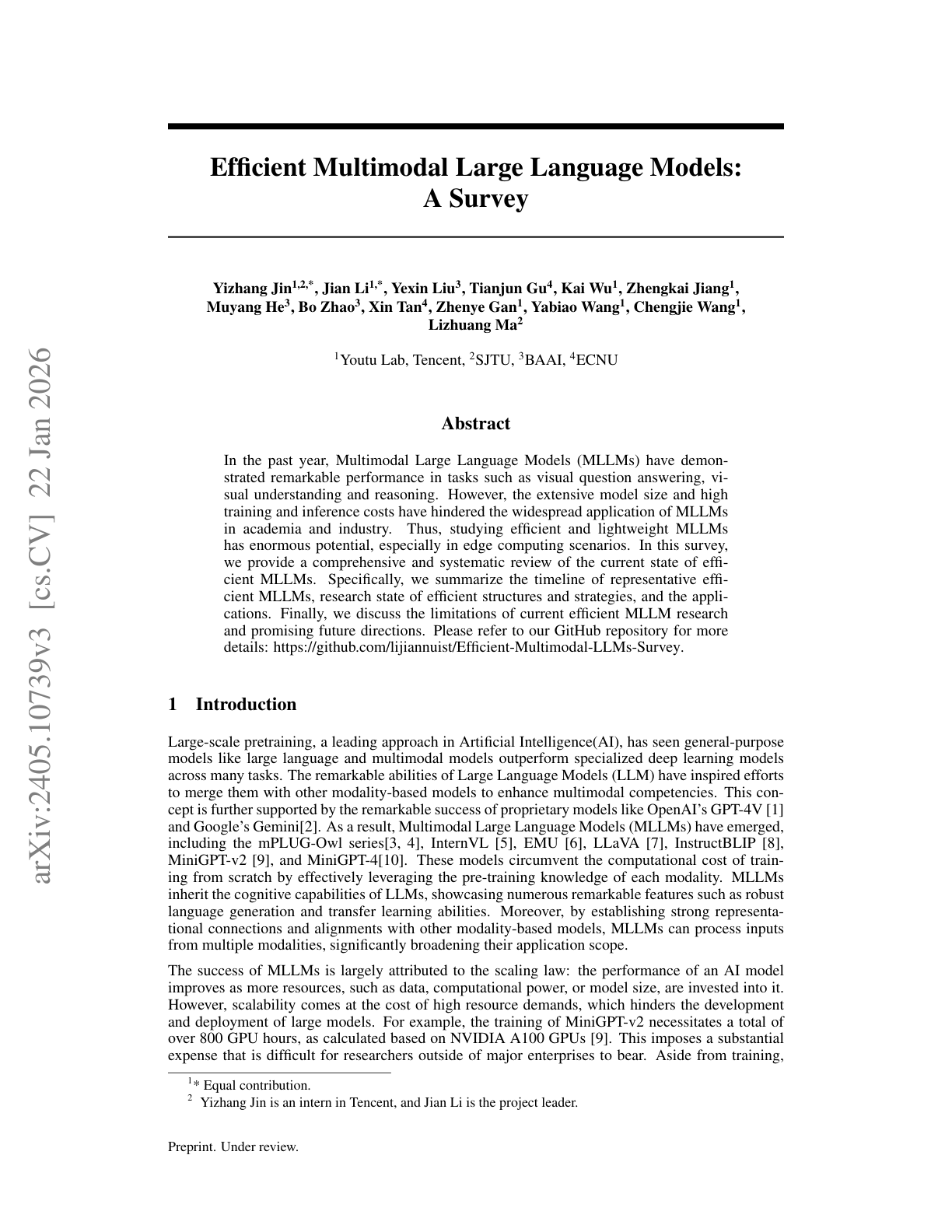
Efficient Multimodal LLMs
provides a comprehensive and systematic survey of the current state of efficient multimodal large language models; discusses efficient structures and strategies, applications, limitations, and promising future directions.