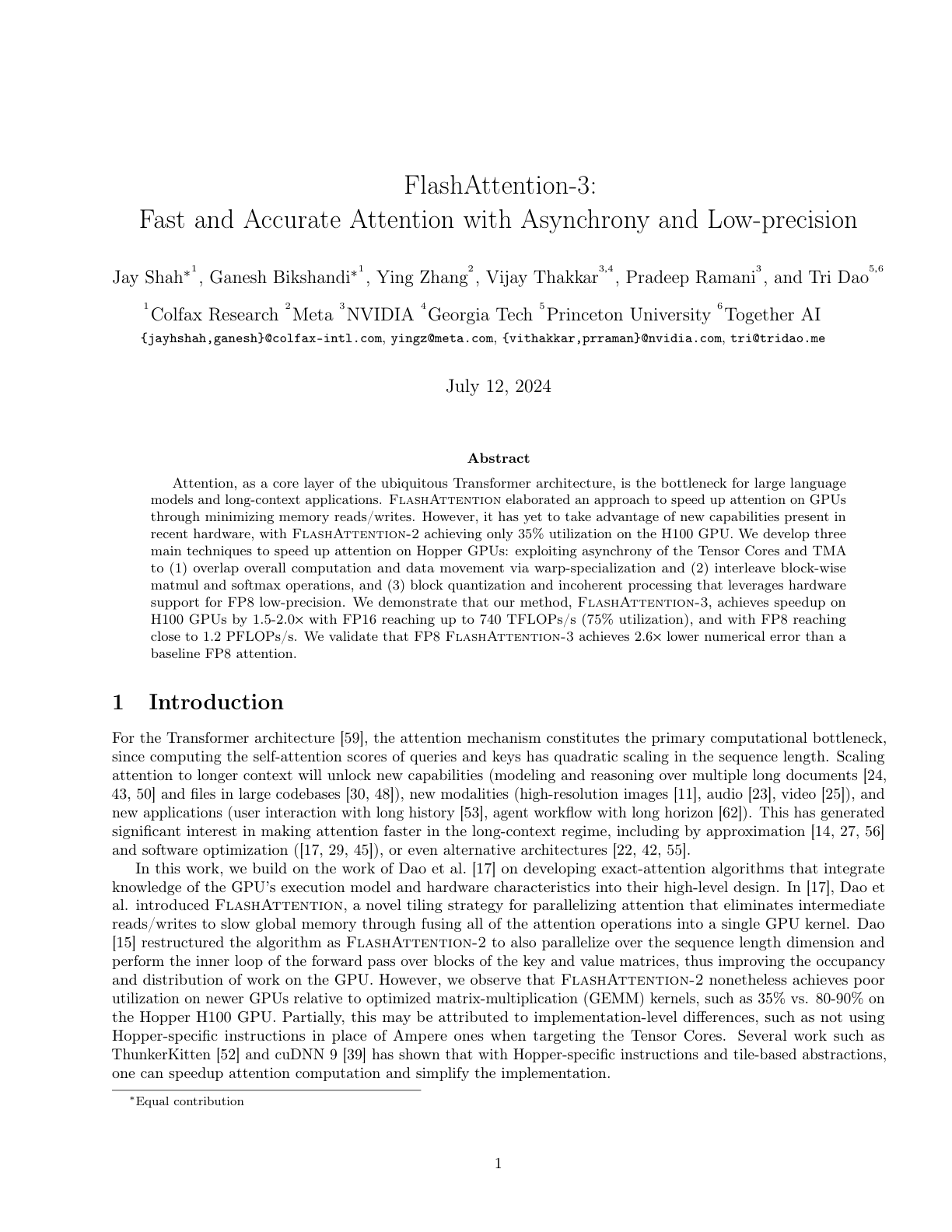
FlashAttention-3
proposes to adapt FlashAttention to take advantage of modern hardware; the techniques used to speed up attention on modern GPUs include producer-consumer asynchrony, interleaving block-wise matmul and softmax operations, and block quantization and incoherent processing; achieves speedup on H100 GPUs by 1.5-2.0x with FP16 reaching up to 740 TFLOPs/s (75% utilization), and with FP8 reaching close to 1.2 PFLOPs/s.
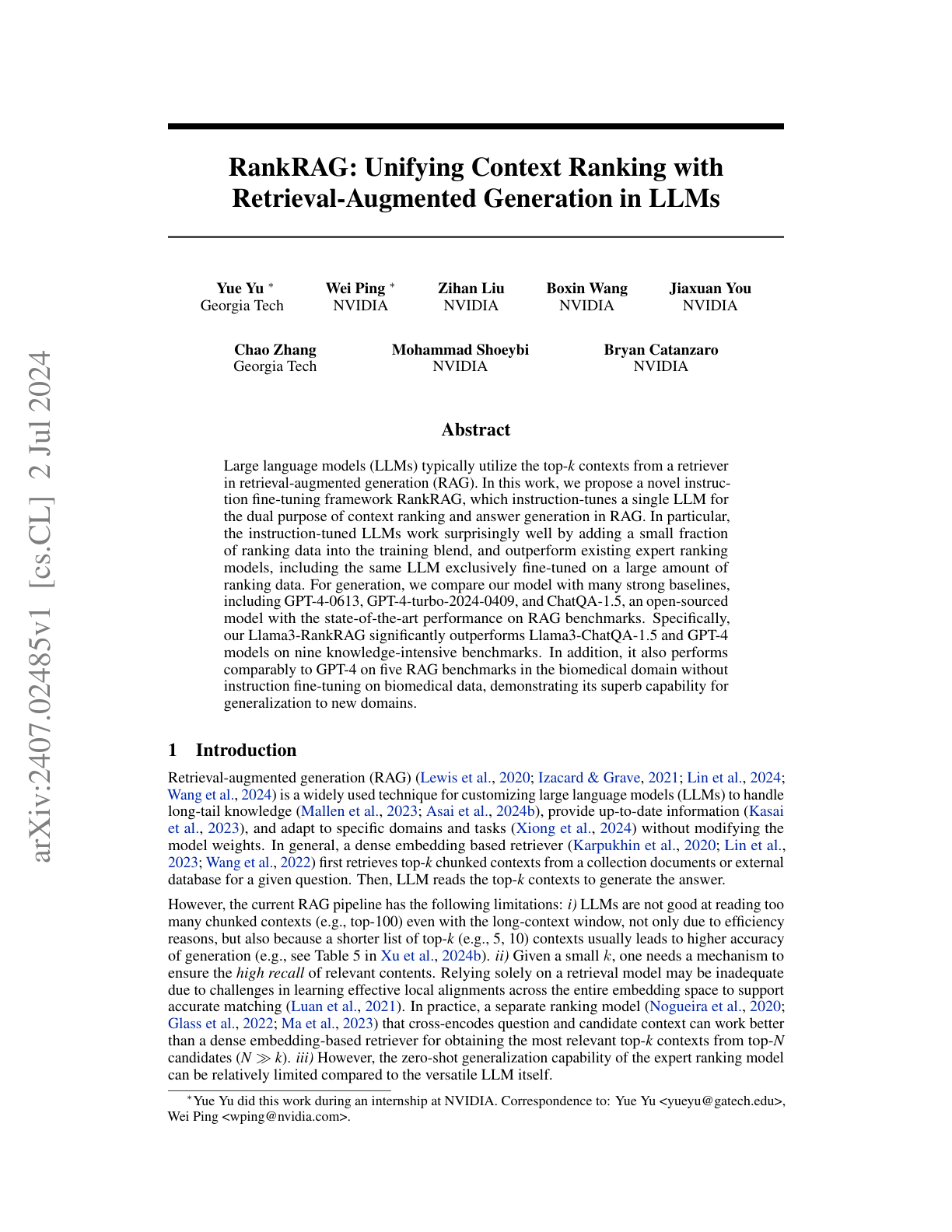
RankRAG
introduces a new instruction fine-tuning framework to perform effective context ranking and answering generation to enhance an LLM’s RAG capabilities; it leverages a small ranking dataset to outperform existing expert ranking models; shows that a Llama3-RankRAG significantly outperforms Llama3-ChatQA-1.5 and GPT-4 models on nine knowledge-intensive benchmarks.
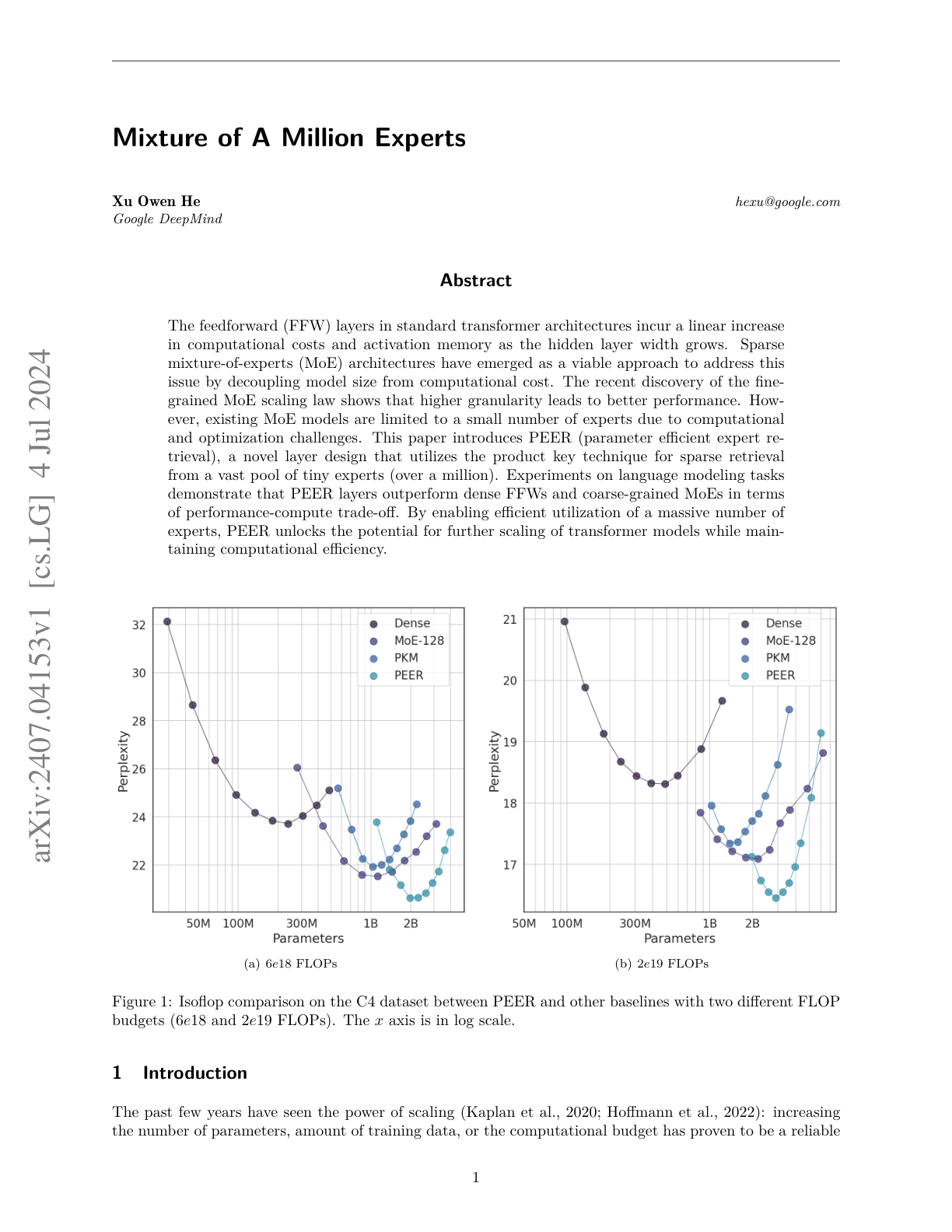
Mixture of A Million Experts
introduces a parameter-efficient expert retrieval mechanism that leverages the product key technique for sparse retrieval from a million tiny experts; it attempts to decouple computational cost from parameter count by efficiently routing to a very large number of tiny experts through a learned index structure used for routing; demonstrates superior efficiency compared to dense FFW, coarse-grained MoEs, and Product Key Memory (PKM) layers.
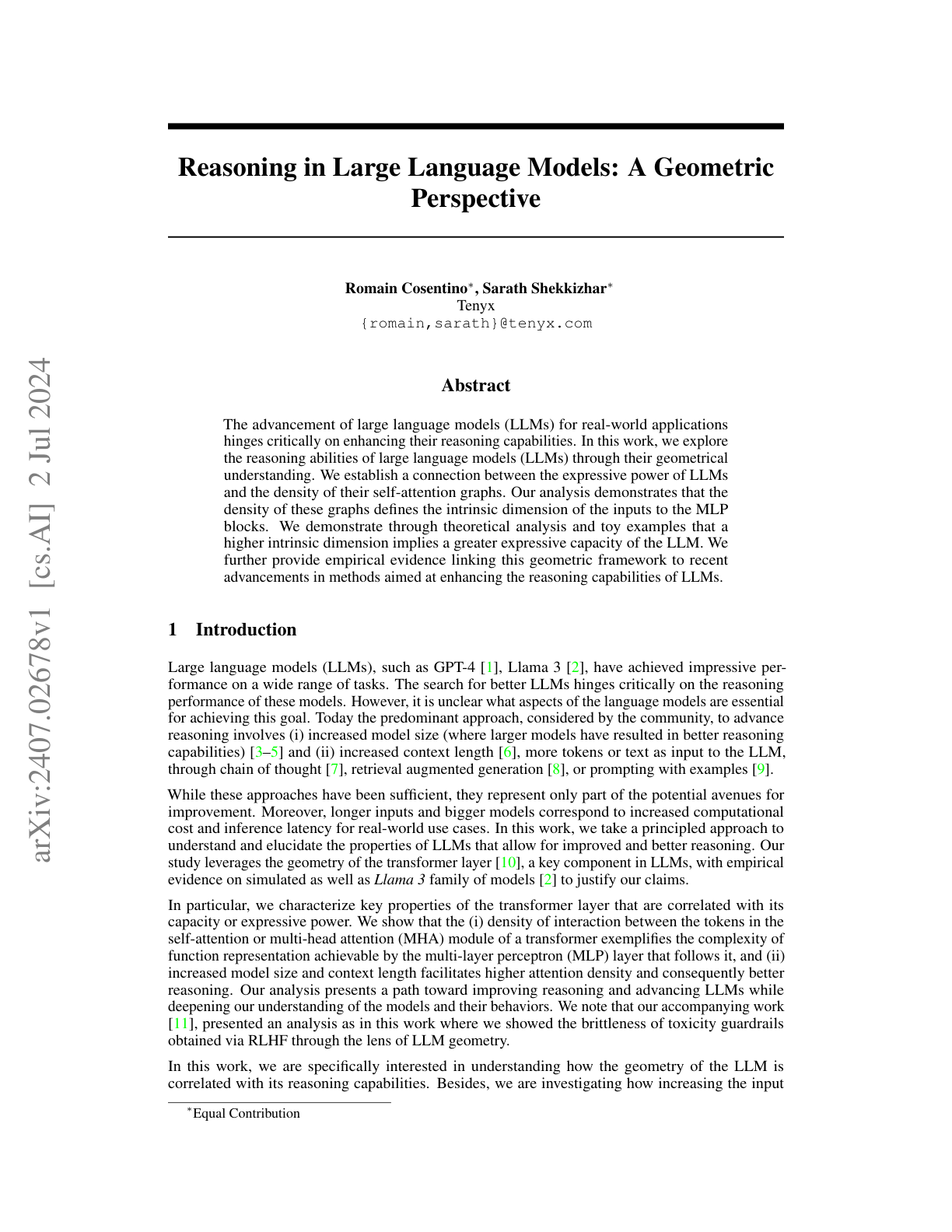
Reasoning in LLMs: A Geometric Perspective
explores the reasoning of LLMs from a geometrical perspective; reports that a higher intrinsic dimension implies greater expressive capacity of the LLM; reports that they establish a connection between the expressive power of LLMs and the density of their self-attention graphs; their analysis demonstrates that the density of these graphs defines the intrinsic dimension of the inputs to the MLP blocks.
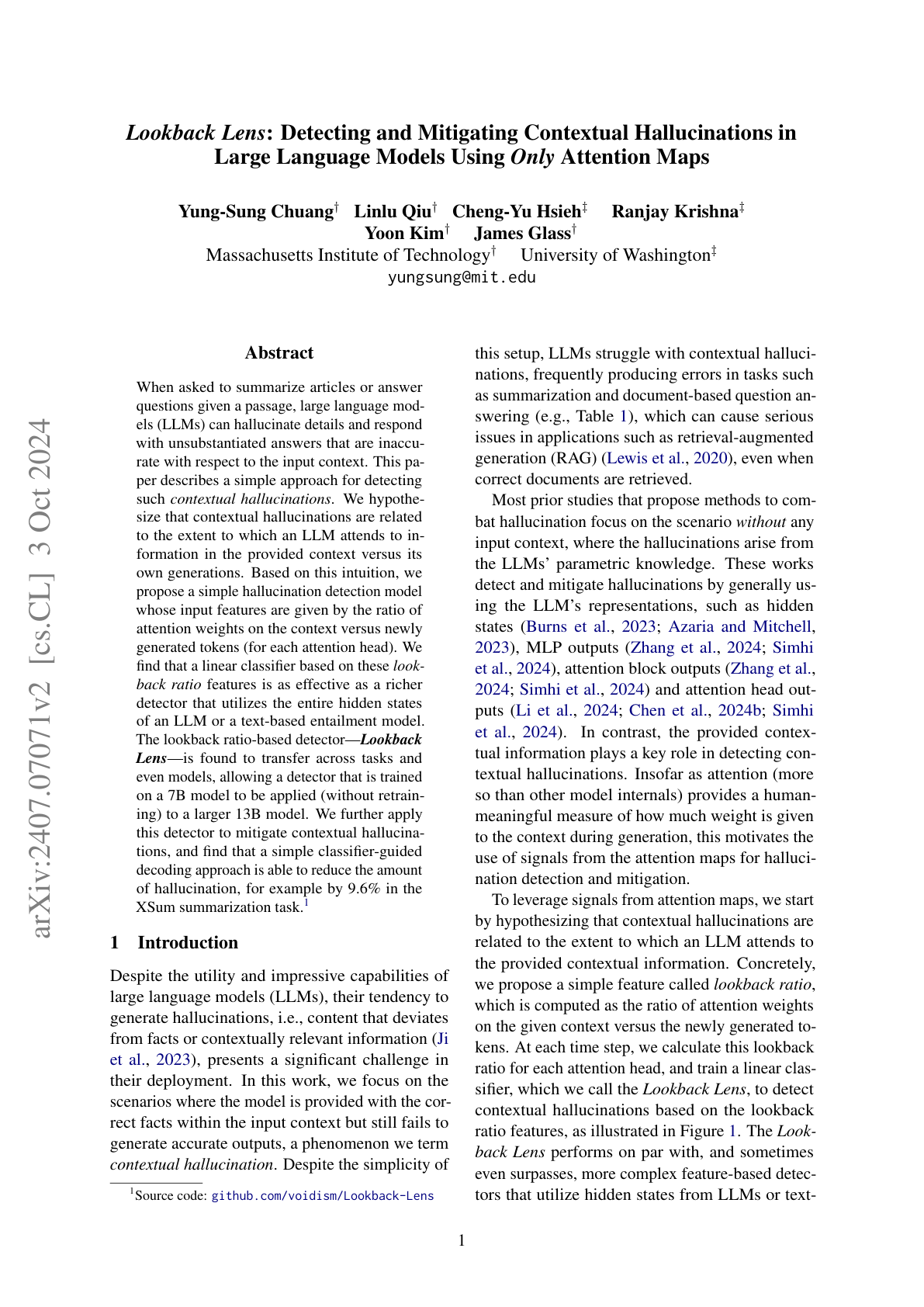
Contextual Hallucinations Mitigation in LLMs
proposes a new method that detects and significantly reduces contextual hallucinations in LLMs (e.g., reduces by 10% in the XSum summarization task); builds a hallucination detection model based on input features given by the ratio of attention weights on the context vs. newly generated tokens (for each attention head); the hypothesis is that contextual hallucinations are related to the extent to which an LLM attends to the provided contextual information; they also propose a decoding strategy based on their detection method which mitigates the contextual hallucination; the detector can also be transferred across models without the need for retraining.
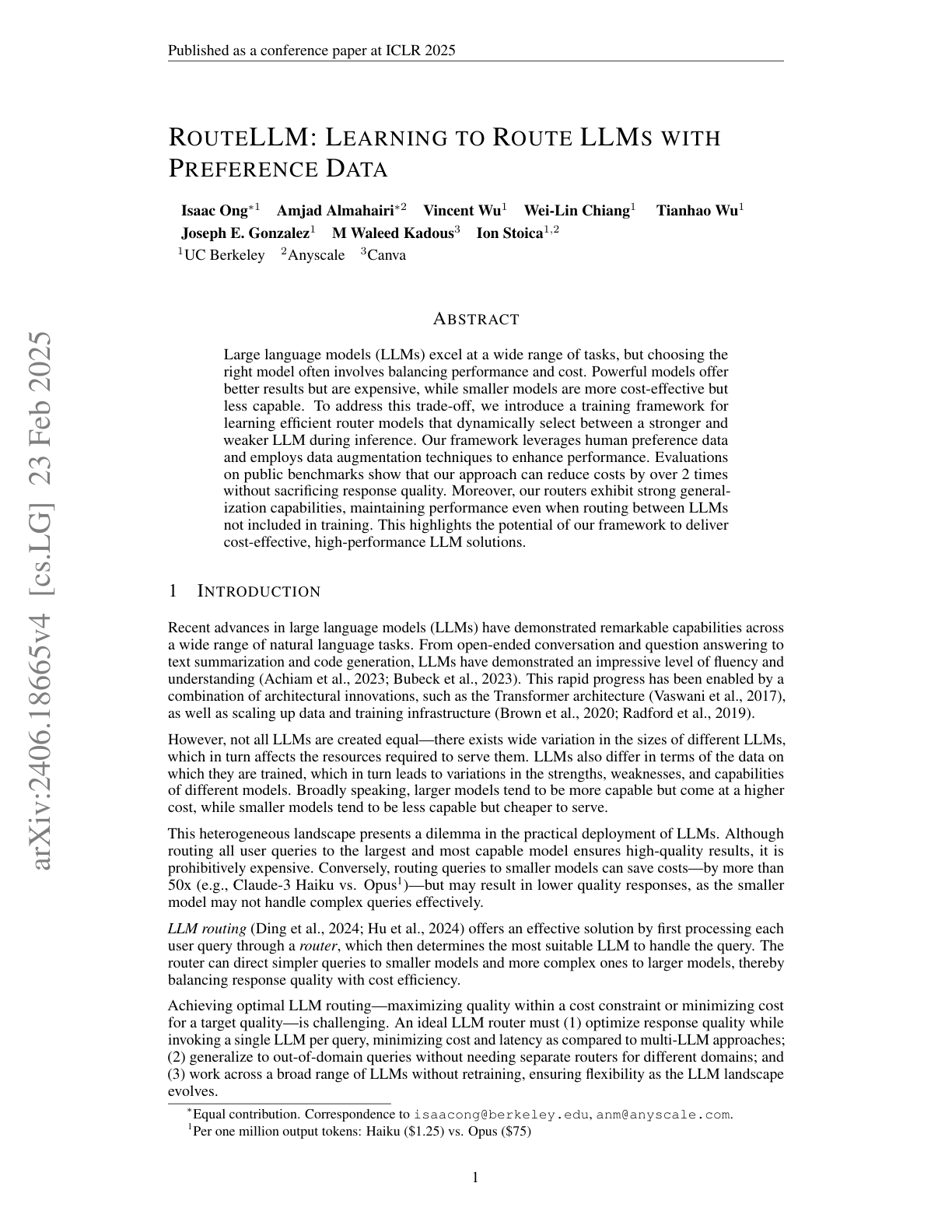
RouteLLM
proposes efficient router models to dynamically select between stronger and weak LLMs during inference to achieve a balance between cost and performance; the training framework leverages human preference data and data augmentation techniques to boost performance; shows to significantly reduce costs by over 2x in certain cases while maintaining the quality of responses.
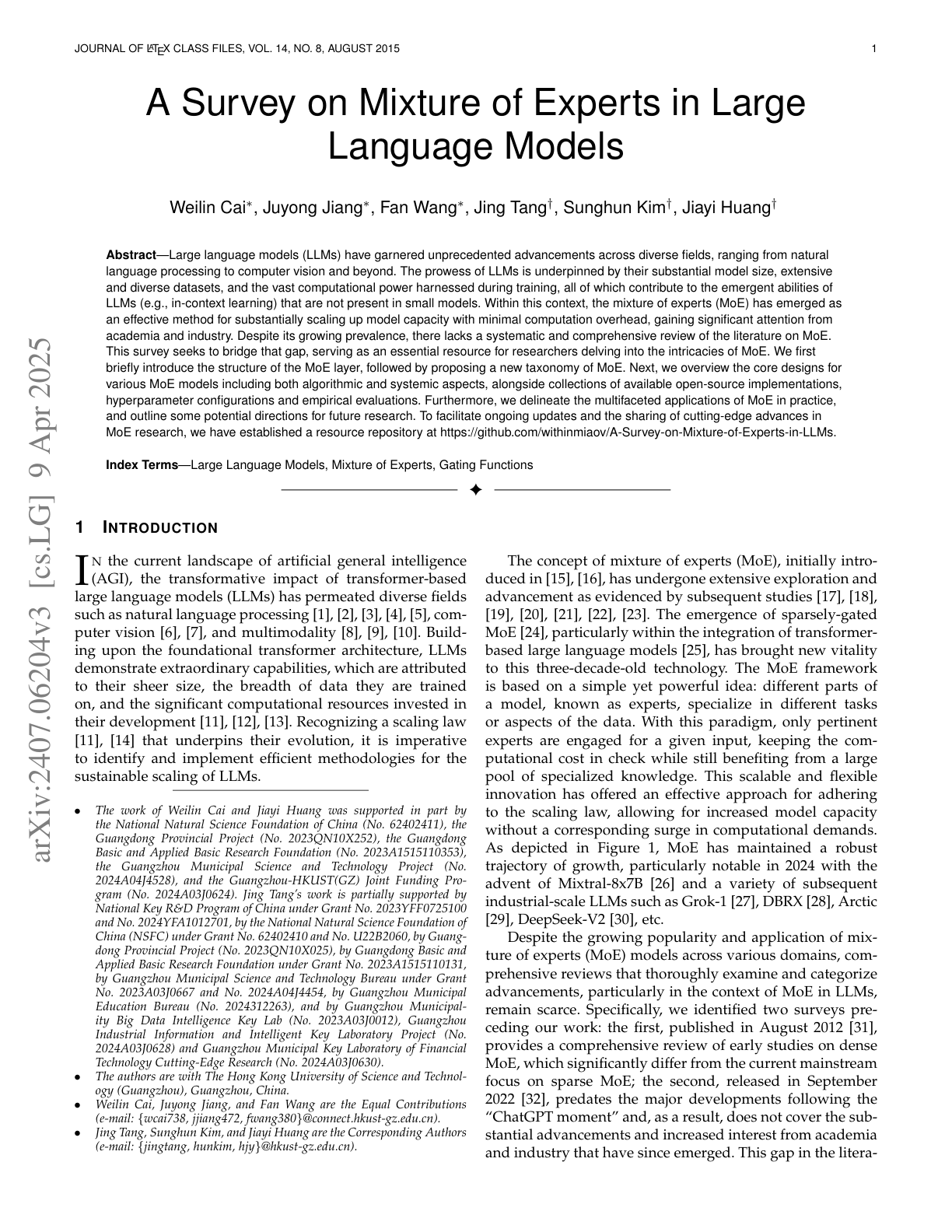
A Survey on Mixture of Experts
a survey paper on Mixture of Experts (MoE), including the technical details of MoE, open-source implementations, evaluation techniques, and applications of MoE in practice.
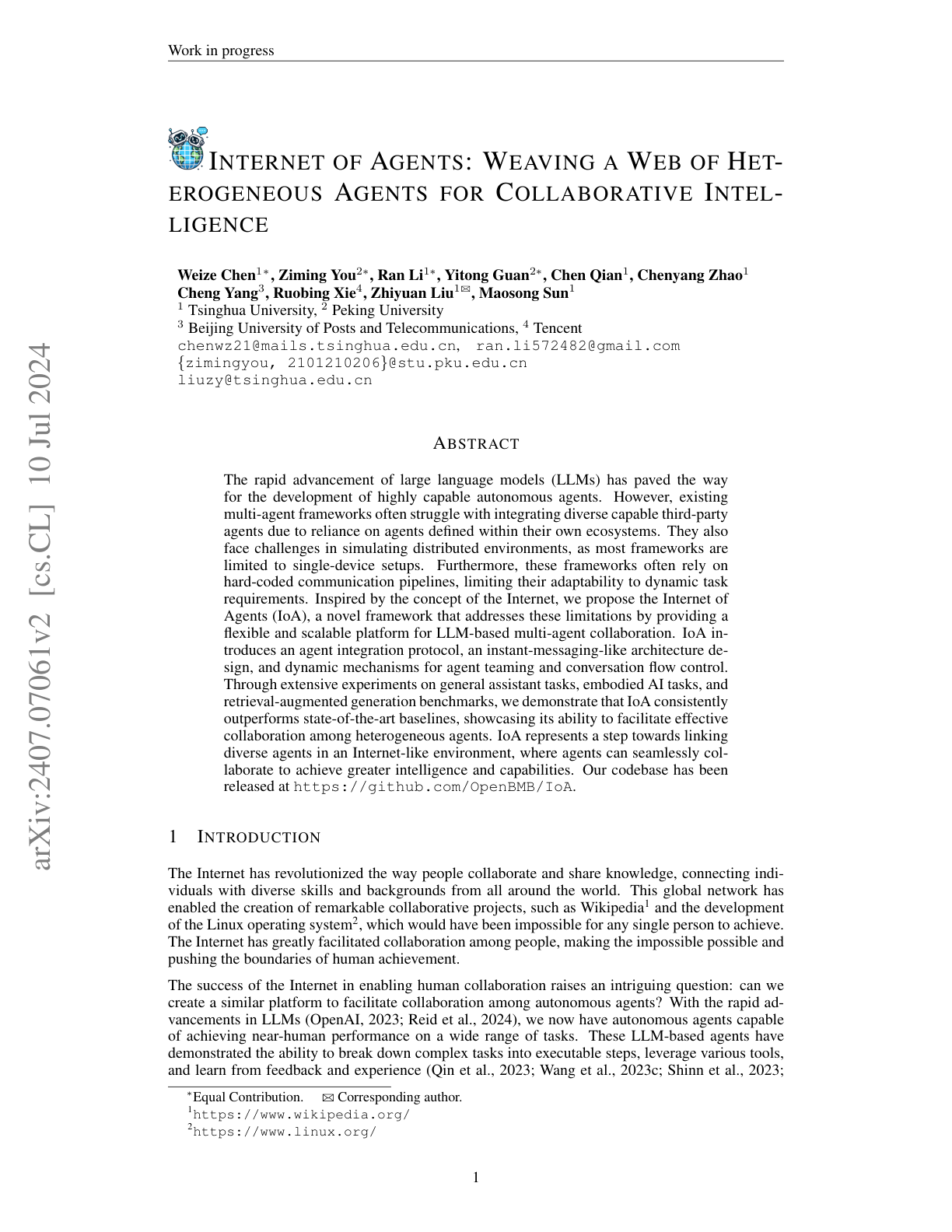
Internet of Agents
a new framework to address several limitations in multi-agent frameworks such as integrating diverse third-party agents and adaptability to dynamic task requirements; introduces an agent integration protocol, instant messaging architecture design, and dynamic mechanisms for effective collaboration among heterogeneous agents.
3DGen
a new pipeline for end-to-end text-to-3D asset generation in under a minute; integrates state-of-the-art components like AssetGen and TextureGen to represent 3D objects in three ways, namely view space, in volumetric space, and in UV space; achieves a win rate of 68% with respect to the single-stage model.
Learning at Test Time
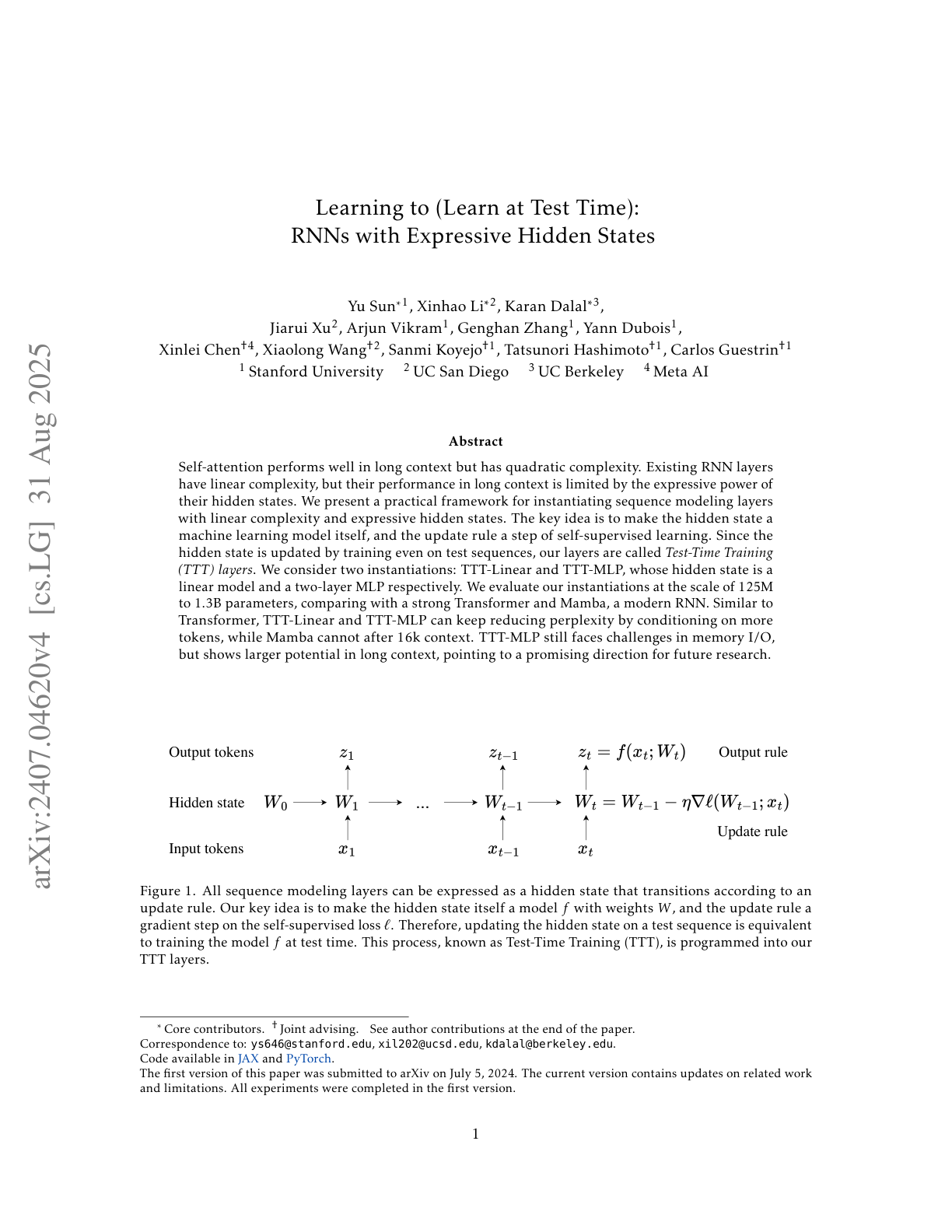
proposes new sequence modeling layers with linear complexity and an expressive hidden state; defines a hidden state as an ML model itself capable of updating even on test sequence; by a linear model and a two-layer MLP based hidden state is found to match or exceed baseline models like Transformers, Mamba, and modern RNNs; the linear model is faster than Transformer at 8k context and matches Mamba in wall-clock time.