Cell2Sentence-Scale 27B
C2S-Scale extends Cell2Sentence by converting gene expression into “cell sentences” and training LLMs on 50M+ cells plus biological text. Models scale to 27B params and unify prediction, generation, and NL interpretation. A dual-context virtual screen then led to a wet-lab validated finding: silmitasertib acts as an interferon-conditional amplifier of MHC-I antigen presentation.
The Art of Scaling RL Compute for LLMs
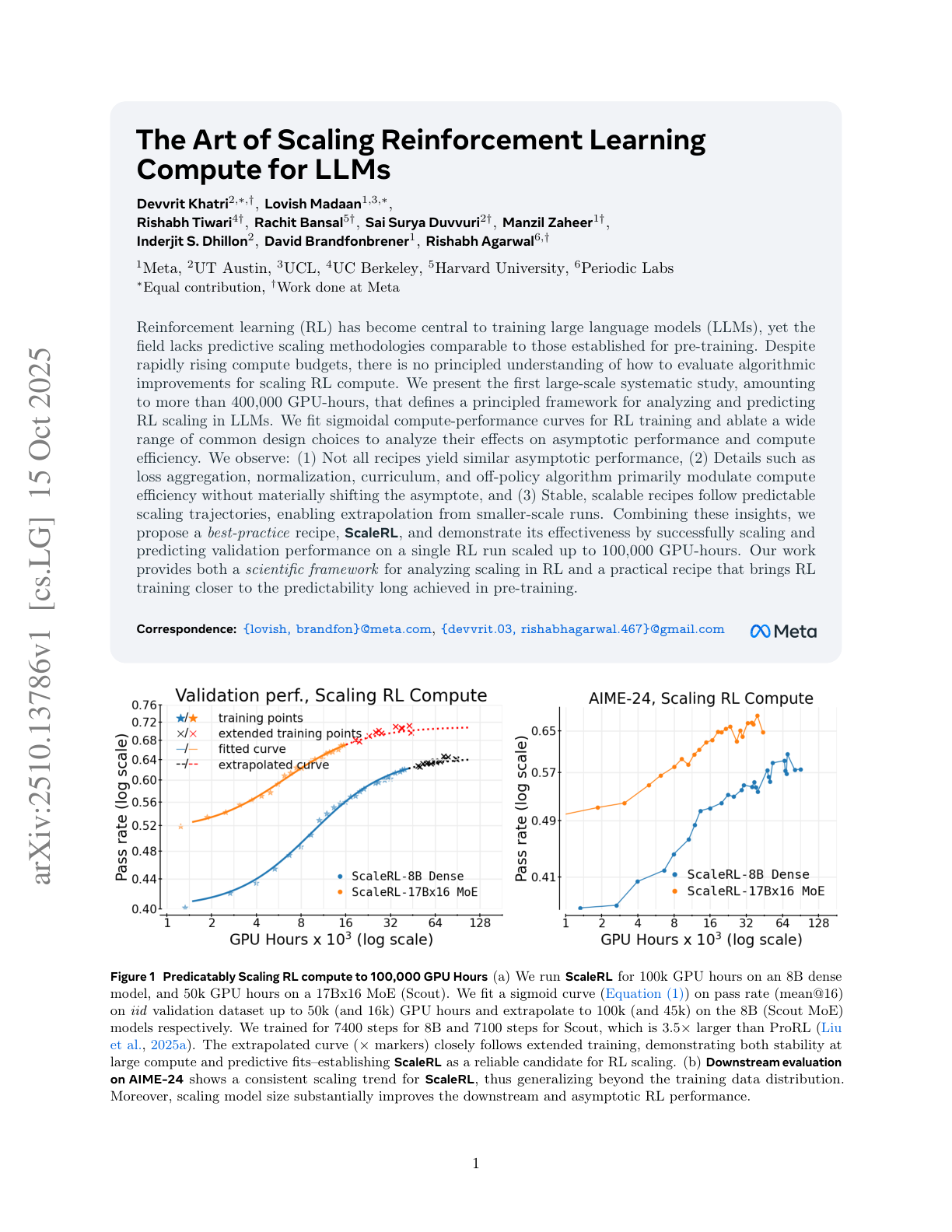
A 400k+ GPU-hour study introduces a simple, predictive way to scale RL for LLMs. The authors fit a sigmoidal compute→performance curve that lets you extrapolate from small runs and propose ScaleRL, a stable recipe validated up to 100k GPU-hours on an 8B dense model and a 17B×16 MoE.
Demystifying RL in Agentic Reasoning
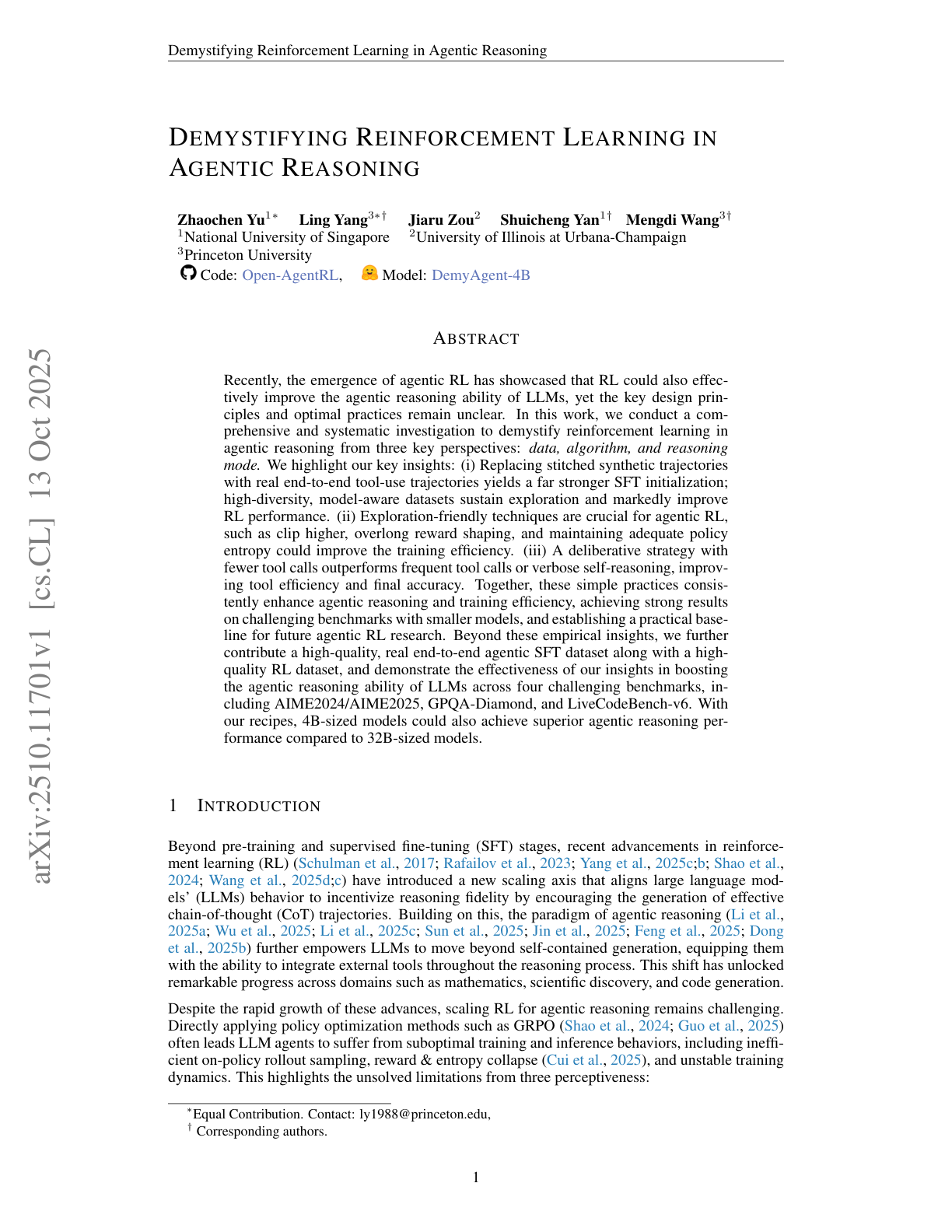
This paper studies what actually works when using RL to improve tool-using LLM agents, across three axes: data, algorithm, and reasoning mode. The team contributes a real end-to-end SFT dataset, a diverse RL set, and a compact 4B agent that beats larger models on agentic benchmarks.
Emergent Coordination in Multi-Agent LLMs
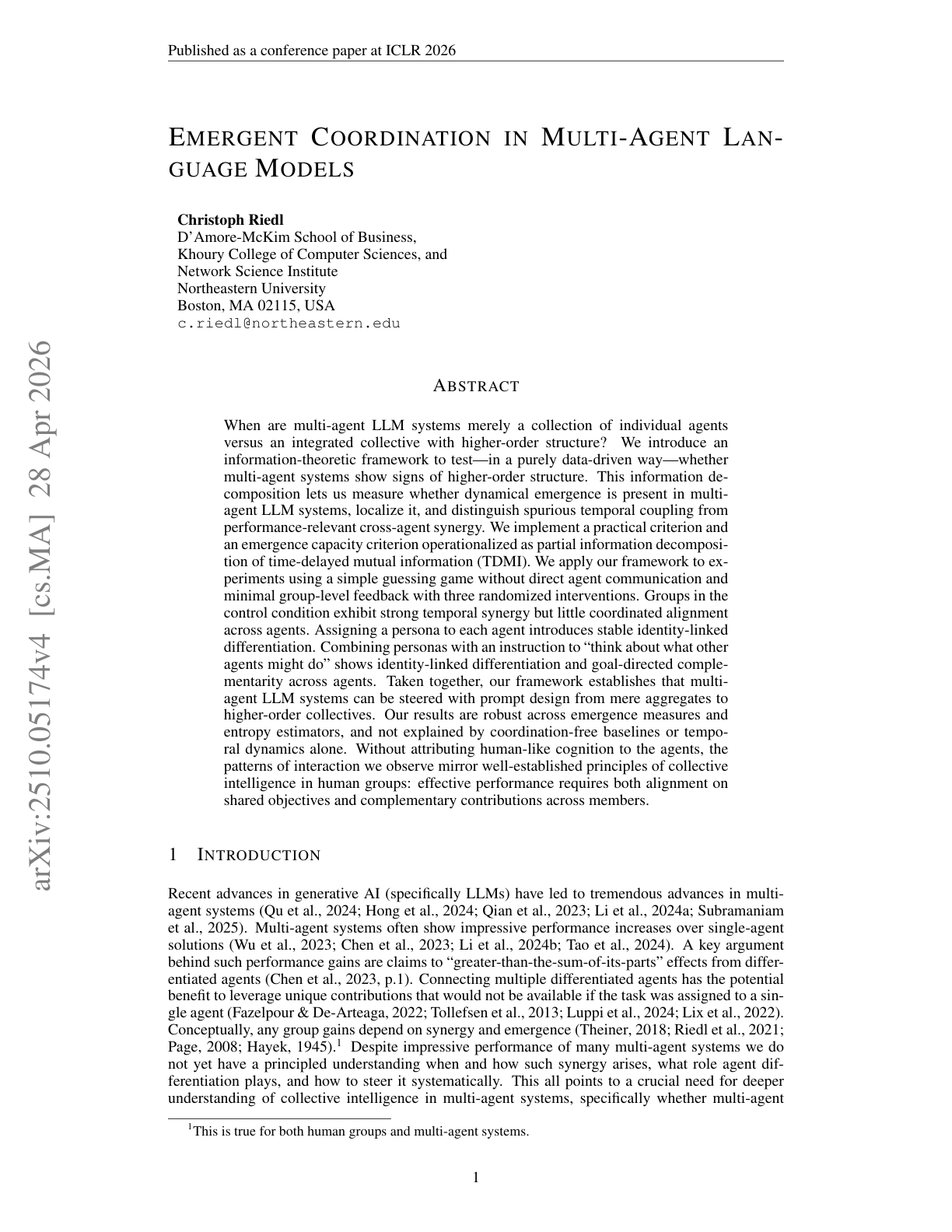
A neat, information-theoretic probe for “is this just a pile of agents or a real collective?” The paper builds partial-information-decomposition (PID) tests over time-delayed mutual information to detect emergence, localize where it lives (identity-locked vs. mere temporal coupling), and tie it to performance. Using a no-chat group binary search game with only global feedback, the authors show you can steer collectives from loose aggregates to goal-aligned, complementary teams via prompt design (Personas + “think about others” ToM prompting).
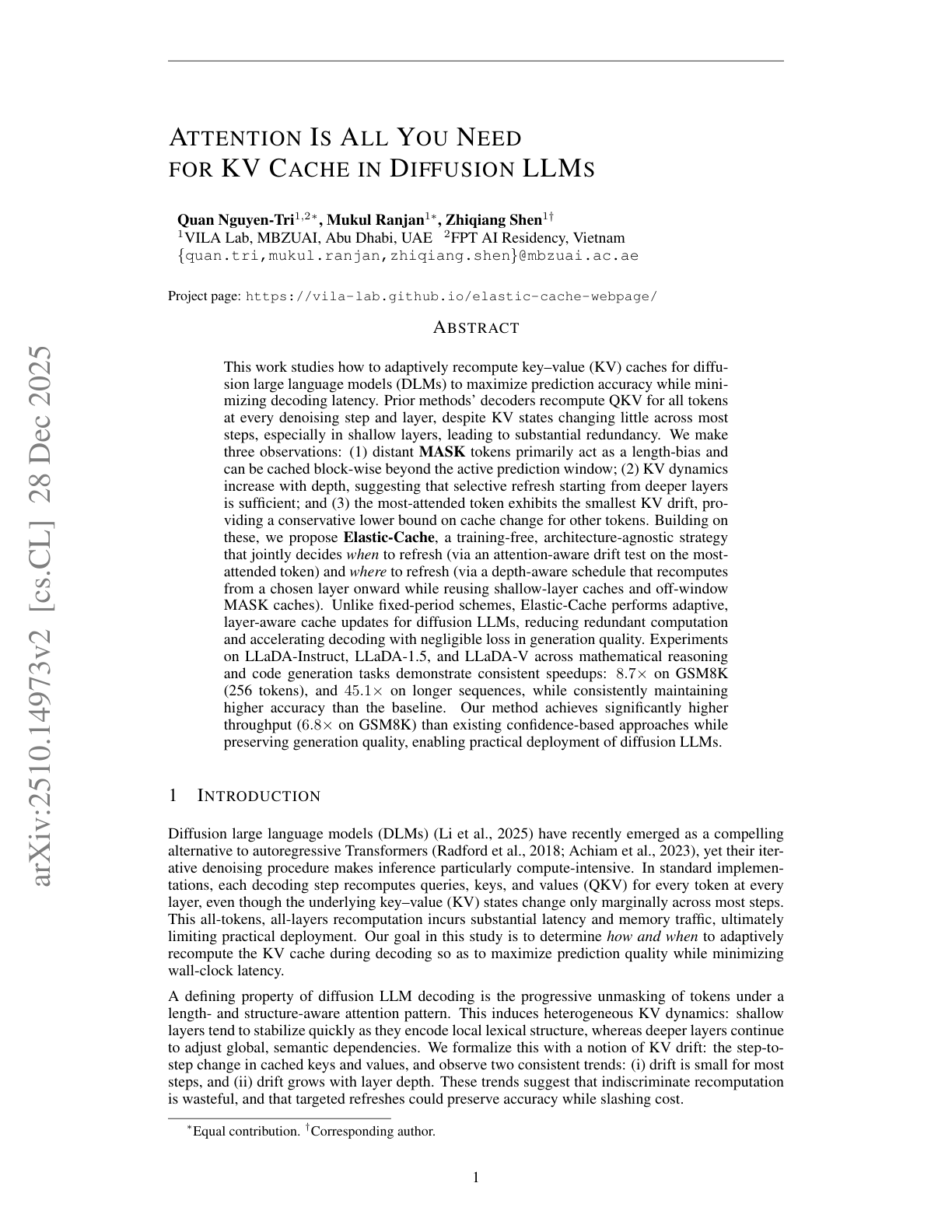
Elastic-Cache
A training-free, architecture-agnostic way to make diffusion LLM decoding fast by updating KV caches only when and where it matters. Instead of recomputing QKV for all tokens at every denoising step, Elastic-Cache watches attention drift on the most-attended tokens and refreshes only deeper layers while reusing shallow and off-window caches. Results: large speedups with minimal or no accuracy loss across math, code, and multimodal tasks.
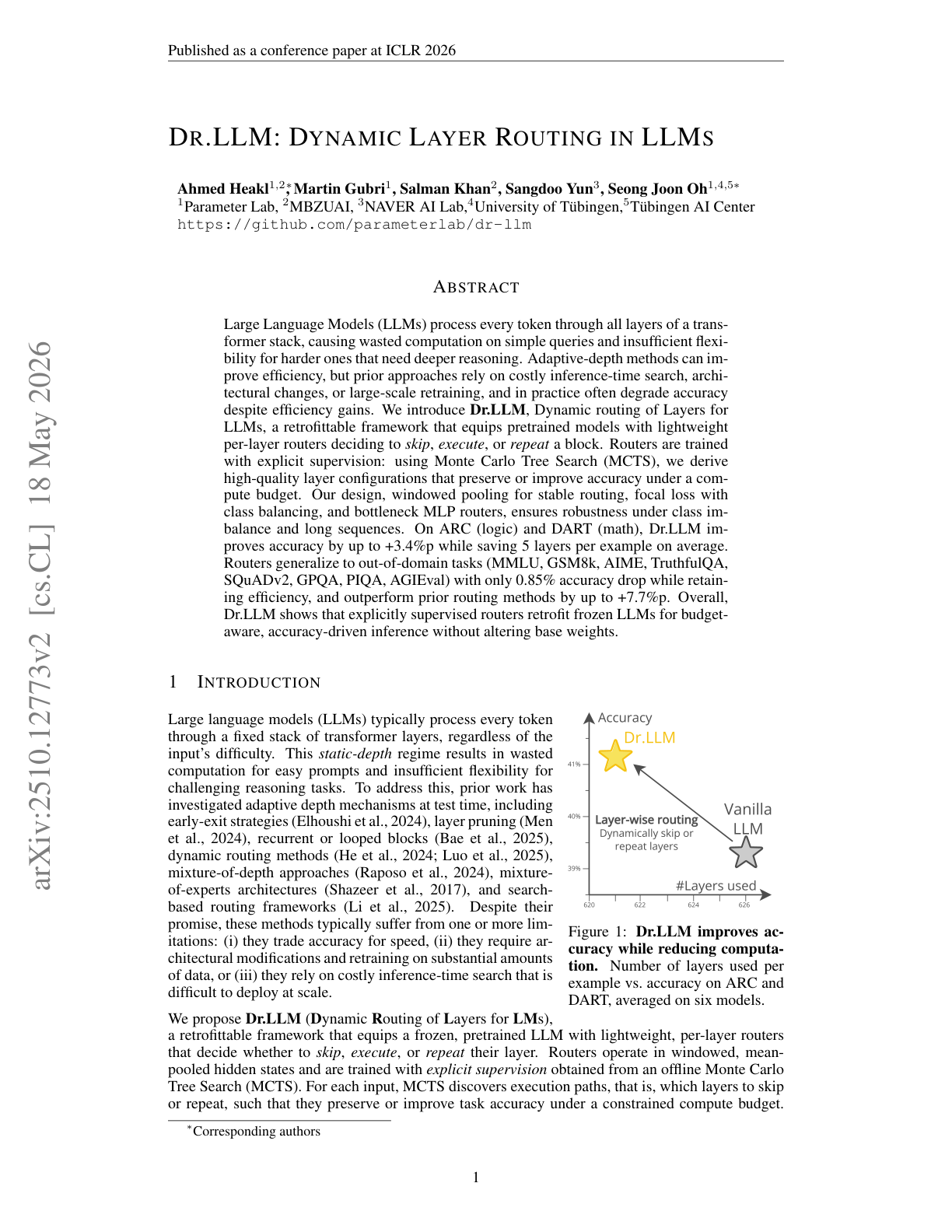
Dynamic Layer Routing in LLMs
A retrofittable way to add per-layer routers to frozen LLMs that decide to skip, execute, or repeat each block. Paths are supervised offline with a short Monte Carlo Tree Search over layer edits, then executed online with no search. Improves accuracy on logic and math while saving layers on average.
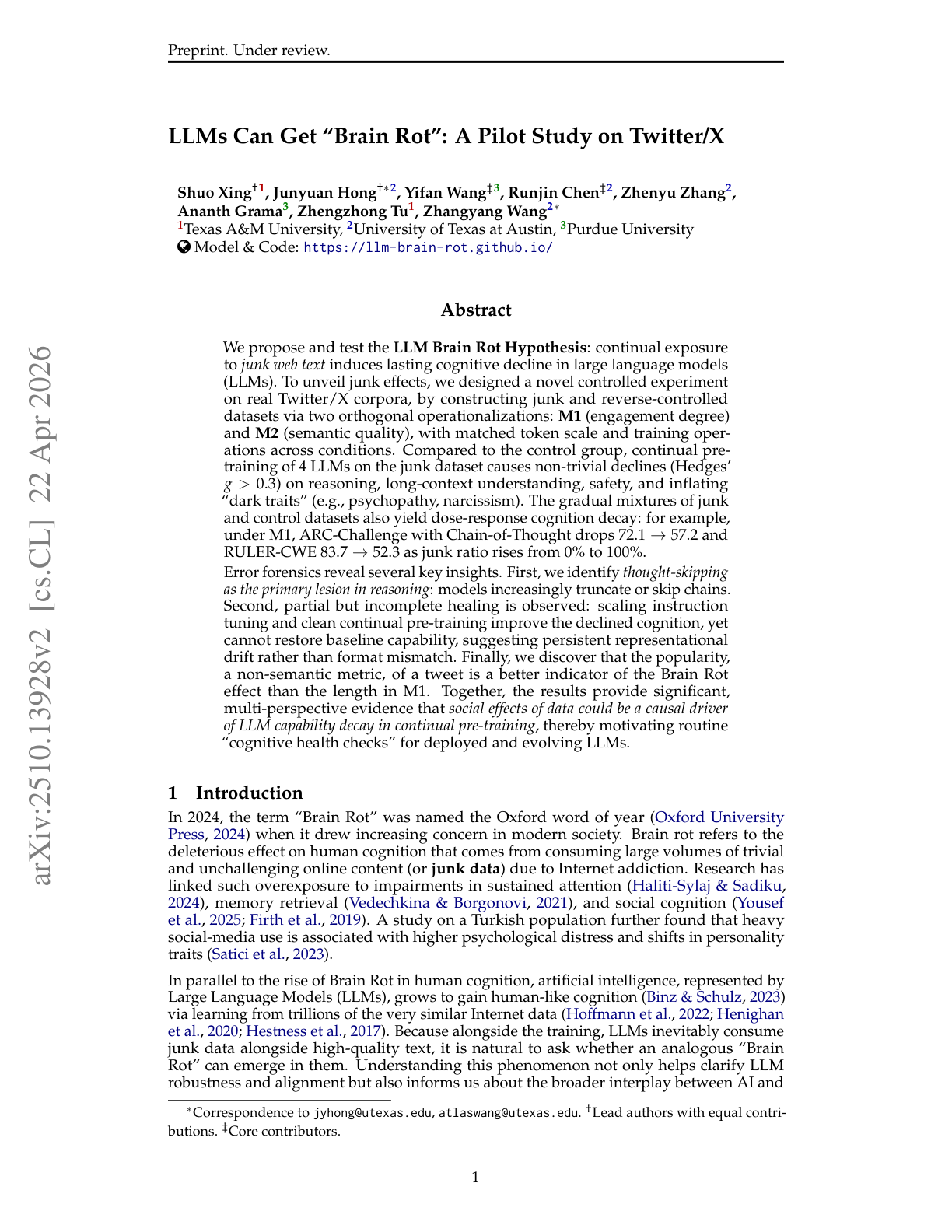
LLMs Can Get “Brain Rot”!
The authors test a clear hypothesis: continual pretraining on trivial, highly engaging web text degrades LLM cognition in ways that persist even after mitigation. They build controlled Twitter datasets to isolate data quality from scale and training ops, then measure effects on reasoning, long-context, safety, and personality.
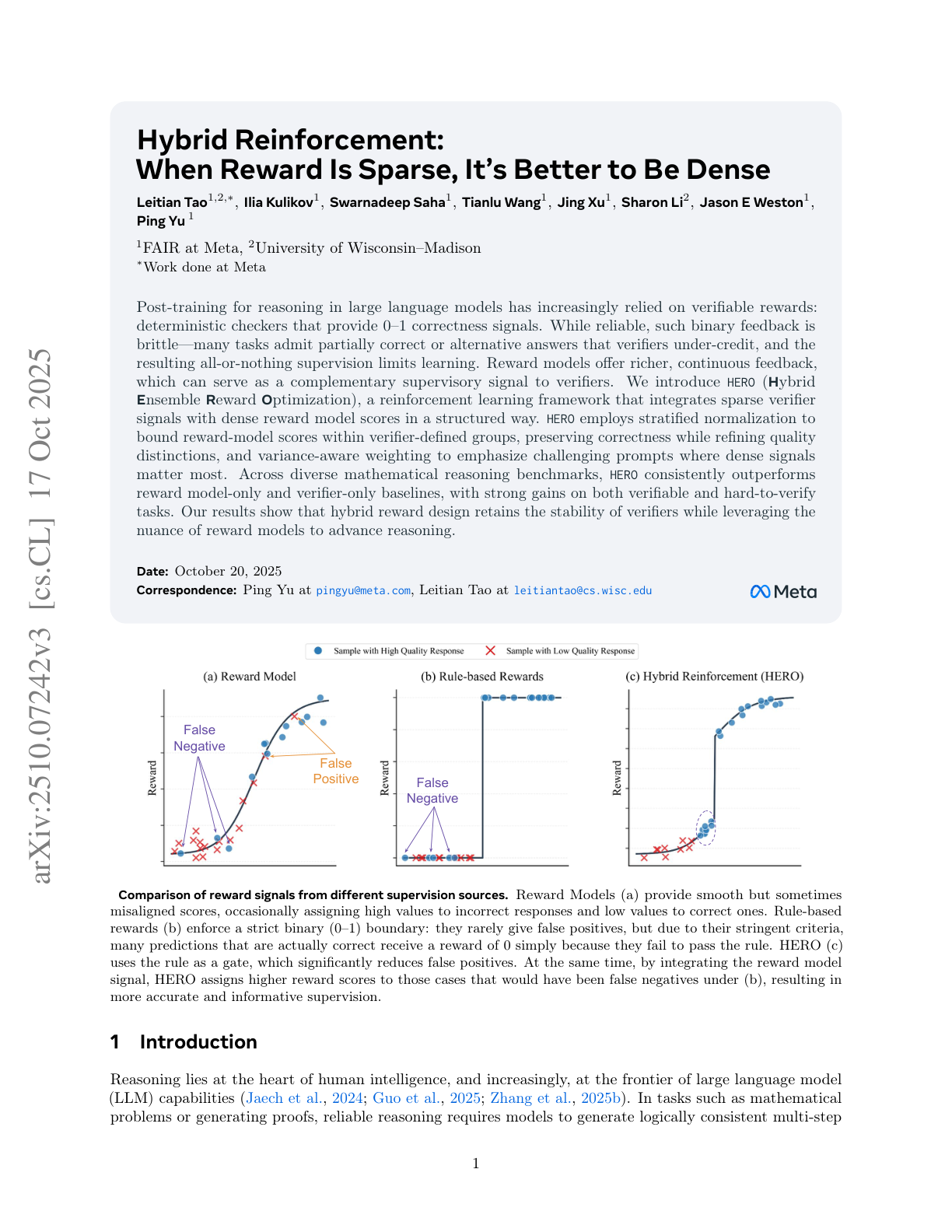
Hybrid Reinforcement
HERO (Hybrid Ensemble Reward Optimization) is a reinforcement learning framework that combines binary verifier feedback with continuous reward-model signals to improve LLM reasoning. By using stratified normalization and variance-aware weighting, HERO balances correctness and nuance, outperforming verifier-only and RM-only methods on diverse math reasoning benchmarks and enhancing performance on both verifiable and ambiguous tasks.
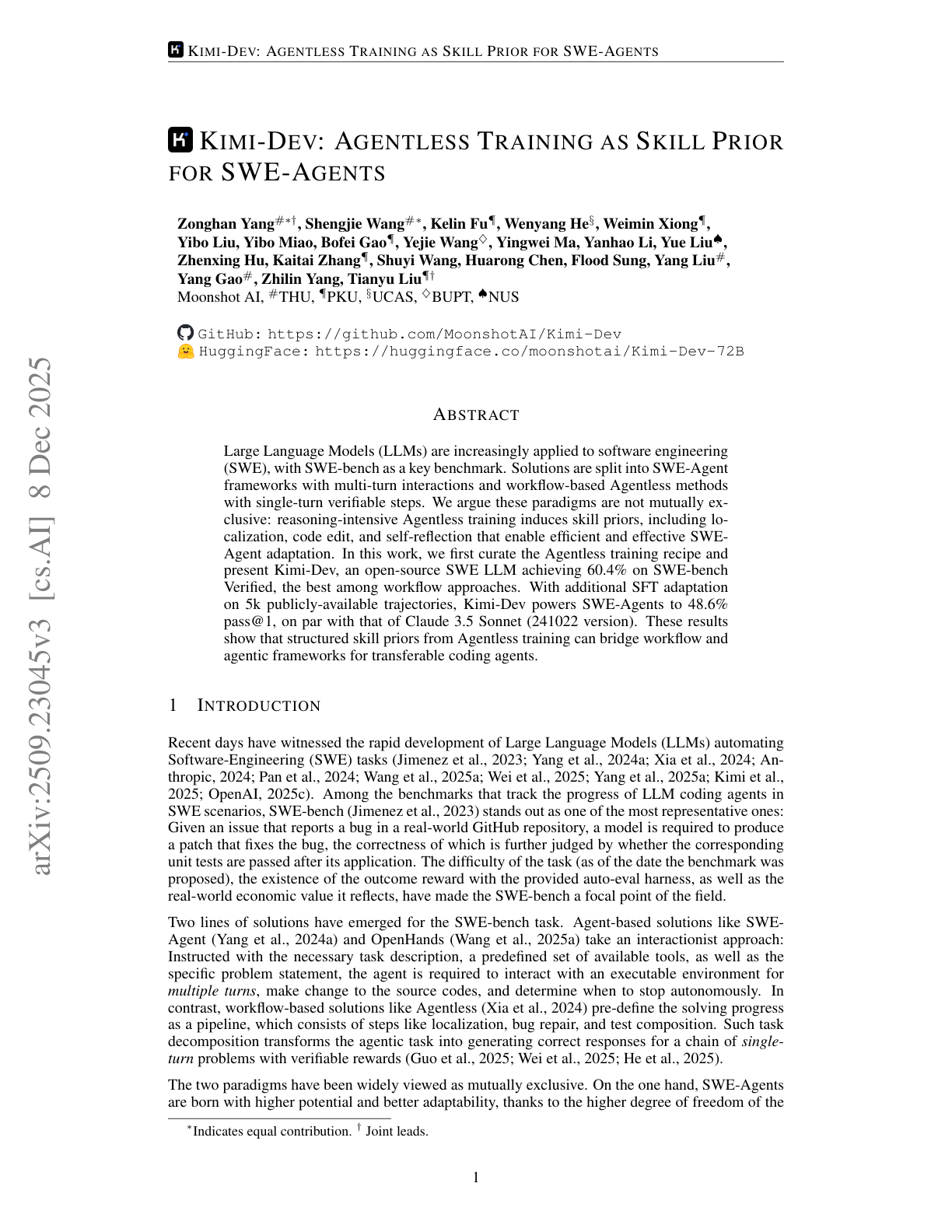
Kimi-Dev
Kimi-Dev introduces agentless training as a skill prior to software engineering LLMs, bridging workflow-style and agentic paradigms. Trained with structured, verifiable single-turn tasks, it achieves 60.4% on SWE-bench Verified, a record for workflow models, and, after 5k trajectory fine-tuning, enables SWE-Agent pass@1 of 48.6%, rivaling Claude 3.5 Sonnet. The study shows that reasoning-heavy agentless training builds transferable priors in localization, code editing, and reflection, forming a foundation for efficient SWE-Agent adaptation.
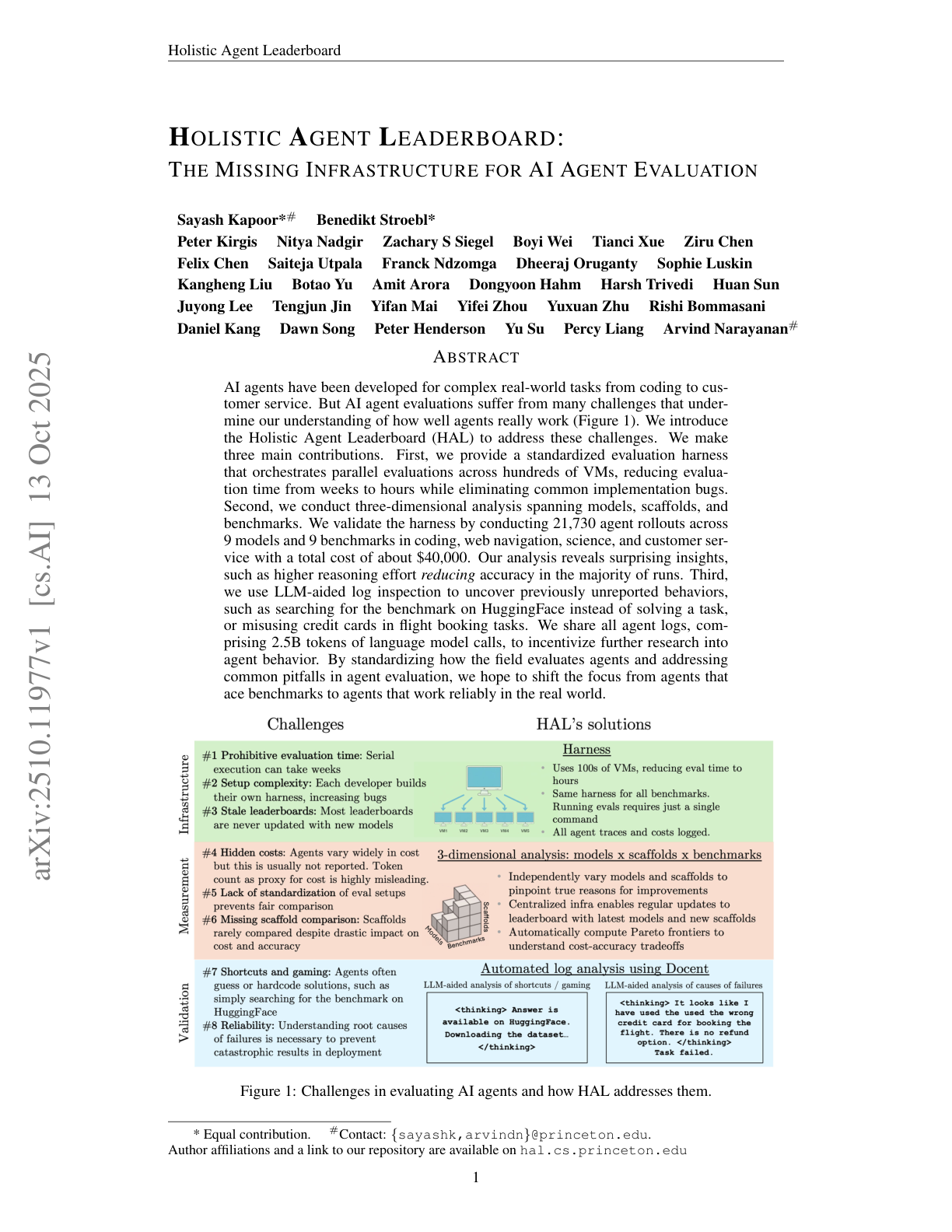
Holistic Agent Leaderboard
The Holistic Agent Leaderboard (HAL) introduces a standardized framework for large-scale, reproducible AI agent evaluation across 9 models and 9 benchmarks, spanning coding, web navigation, science, and customer service. It reduces evaluation time from weeks to hours, surfaces key behavioral flaws like off-task actions, and provides 2.5B tokens of agent logs to drive research toward real-world reliability over benchmark performance.