Hyperagents
Self-improving AI systems promise to reduce reliance on human engineering, but existing approaches rely on fixed, handcrafted meta-level mechanisms that fundamentally limit how fast they can improve. Hyperagents introduce self-referential agents that integrate a task agent and a meta agent into a single editable program, enabling the system to improve not just its task-solving behavior but also the mechanism that generates future improvements.
Agentic AI and the Next Intelligence Explosion
A new report from Google researchers argues that the AI “singularity” framed as a single superintelligent mind bootstrapping to godlike intelligence is fundamentally wrong. Drawing on evolution, sociology, and recent advances in agentic AI, the authors make the case that every prior intelligence explosion in human history was social, not individual, and that the next one will follow the same pattern.
ARC-AGI-3
Francois Chollet and the ARC Prize Foundation introduce ARC-AGI-3, an interactive benchmark for studying agentic intelligence through novel, abstract, turn-based environments. Unlike its predecessors, ARC-AGI-3 requires agents to explore, infer goals, build internal models of environment dynamics, and plan effective action sequences without explicit instructions, making it the only unsaturated general agentic intelligence benchmark as of March 2026.
Claudini
Researchers demonstrate that an autoresearch-style pipeline powered by Claude Code can autonomously discover novel adversarial attack algorithms for LLMs that significantly outperform all 30+ existing methods. The work, called Claudini, shows that incremental safety and security research can be effectively automated using LLM agents, with white-box red-teaming being a particularly well-suited domain.
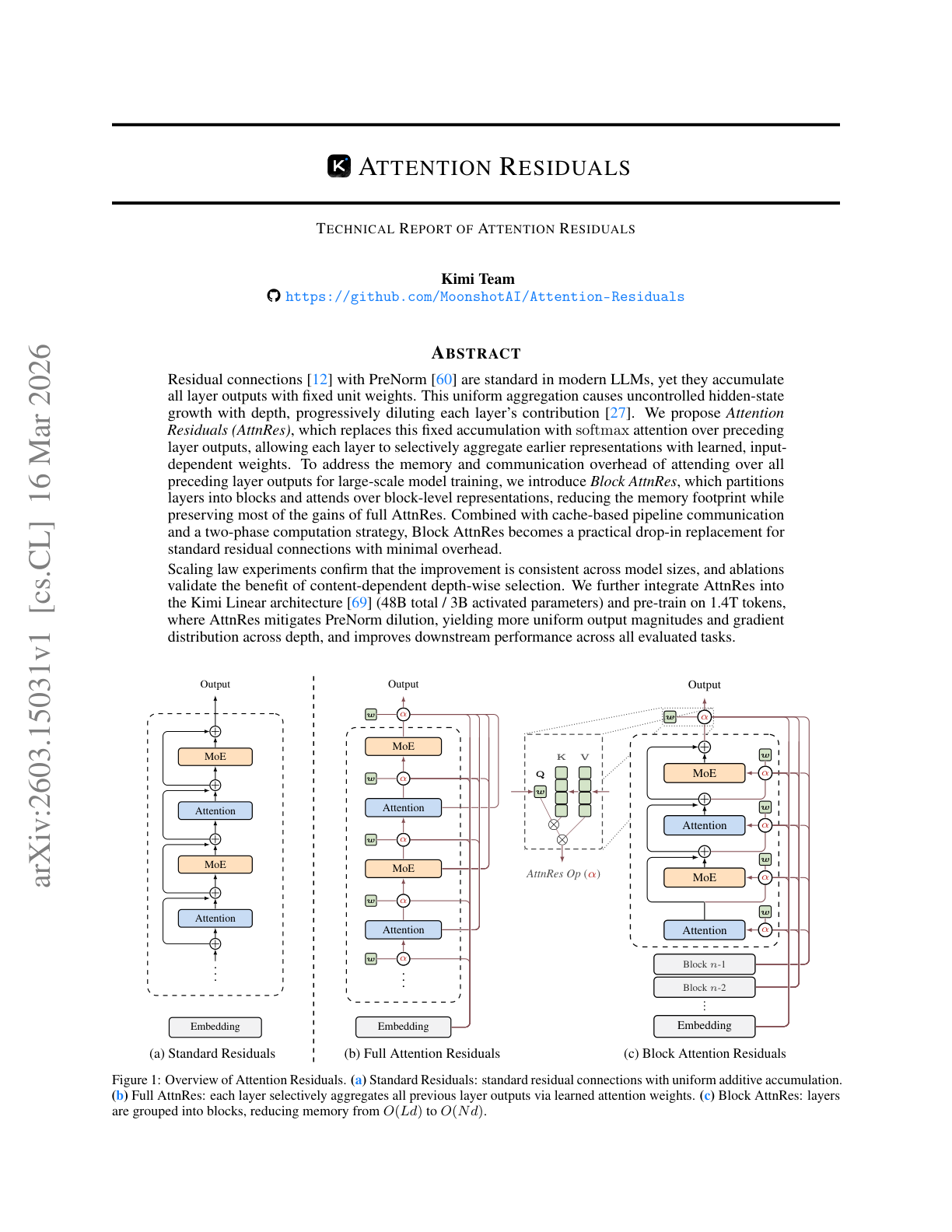
Attention Residuals
The Kimi team at Moonshot AI presents Attention Residuals (AttnRes), a technique that replaces fixed unit-weight residual connections in Transformers with softmax attention over preceding layer outputs. Residual connections with PreNorm are standard in modern LLMs, yet they accumulate all layer outputs with fixed unit weights, causing uncontrolled hidden-state growth with depth that progressively dilutes each layer’s contribution.
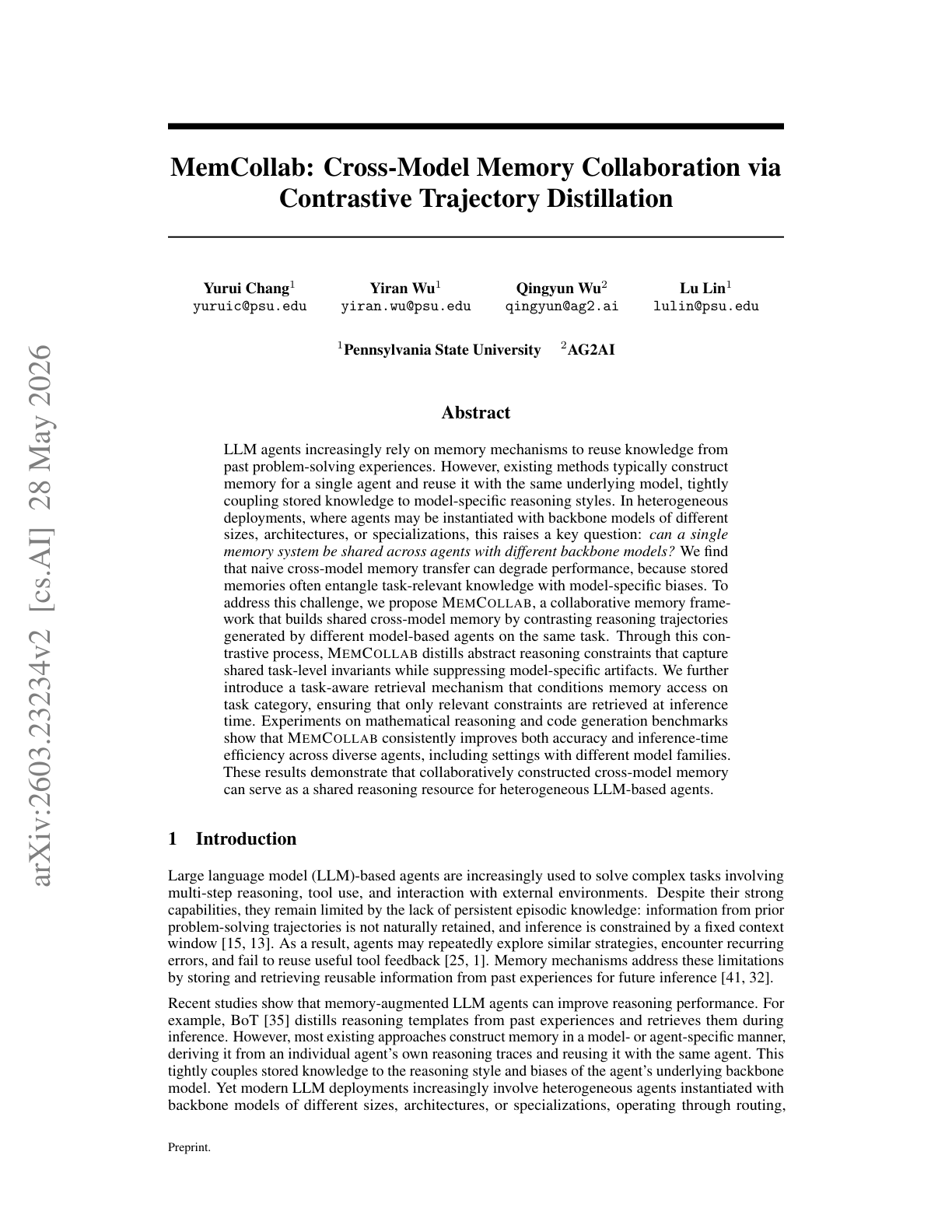
MemCollab
LLM-based agents build useful memory during tasks, but that memory is typically trapped within a single model. MemCollab introduces a collaborative memory framework that constructs agent-agnostic memory by contrasting reasoning trajectories generated by different agents on the same task, enabling a single memory system to be shared across heterogeneous models.
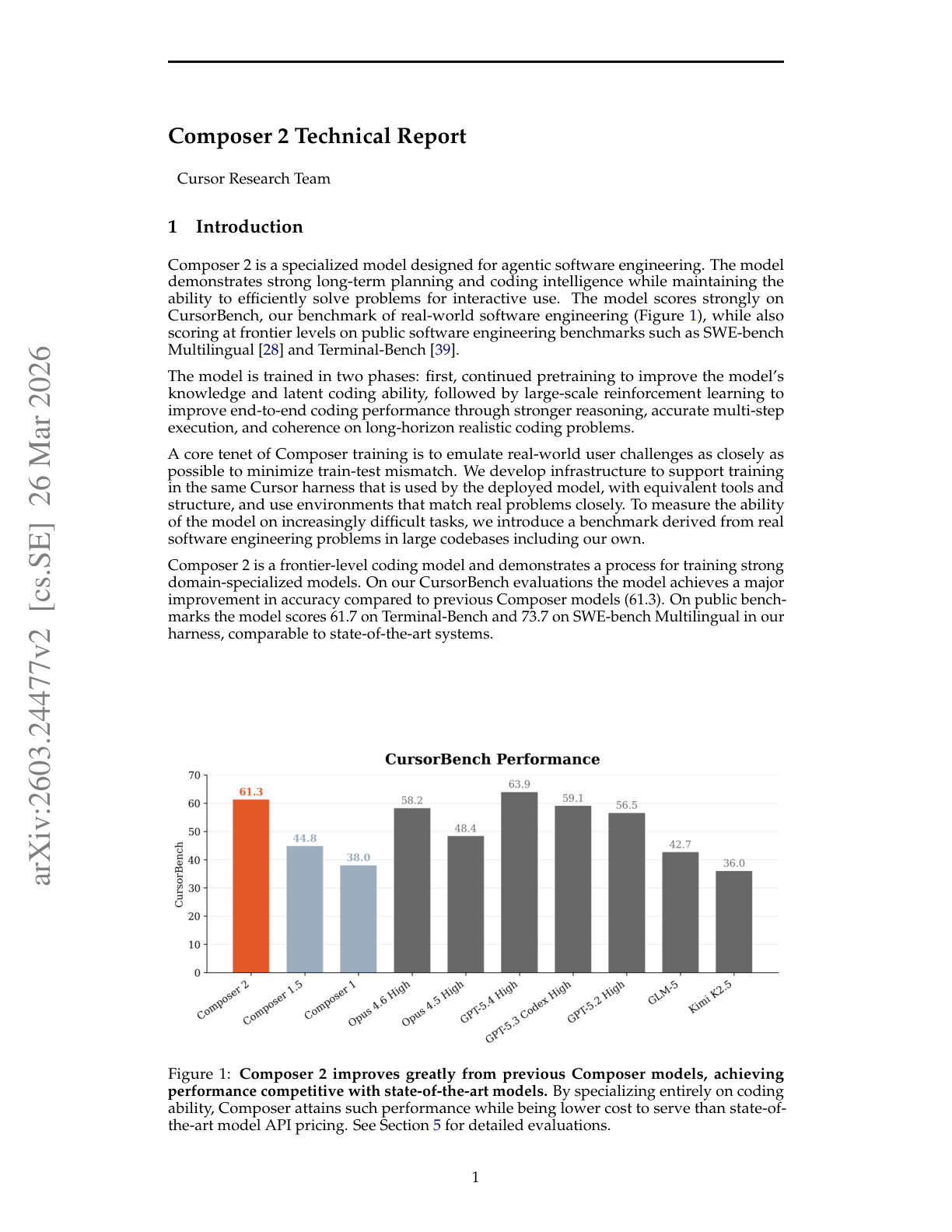
Composer 2
Cursor releases the technical report for Composer 2, a specialized model designed for agentic software engineering that demonstrates strong long-term planning and coding intelligence while maintaining efficiency for interactive use. The report details a process for training domain-specialized models that starts with continued pretraining and scales up with reinforcement learning.
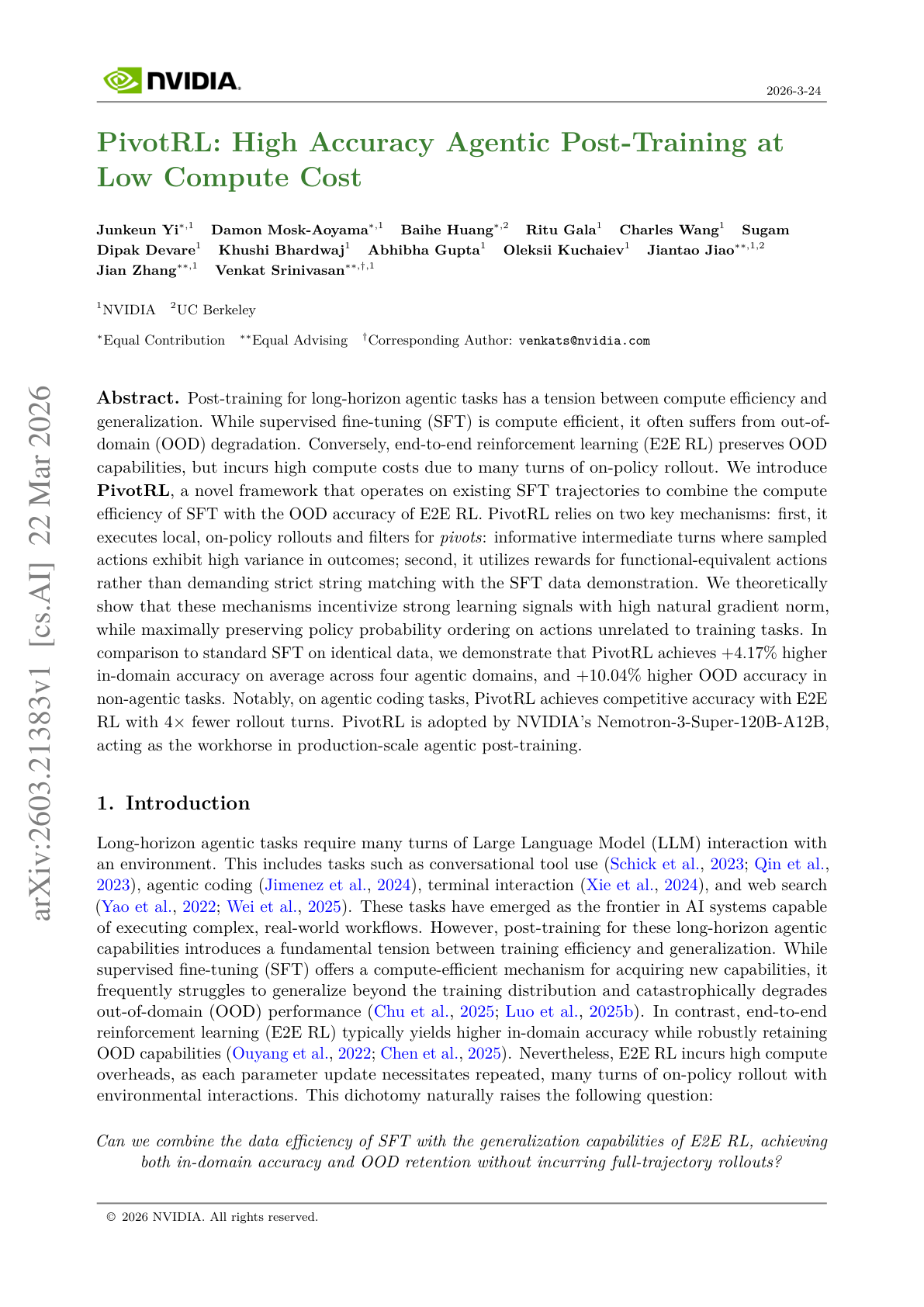
PivotRL
PivotRL is a turn-level reinforcement learning algorithm from NVIDIA designed to tractably post-train large language models for long-horizon agentic tasks. The method operates on existing SFT trajectories, combining the compute efficiency of supervised fine-tuning with the out-of-domain accuracy of end-to-end RL. PivotRL identifies “pivots,” informative intermediate turns where sampled actions exhibit high variance in outcomes, and focuses training signal on these critical decision points. The approach achieves +4.17% higher in-domain accuracy and +10.04% higher out-of-domain accuracy compared to standard SFT, while matching end-to-end RL accuracy with 4x fewer rollout turns. PivotRL is adopted by NVIDIA’s Nemotron-3-Super-120B-A12B as the workhorse for production-scale agentic post-training.
Workflow Optimization for LLM Agents
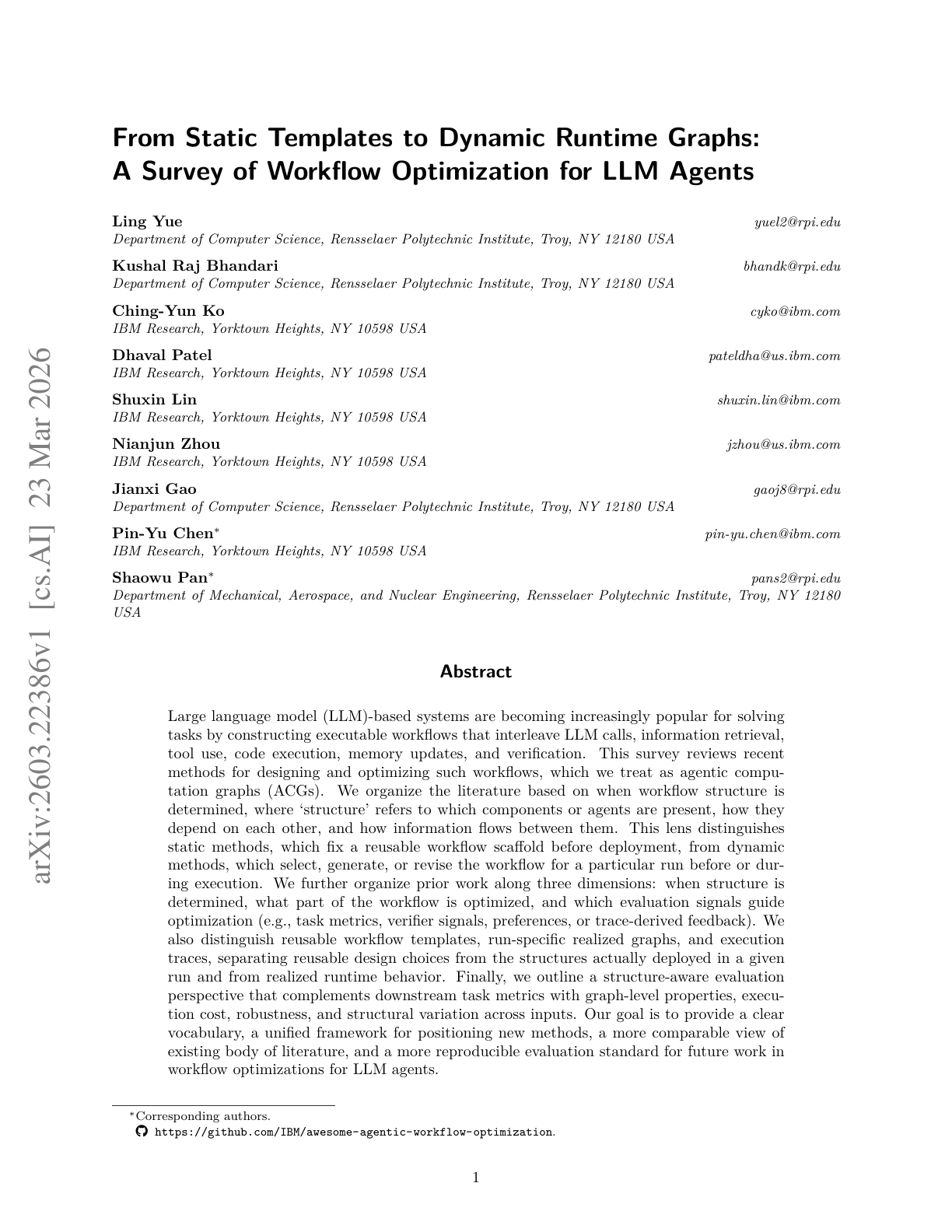
A comprehensive survey from IBM that maps recent methods for designing and optimizing LLM agent workflows, treating them as agentic computation graphs (ACGs). The survey organizes prior work along three dimensions: when structure is determined, what part of the workflow is optimized, and which evaluation signals guide optimization. It distinguishes between reusable workflow templates, run-specific realized graphs, and execution traces, covering methods like AFlow (Monte Carlo Tree Search over operator graphs), Automated Design of Agentic Systems (code-space search via meta-agents), and evolutionary multi-agent system design. A useful reference for teams building production agent systems where wiring decisions between model calls, retrieval, tool use, and verification matter as much as model capability.
BIGMAS
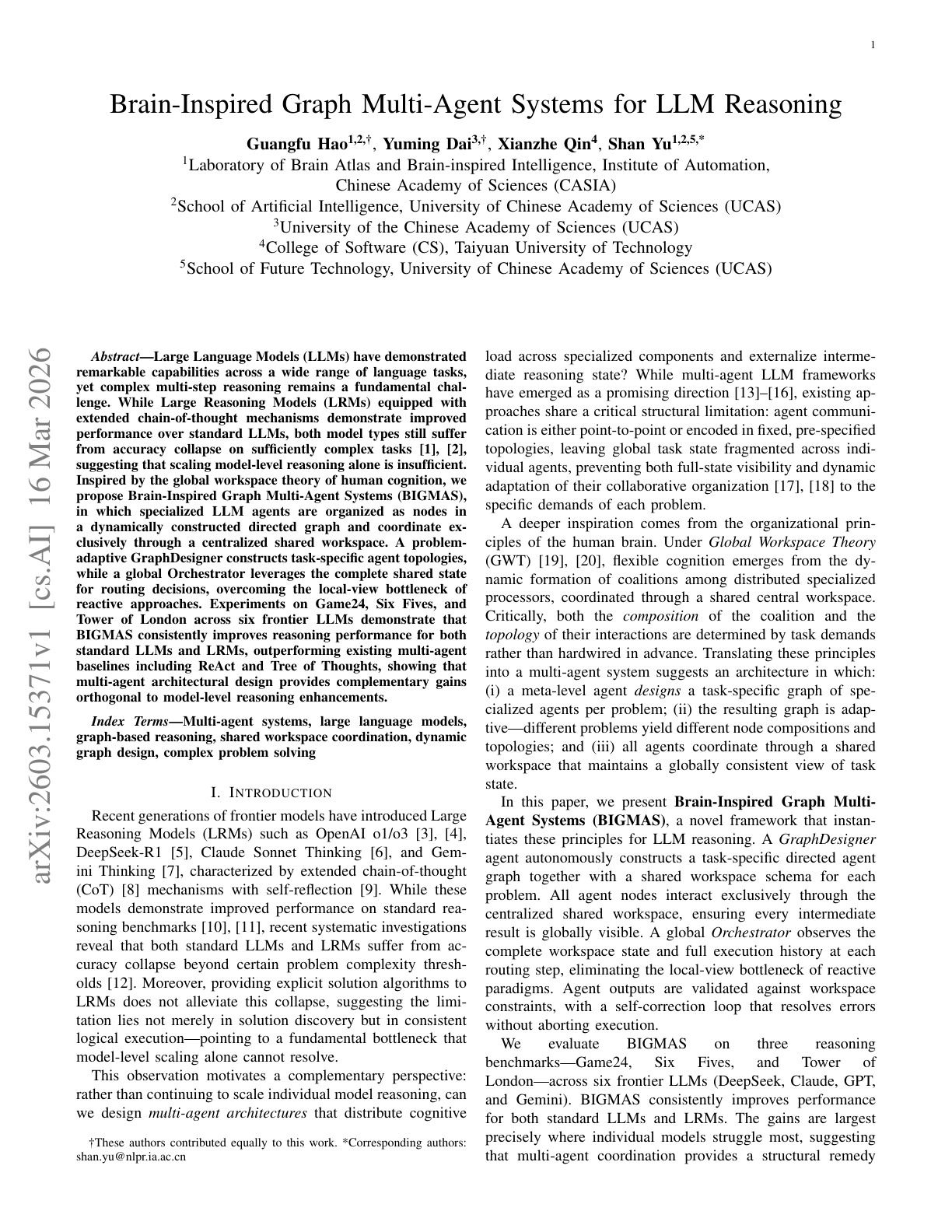
Even the best reasoning models hit an accuracy collapse beyond a certain problem complexity. BIGMAS (Brain-Inspired Graph Multi-Agent Systems) organizes specialized LLM agents as nodes in a dynamically constructed directed graph, coordinating exclusively through a centralized shared workspace inspired by global workspace theory from cognitive neuroscience. A GraphDesigner agent analyzes each problem instance and produces a task-specific directed agent graph together with a workspace contract. The framework constructs structurally distinct graphs whose complexity tracks task demands, from compact three-node pipelines for simple arithmetic to nine-node cyclic structures for multi-step planning. BIGMAS consistently improves reasoning performance for both standard LLMs and large reasoning models, outperforming existing multi-agent baselines.