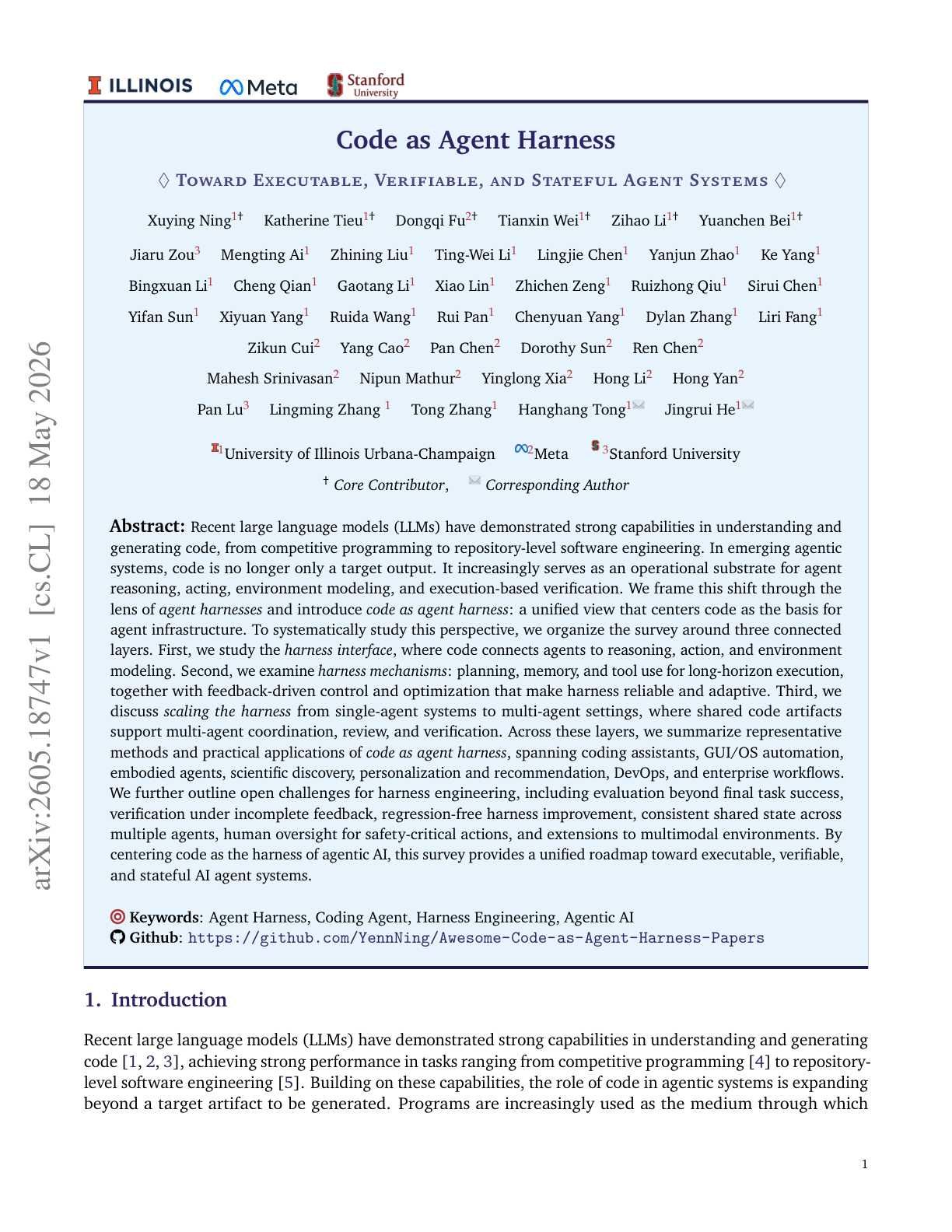
Code as Agent Harness
A 100+ page survey treating the agent harness as a first-class research object rather than glue around an LLM. The authors argue that code-as-harness is the most promising path to general-purpose agency, and that future agent systems should satisfy four properties: executable, inspectable, stateful, and governed. The report consolidates methods, applications, and open problems across the harness layer.
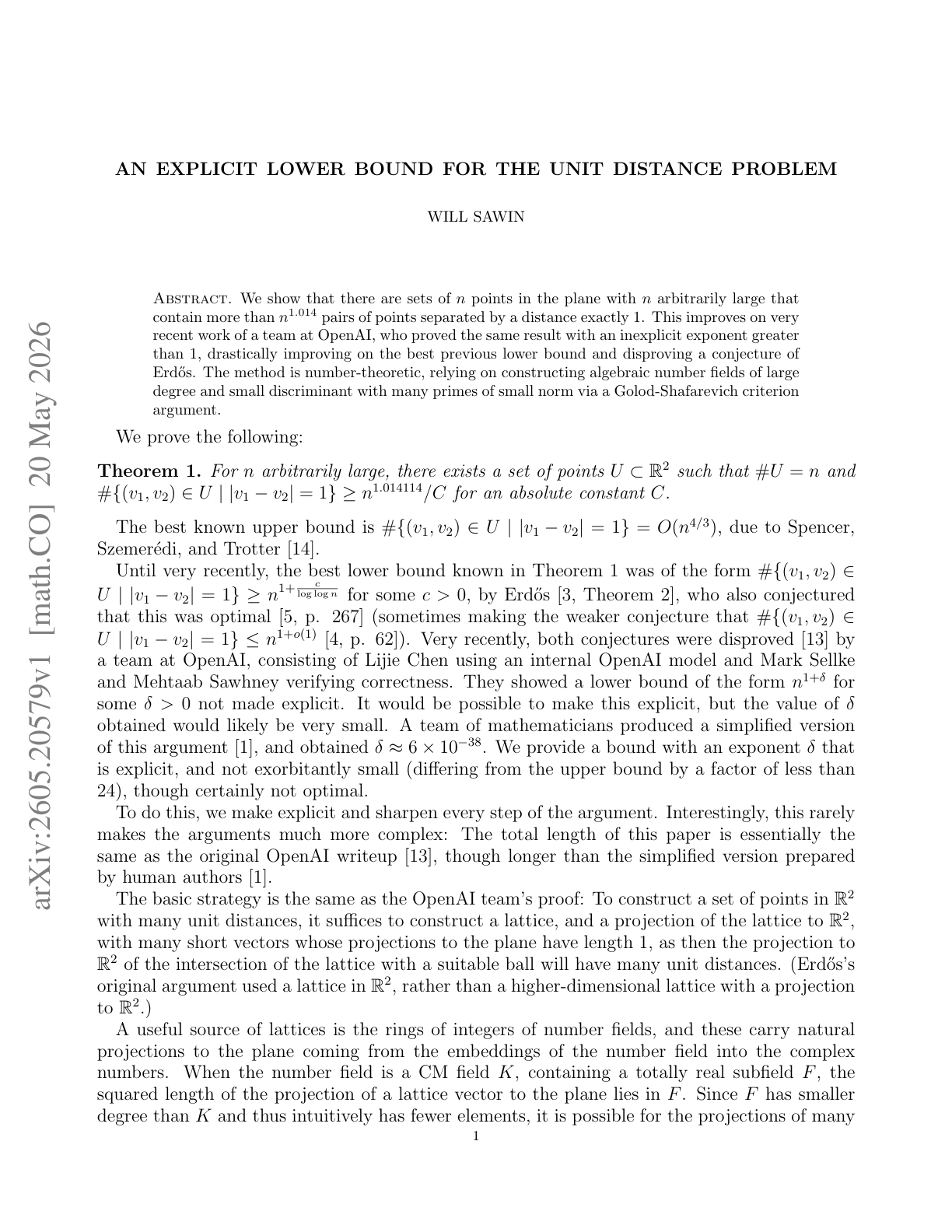
OpenAI Disproves the Unit Distance Conjecture
An OpenAI internal reasoning model produced a counterexample to Erdős's 1946 unit distance conjecture, the first time an AI system has autonomously resolved a prominent open problem in mathematics. For nearly 80 years, mathematicians believed square grids were essentially optimal for placing n points to maximize unit-distance pairs. The new construction beats grids using an infinite unramified tower of totally real number fields with 3-power Galois groups, producing n-point sets with more than n^(1.014) unit distances. A human-verified companion paper was prepared by nine external mathematicians including Noga Alon, Tim Gowers, and Melanie Matchett Wood.
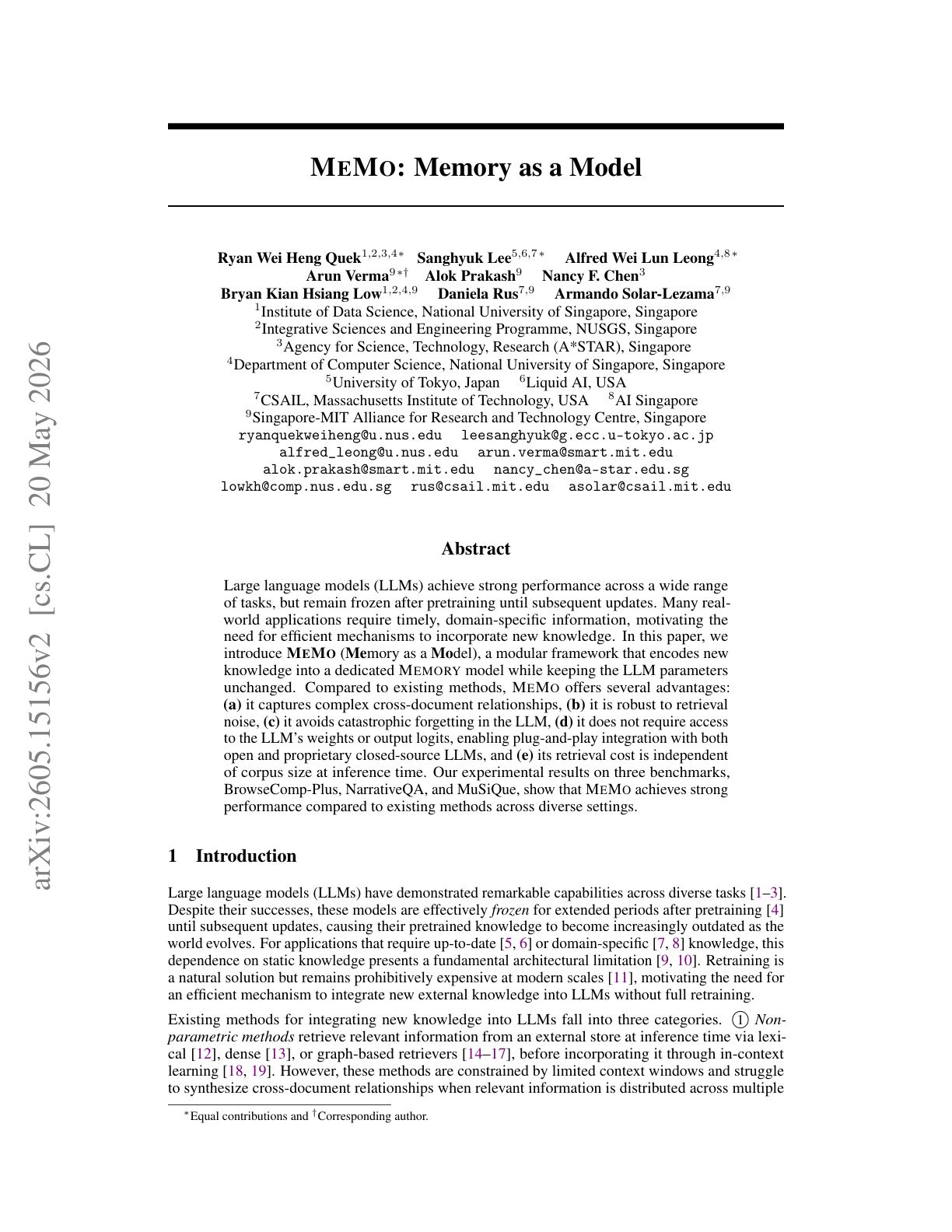
Memory as a Model
MeMo augments any frozen LLM with a separately trained memory model that stores, retrieves, and integrates facts on the base model's behalf. Memory updates are decoupled from base-model weight updates, so the system supports continual learning without catastrophic forgetting, a property RAG fails to deliver because a vector store is just a database with a learned encoder bolted on.
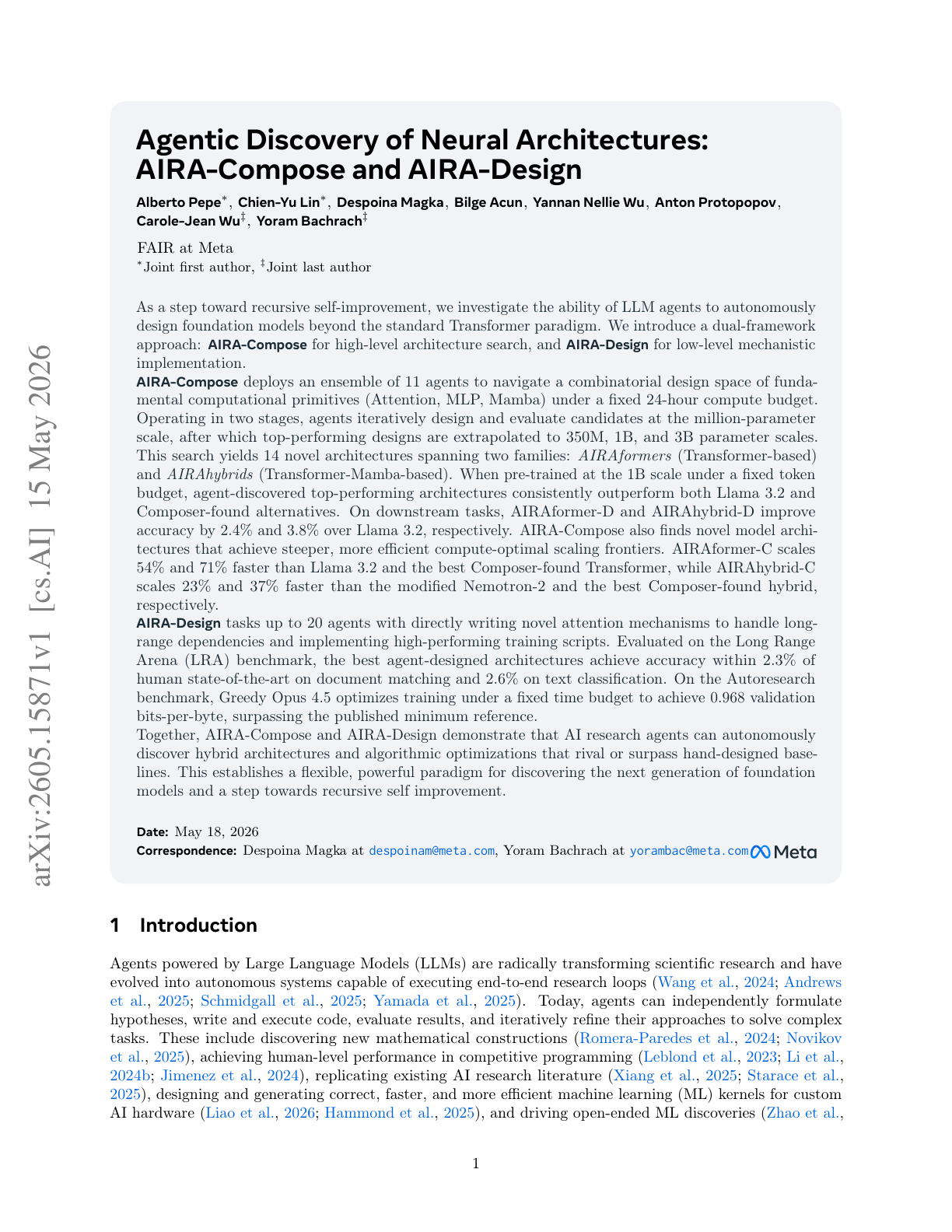
AIRA
Meta's AIRA is an agent system that autonomously discovers neural architectures, producing models that beat Llama 3.2 at 350M, 1B, and 3B scales under a 24-hour compute budget. The search is split across two specialized agents: AIRA-Compose searches macro architecture, and AIRA-Design implements the low-level mechanisms. The split outperforms a single end-to-end agent on this non-toy search problem.
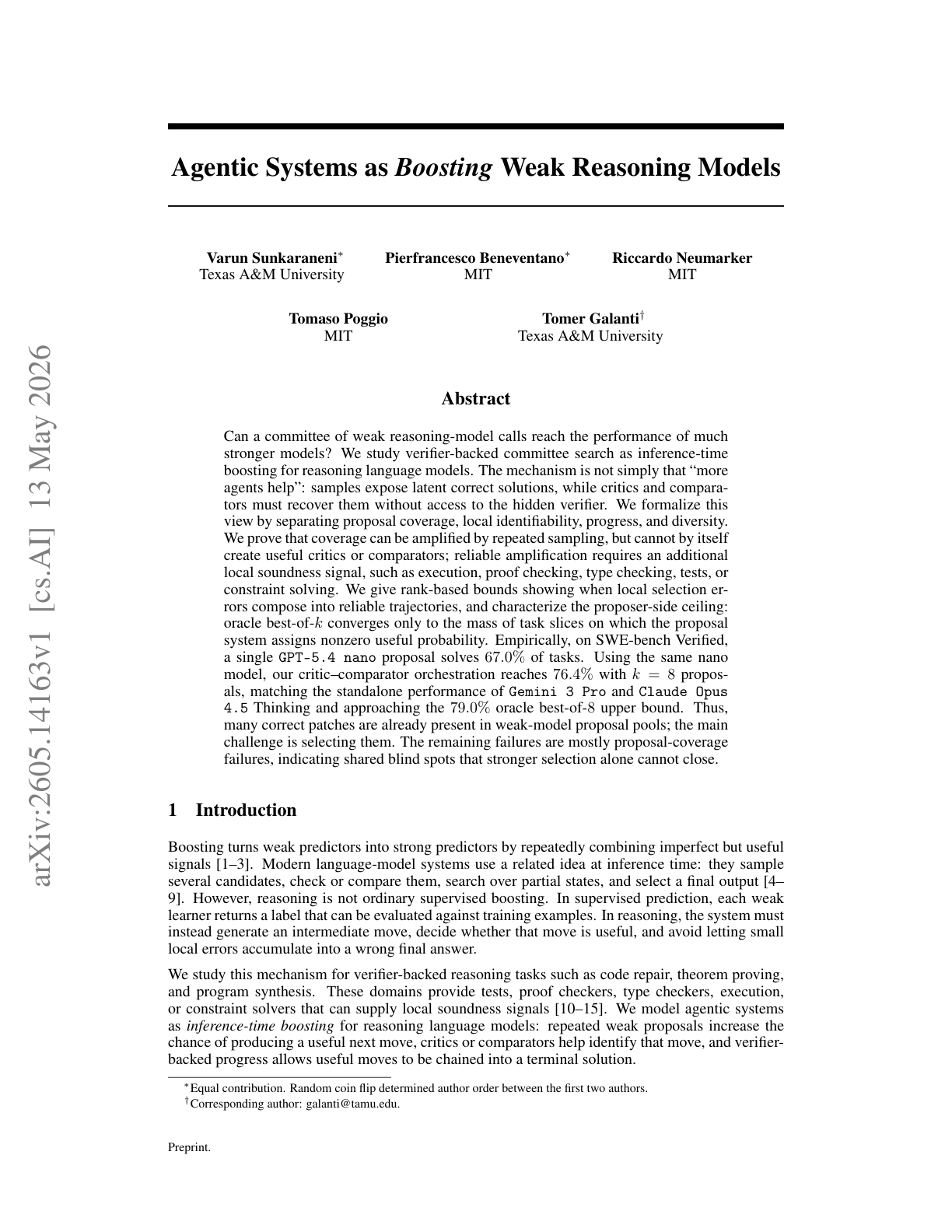
Weak-Model Critic-Comparator
GPT-5.4 nano wrapped in a critic-comparator orchestration loop reaches 76.4% on SWE-bench Verified, matching standalone Gemini 3 Pro and Claude Opus 4.5 Thinking. The trick is to sample k=8 candidate patches from the weak model and select the winner using execution and proof signals rather than asking the model to self-rank.
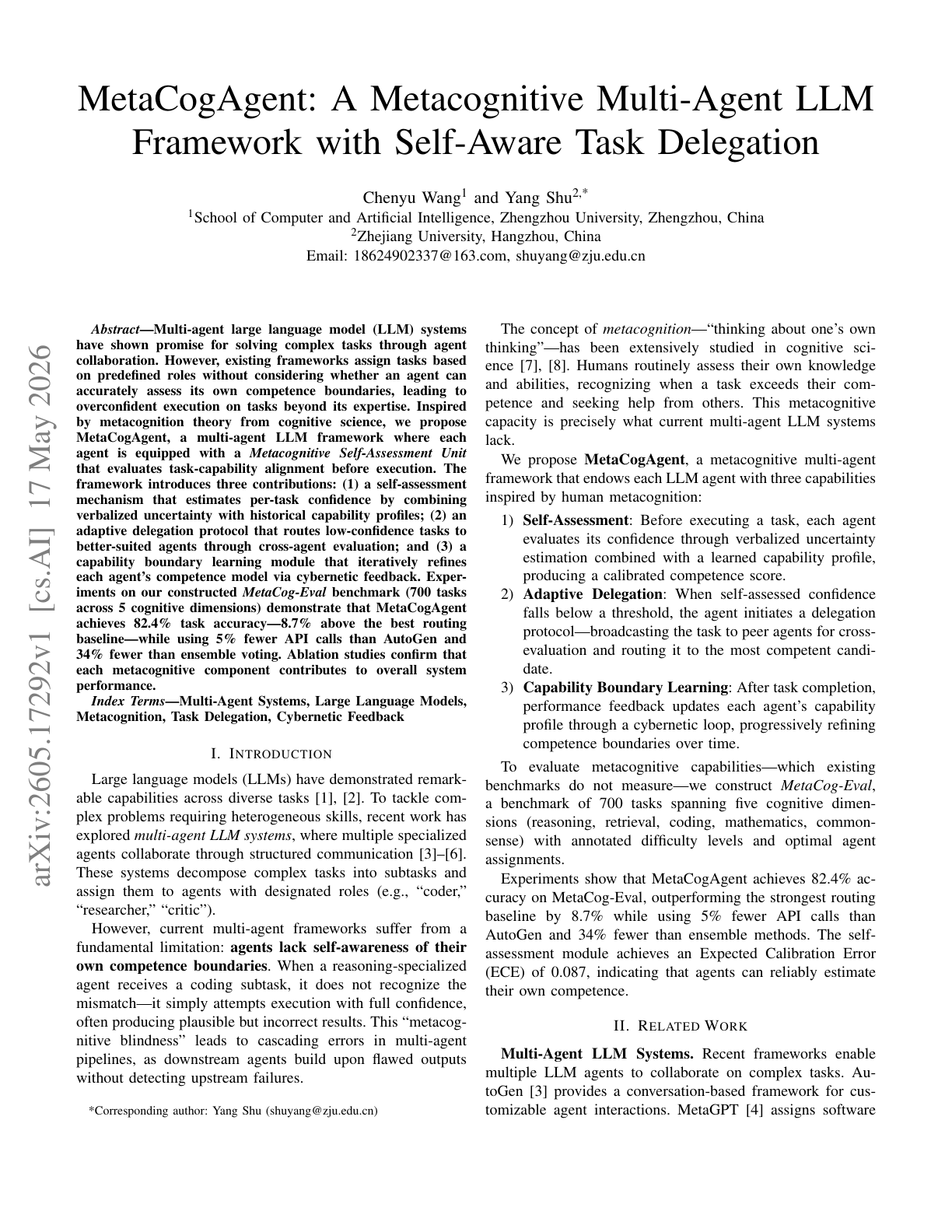
MetaCogAgent
MetaCogAgent equips a multi-agent system with metacognition, so each agent decides whether it should answer or delegate. The bottleneck in current multi-agent systems is over-delegation and under-delegation, and a metacognitive gate is a principled way to manage both. The Metacognitive Unit (MCU) at each agent produces confidence scores that drive routing to a delegation hub.
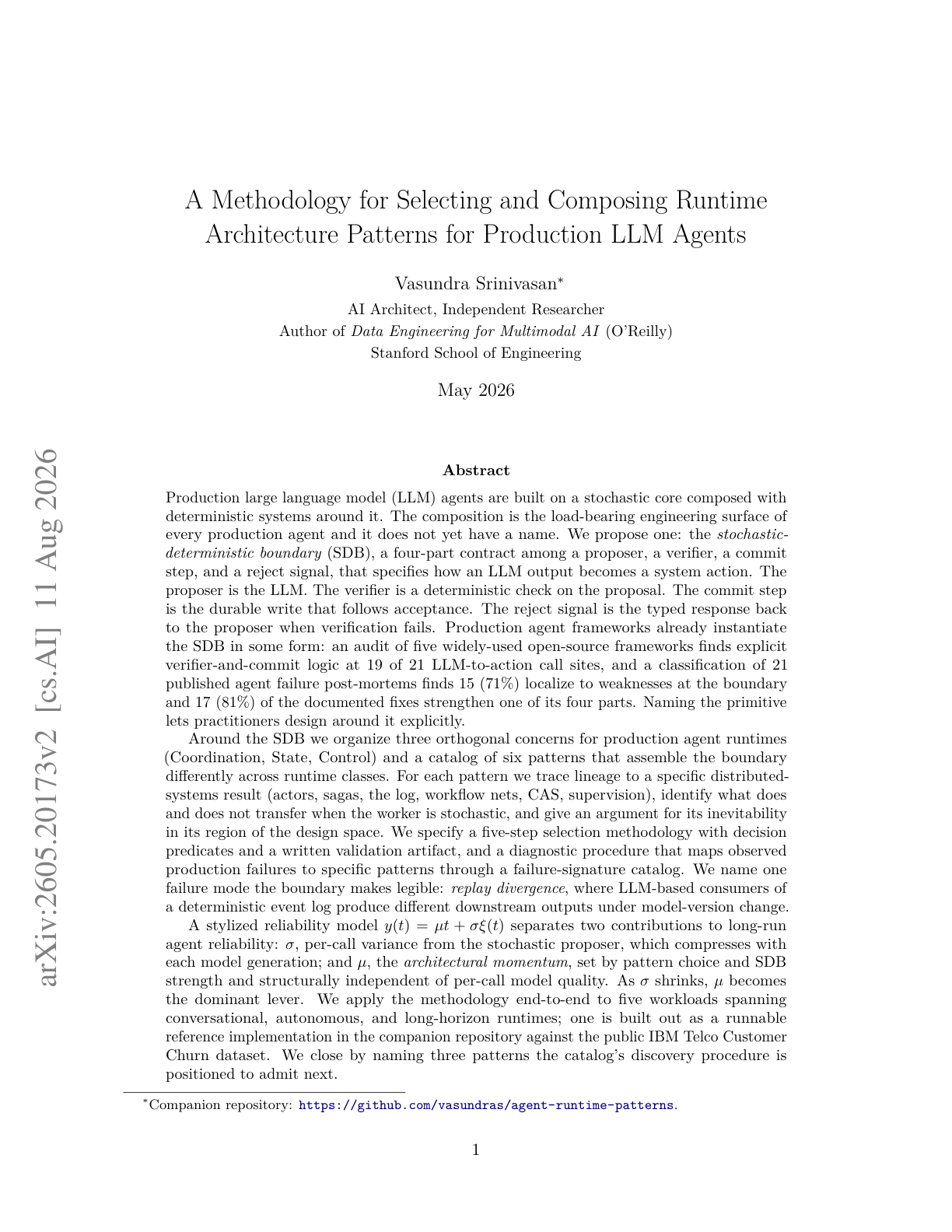
Production Agent Architecture Methodology
A methodology paper on selecting and composing runtime architecture patterns for production LLM agents. The core argument is that most teams accidentally let framework defaults make critical architecture decisions for them. The paper introduces the stochastic-deterministic boundary (SDB) as a named primitive and presents a six-pattern catalog organized by the three runtime concerns of coordination, state, and control.
NanoGPT-Bench
A new evaluation of whether coding agents can do real AI R&D. Intology runs Codex, Claude Code, and Autoresearch on the NanoGPT-Bench suite and reports that the agents recover only 9.3% of human progress on the same problems. Coding agents spend the bulk of their compute on hyperparameter tuning and rarely attempt algorithmic research. Claude Code and Autoresearch reason about algorithmic changes more often, but still tend to dodge implementing them. The headline result tempers the current wave of "self-improving agent" claims: producing real research progress requires a different distribution of effort than the one current coding agents converge to under their default scaffolds.
General-Agent
Prime Intellect's General-Agent is a fully synthetic reinforcement learning environment whose task corpus self-evolves and grows harder over time. The release ships with 4,504 tool-use tasks across 1,040 domains and 8,159 unique tools. Synthetic task creation is formulated as a two-player game between a Synthesizer that proposes new task families and a Solver that runs rollouts to measure pass rates. Tasks whose pass rate falls inside a calibrated difficulty band are accepted into the corpus, and hard tiers seed the next round of extensions. The framing turns RL environment creation, historically a major bottleneck, into an automated agentic search problem in its own right.
Contrastive Neuron Attribution
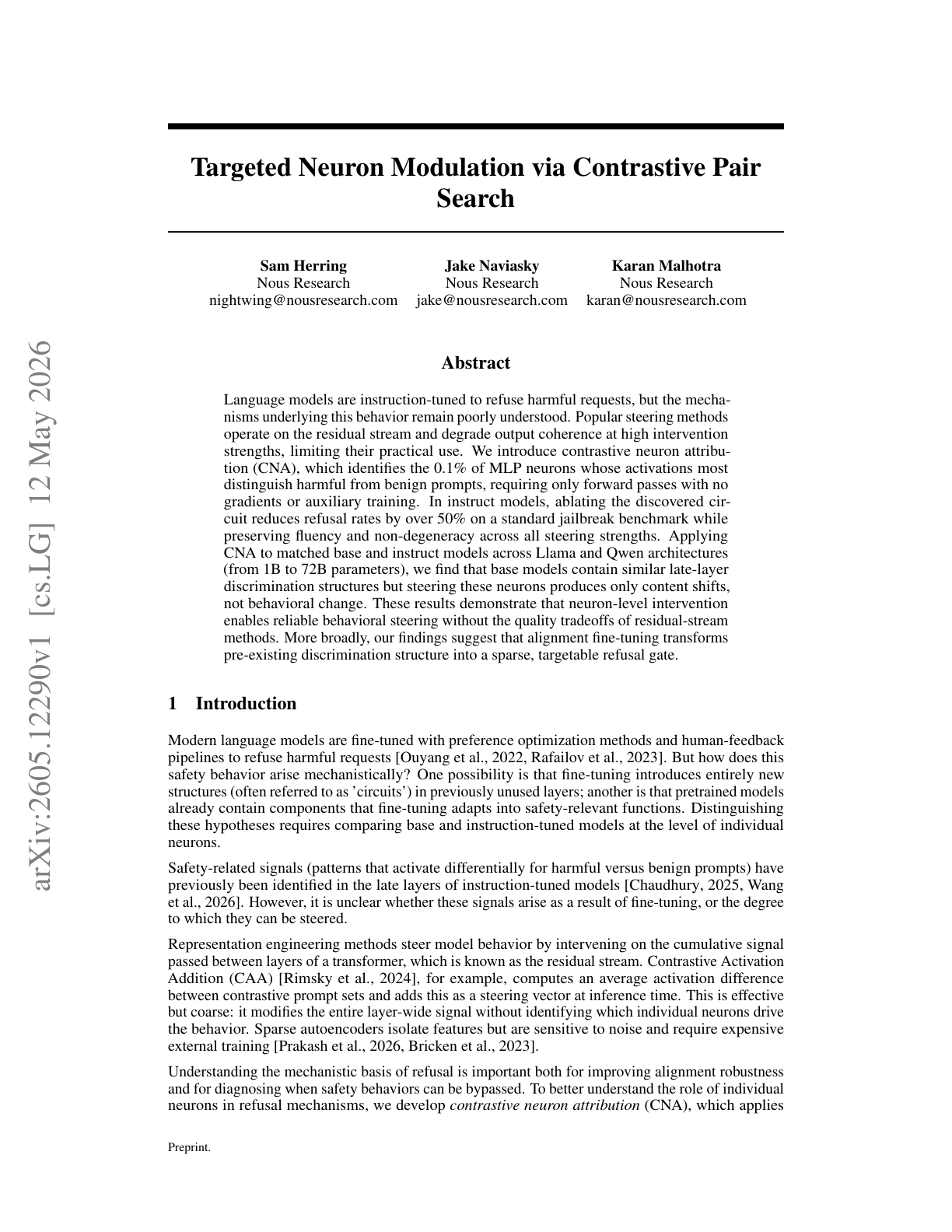
Nous Research releases Contrastive Neuron Attribution (CNA), a method for steering LLM behavior by identifying and ablating sparse circuits in the MLP basis without training a sparse autoencoder, modifying weights, or degrading general capability benchmarks. Given a small set of contrastive prompt pairs that elicit a target behavior and its opposite, CNA isolates the top 0.1% of MLP neurons whose activations differ most between the two sets. Ablating that small circuit removes the behavior while leaving the rest of the model intact. The intervention remains robust at high strengths where residual-stream methods like Contrastive Activation Addition (CAA) start to degrade. Validated on the refusal circuit across 8 instruct-tuned models including Llama-3.1-70B, Llama-3.2-3B, Qwen2.5-72B, and Qwen2.5-14B.