Harness Handbook
Teams now let agents evolve their own harnesses, but the harness itself becomes a sprawling codebase where finding every file behind one behavior is often harder than writing the edit. Harness Handbook attacks this by turning a harness into a behavior-centric map that stays linked to source.
From Memory to Skills
Most agent memory systems retrieve past traces as passive context, so hard-won experience never becomes something the agent can directly execute. MSCE, a training-free memory-skill co-evolution framework, instead governs how experience turns into callable skills for long-horizon LLM agents.
PRO-LONG
Long-horizon tasks force a harness to decide what to save from a long stream of observations and how to load it back into context, and richer summaries usually make the exact detail you need harder to retrieve. PRO-LONG sidesteps this tradeoff with programmatic memory.
Global Workspace in LLMs
This Anthropic interpretability work gives a mechanistic account of when a model's verbalized reasoning is load-bearing and when it is not. It identifies a small, privileged set of internal representations that behaves like the global workspace some neuroscientists tie to conscious access.
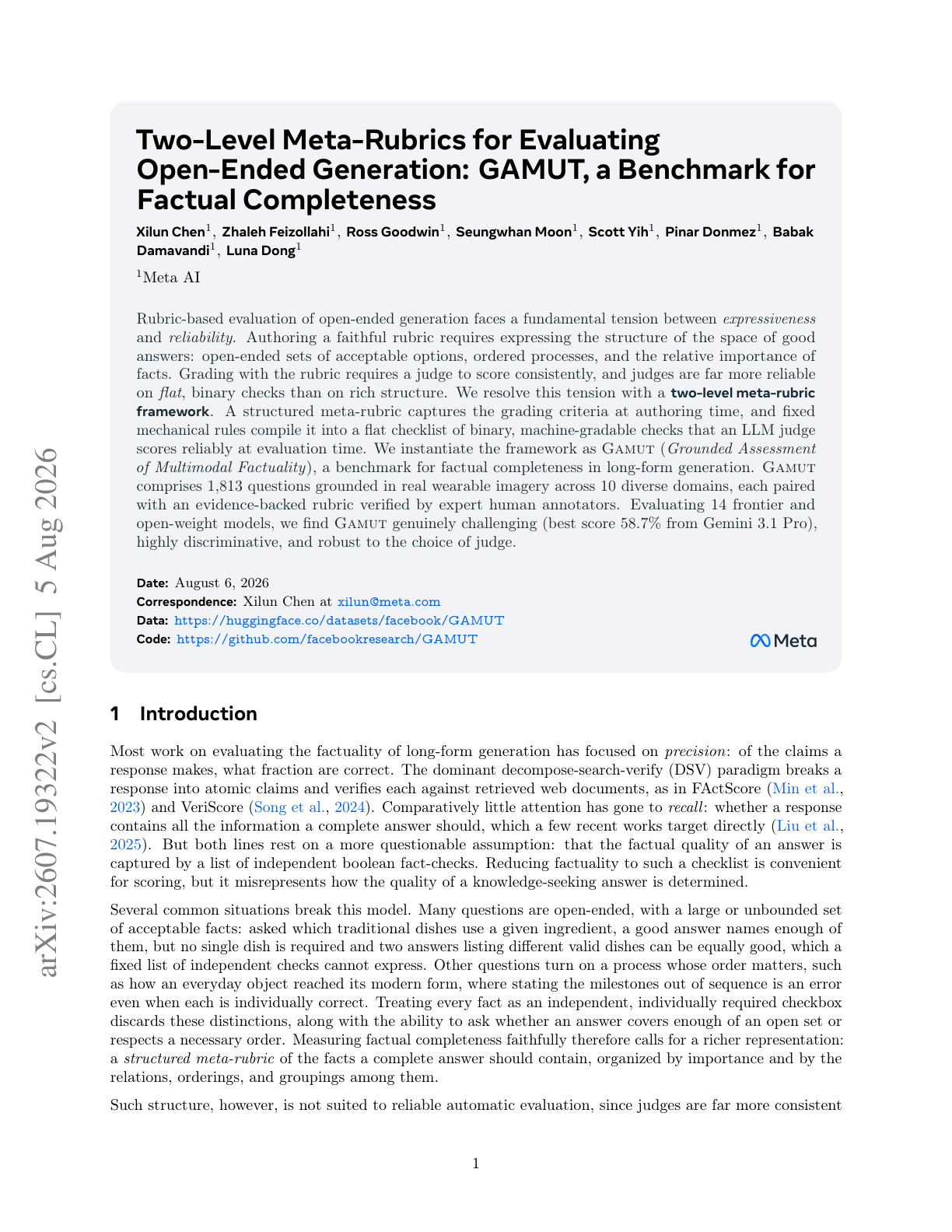
GAMUT
Most factuality evaluation measures precision, whether the claims in an answer are correct. This Meta AI work targets the harder and mostly ignored half, completeness, meaning whether an answer covers everything it should, and packages it as the GAMUT benchmark.
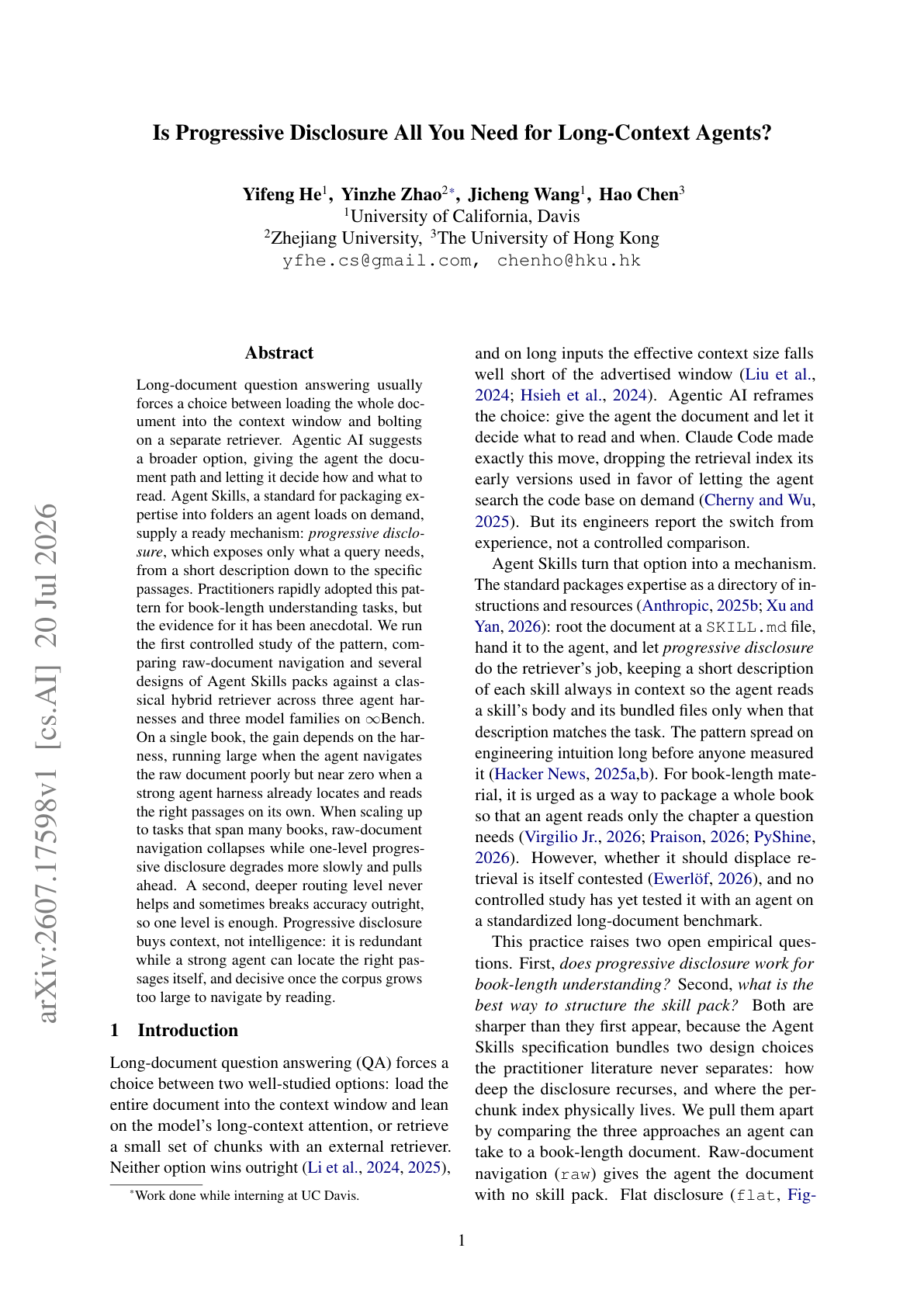
Progressive Disclosure, Measured
Agent Skills package expertise into folders an agent loads on demand, and progressive disclosure exposes only what a query needs, from a short description down to specific passages. Practitioners adopted this pattern fast for book-length tasks, but the supporting evidence was anecdotal until now.
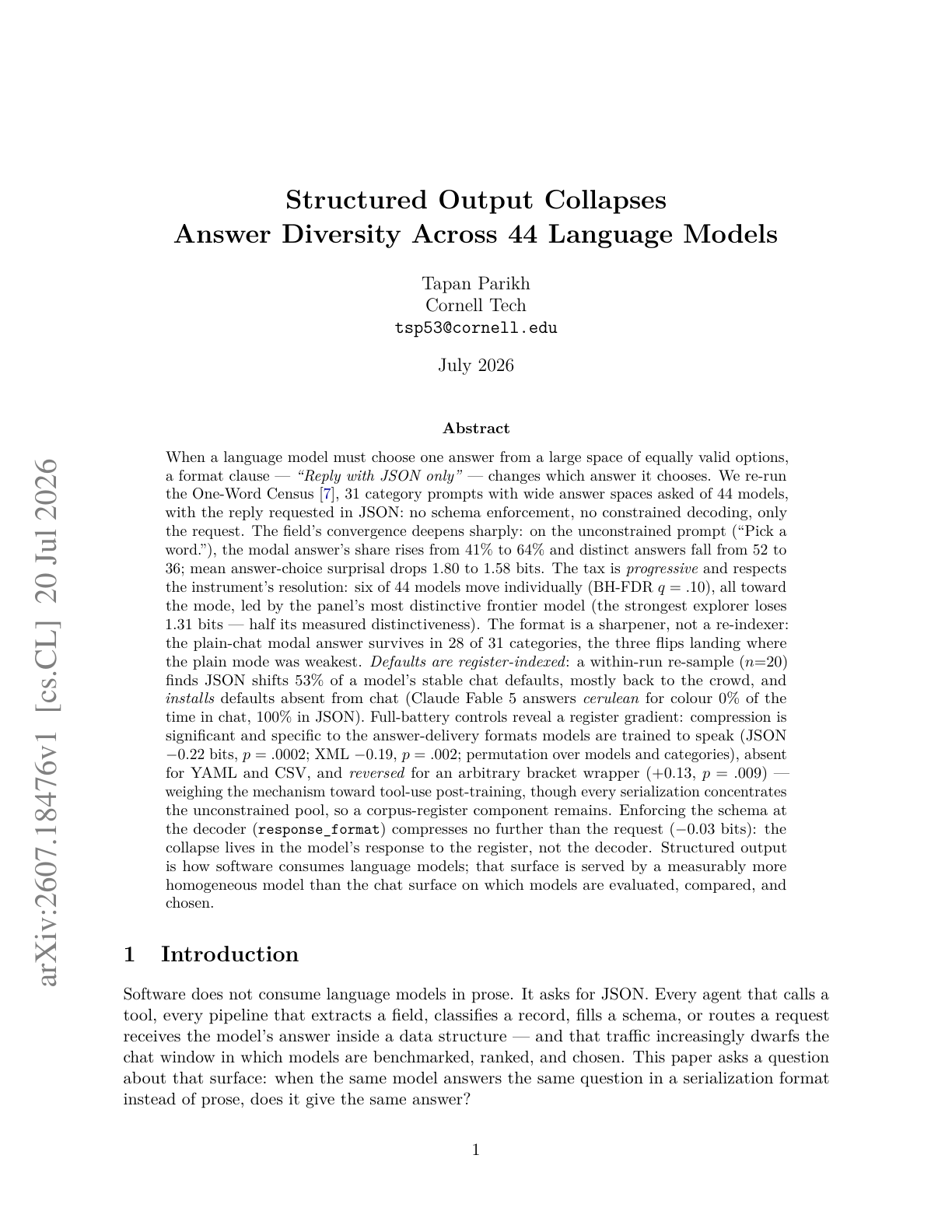
Structured Output Collapses Diversity
Teams benchmark models in chat, then ship them behind JSON schemas for tools, extraction, and routing. This study of 44 language models shows that the structured surface you deploy is measurably more homogeneous than the chat surface you evaluated on.
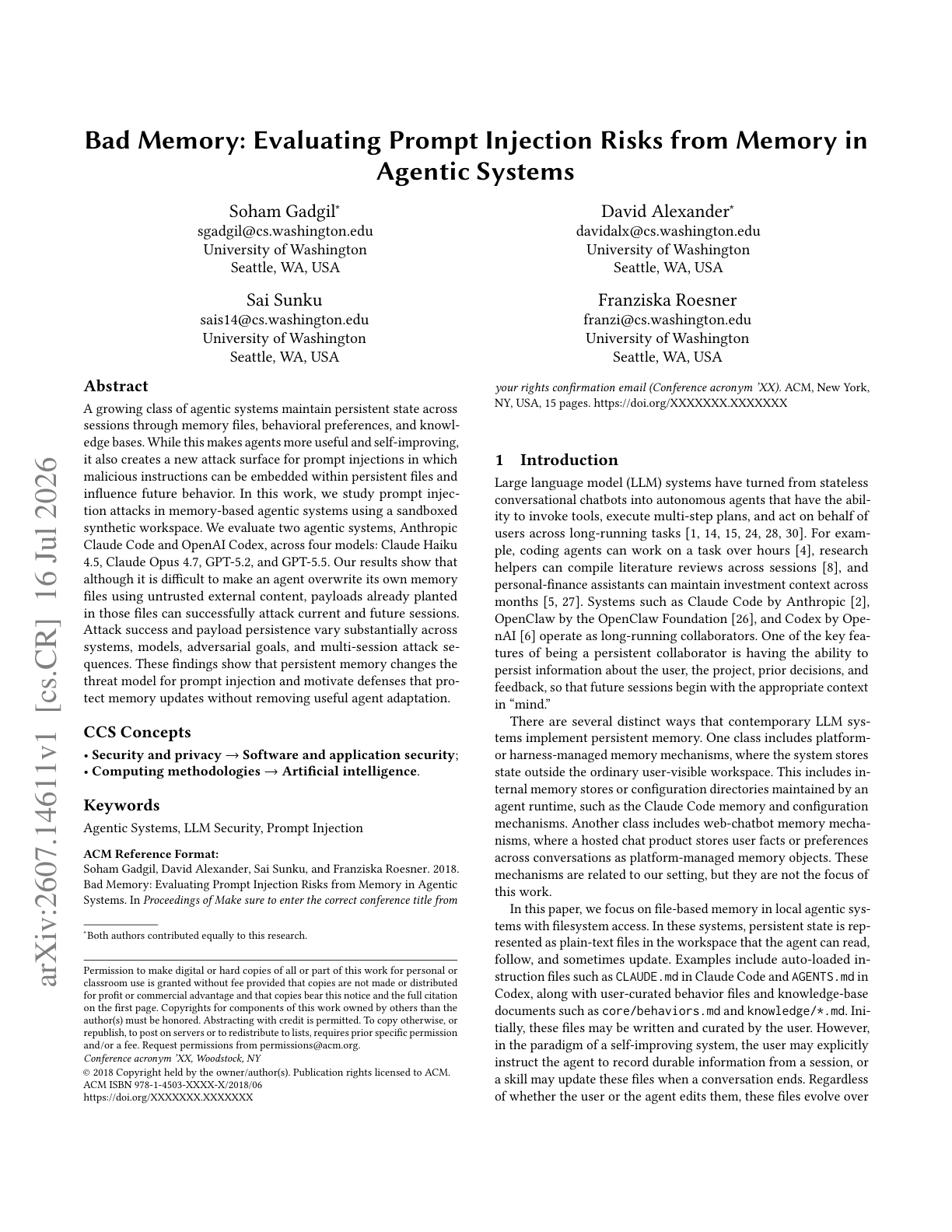
Bad Memory in Agents
Persistent memory is what makes an agent useful across sessions, and it is also a place an attacker can leave something behind. This work evaluates prompt injection from memory files in Claude Code and OpenAI Codex, across Claude Haiku 4.5, Claude Opus 4.7, GPT-5.2, and GPT-5.5. The finding is uneven but sobering: it is hard to make an agent overwrite its own memory using untrusted external content, but payloads already planted in those files reliably attack current and future sessions, with attack success and persistence varying widely across systems, models, adversarial goals, and multi-session sequences.
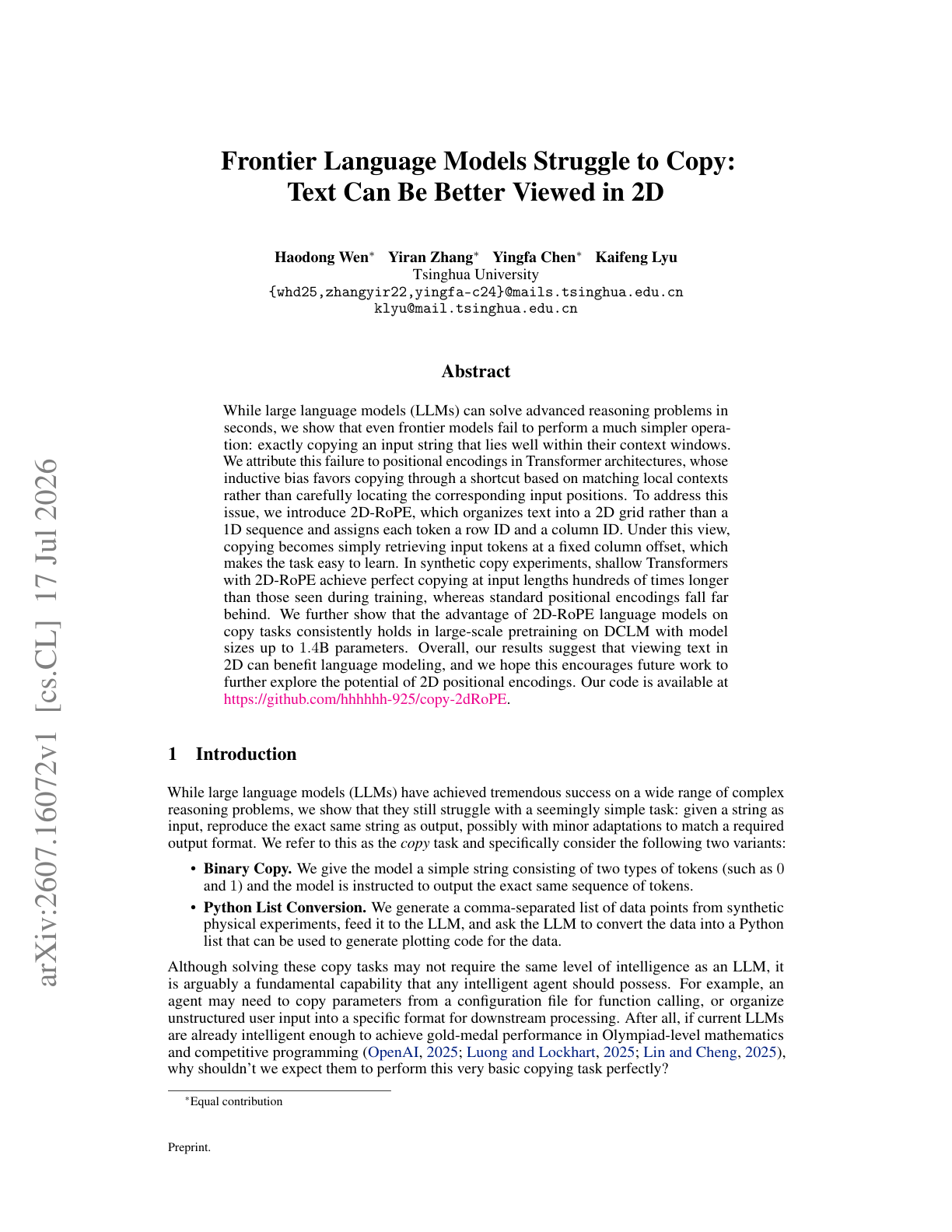
Frontier Models Struggle to Copy
Frontier models can write proofs yet stumble on faithfully copying a long block of text that sits well within their context window. This paper traces the failure to 1D positional encodings, whose inductive bias favors a copying shortcut based on matching local context rather than carefully locating the corresponding input positions. The fix is 2D-RoPE, which lays text out on a 2D grid and gives each token a row and a column ID, so copying becomes retrieving tokens at a fixed column offset. Shallow Transformers with 2D-RoPE copy perfectly at input lengths hundreds of times longer than those seen in training.
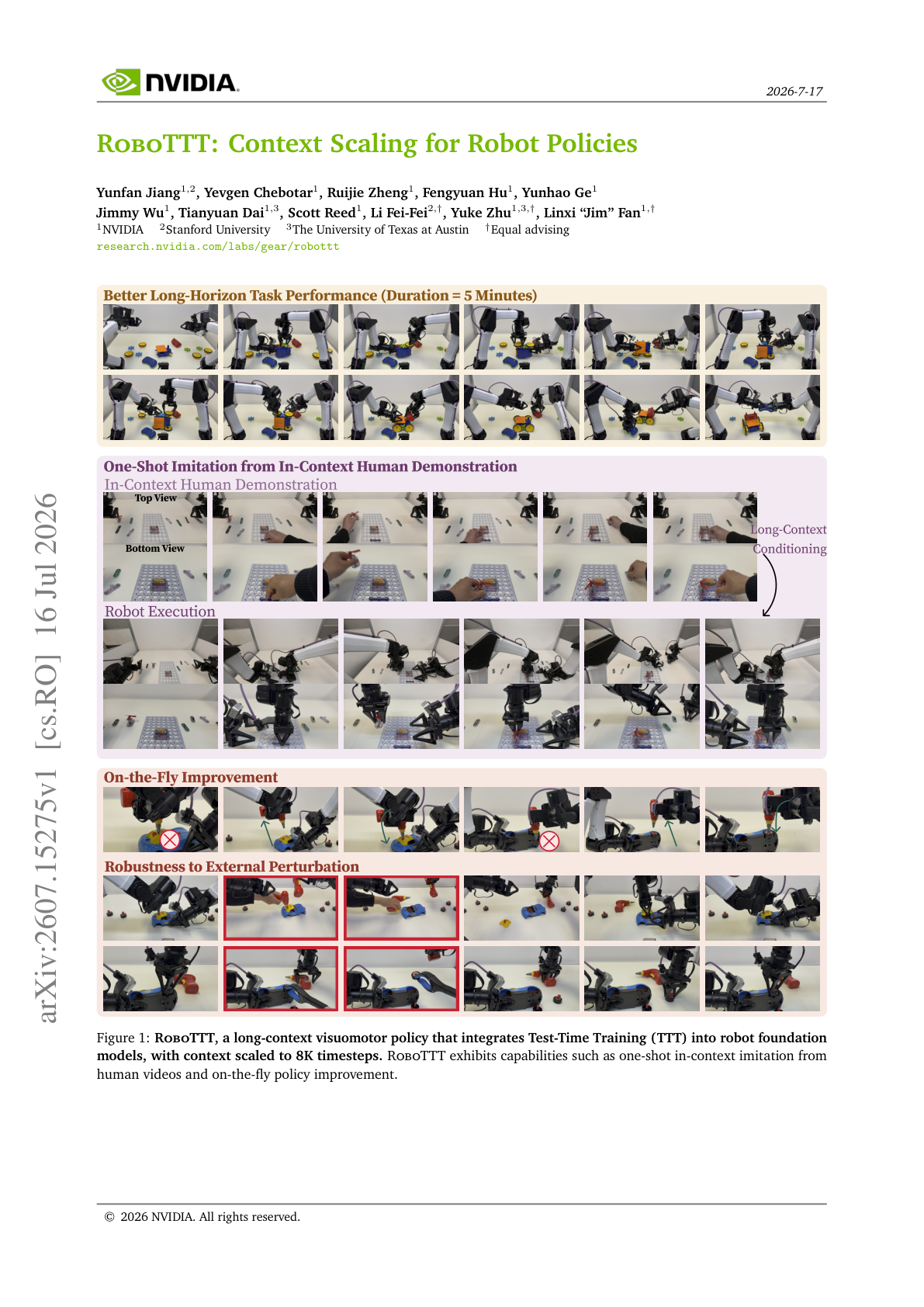
RoboTTT
Recent robot foundation models run on single-step or short-history context, a strange way to attempt a five-minute assembly task. RoboTTT, from NVIDIA with Stanford and UT Austin, integrates test-time training into vision-language-action policies to scale visuomotor context to 8K timesteps, three orders of magnitude past prior policies, without growing inference latency. The longer context unlocks one-shot in-context imitation from human video, on-the-fly policy improvement, and robustness to perturbations. It improves overall performance by 87% over a single-step baseline, fully completes a ten-stage assembly task that no baseline finishes, and gains 62% from pretraining with 8K rather than 1K timesteps.