RoboTTT
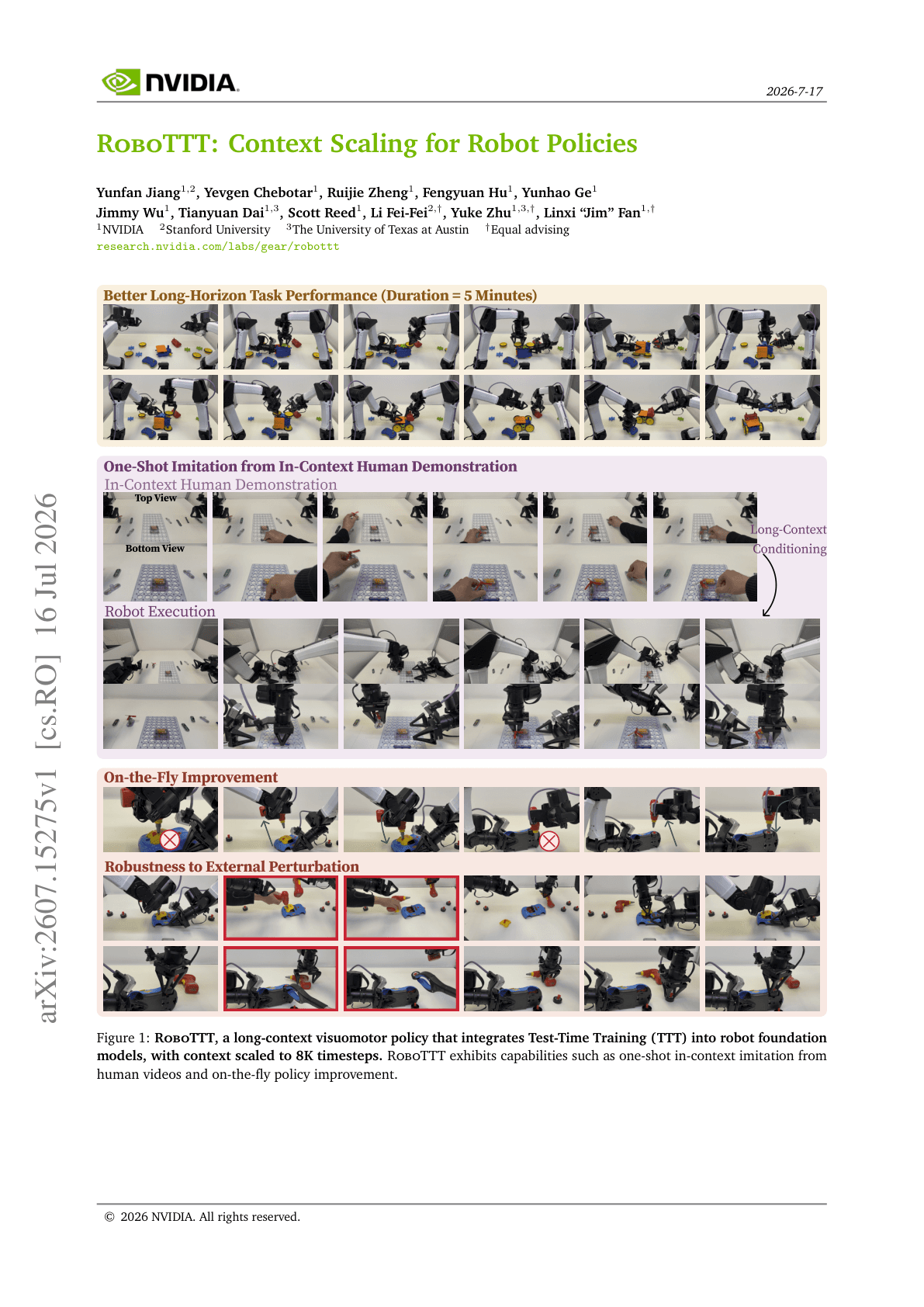
Recent robot foundation models run on single-step or short-history context, a strange way to attempt a five-minute assembly task. RoboTTT, from NVIDIA with Stanford and UT Austin, integrates test-time training into vision-language-action policies to scale visuomotor context to 8K timesteps, three orders of magnitude past prior policies, without growing inference latency. The longer context unlocks one-shot in-context imitation from human video, on-the-fly policy improvement, and robustness to perturbations. It improves overall performance by 87% over a single-step baseline, fully completes a ten-stage assembly task that no baseline finishes, and gains 62% from pretraining with 8K rather than 1K timesteps.
Ask this paper
Abstract
Recent robot foundation models operate with single-step or short-history visuomotor context. We introduce Test-Time-Training Robot Policies (RoboTTT), a robot model and training recipe that scale visuomotor context to 8K timesteps, three orders of magnitude beyond state-of-the-art policies, without growing inference latency. At this context length, we unlock new robot capabilities: one-shot in-context imitation from human video demonstrations, on-the-fly policy improvement, robustness to perturbations, and stronger performance on multi-stage, long-horizon tasks. We also observe, for the first time, steady gains in closed-loop performance as pretraining context length scales. At its core, RoboTTT integrates Test-Time Training into robot foundation models such as Vision-Language-Action policies, yielding a sequence model whose recurrent state consists of fast weights, parameters updated by gradient descent during both training and inference, compressing histories into weight space and retrieving contextual information for long-context conditioning. To scale training context length, the recipe combines sequence action forcing with truncated backpropagation through time. On challenging real-robot manipulation tasks, RoboTTT improves overall performance by 87% over the single-step context baseline and fully completes a five-minute, ten-stage assembly task, which no baseline ever does. RoboTTT trained with 8K-timestep context outperforms the same model pretrained with 1K timesteps by 62%, suggesting context length as a new scaling axis for robot foundation models. Videos are available at https://research.nvidia.com/labs/gear/robottt/