Language Models Can Control Their Own Attention
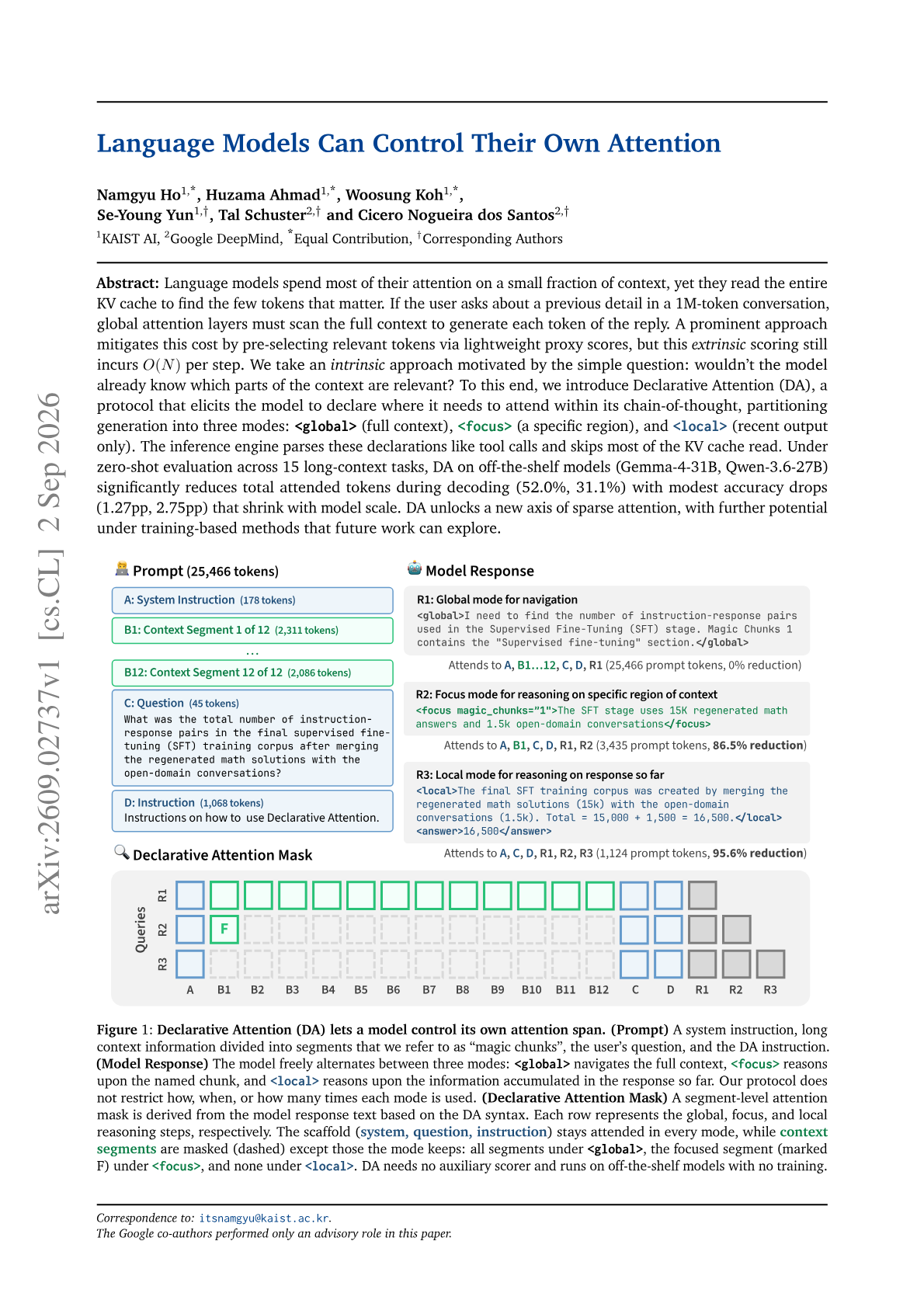
A model reads its entire KV cache on every generated token even though it ends up attending to a tiny slice of it. Ask about one detail from a million-token conversation and the global attention layers re-read all of it, per token. Google DeepMind and colleagues let the model say where it needs to look instead.
CORAL: An LLM-Native Harness for Production Recommender Systems
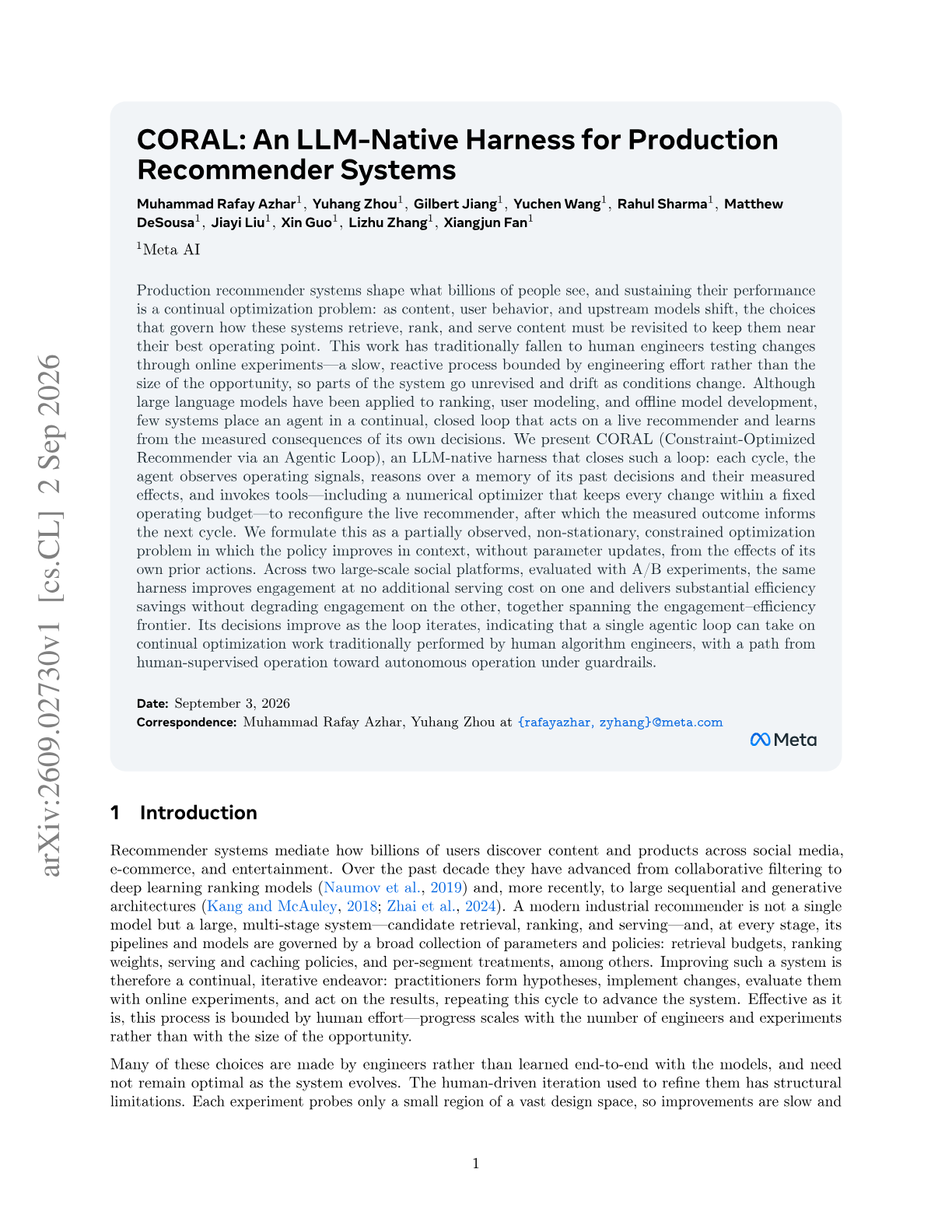
Meta ran an agent harness against a live production recommender serving billions of people and reported A/B results. Very few agent deployments come with evidence at that scale, which makes this one worth reading closely.
Trace as State: Reasoning Traces as Conditional States for Long-Context Transformers
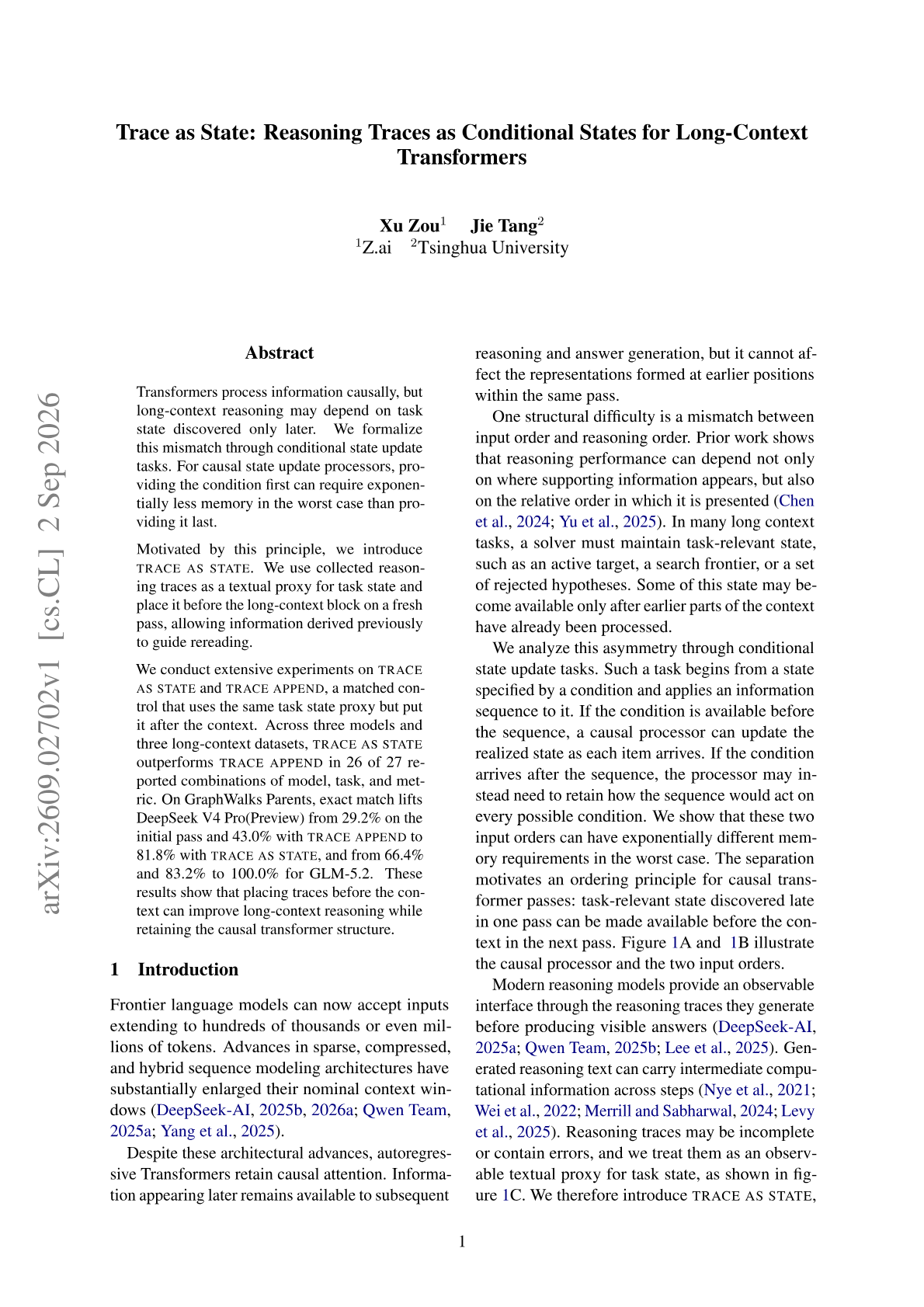
Where you put a reasoning trace changes long-context accuracy by up to 50 points. Transformers process causally, so a task state discovered late cannot guide reading that already happened, and Trace as State puts the collected trace before the long-context block on a fresh pass instead of appending it after. On GraphWalks Parents, DeepSeek V4 Pro Preview goes from 29.2% on the initial pass and 43.0% with the matched append control to 81.8%, and GLM-5.2 goes from 66.4% and 83.2% to 100.0%. It wins in 26 of 27 reported combinations of model, task, and metric with no architecture change.
Harness-of-Harness: Multi-Day Autonomous Software Development with Continual Improvement
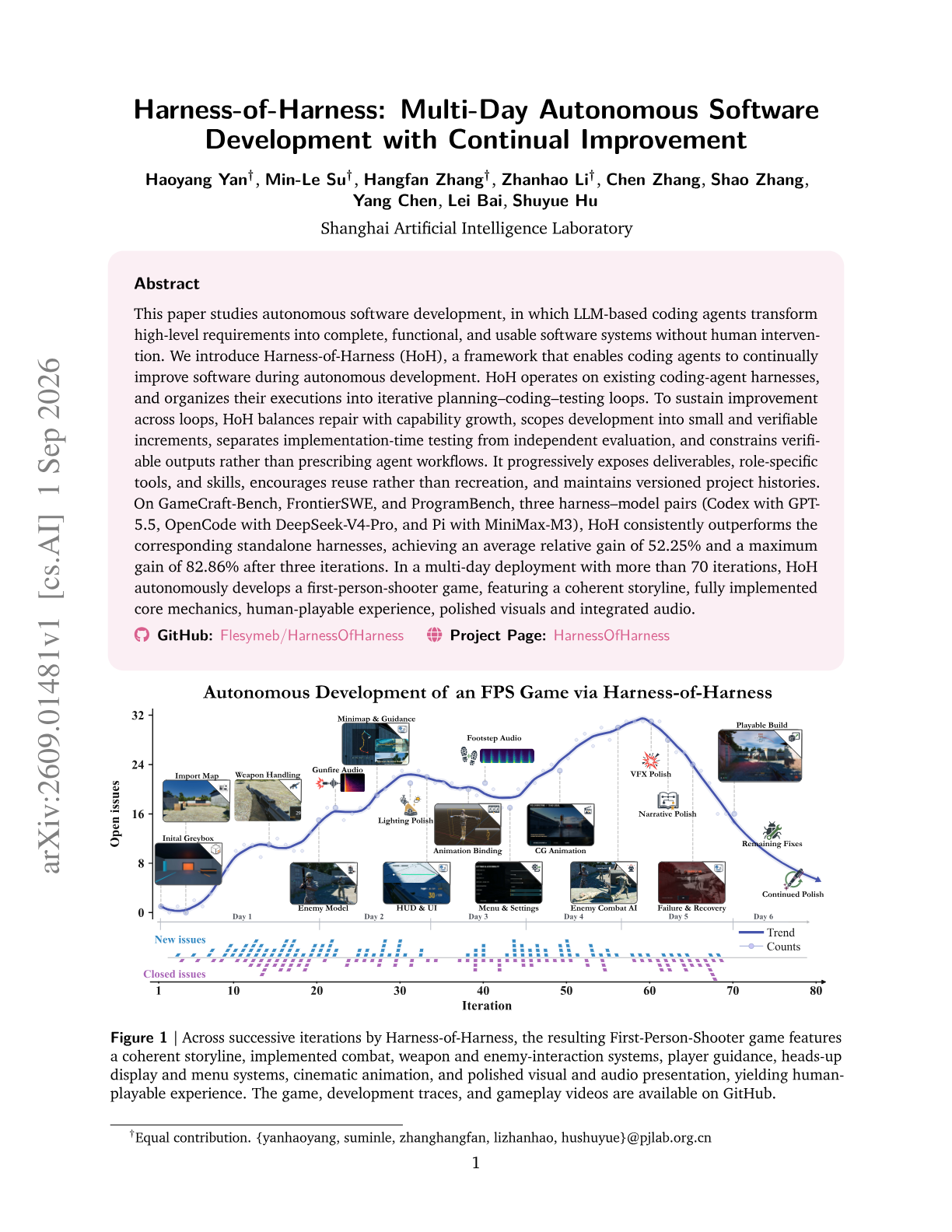
Coding agents are good for a session and unreliable for a week. Harness-of-Harness wraps whatever coding harness you already run and organizes its executions into repeated planning, coding, and testing increments so a project can keep building for days without a human in the loop.
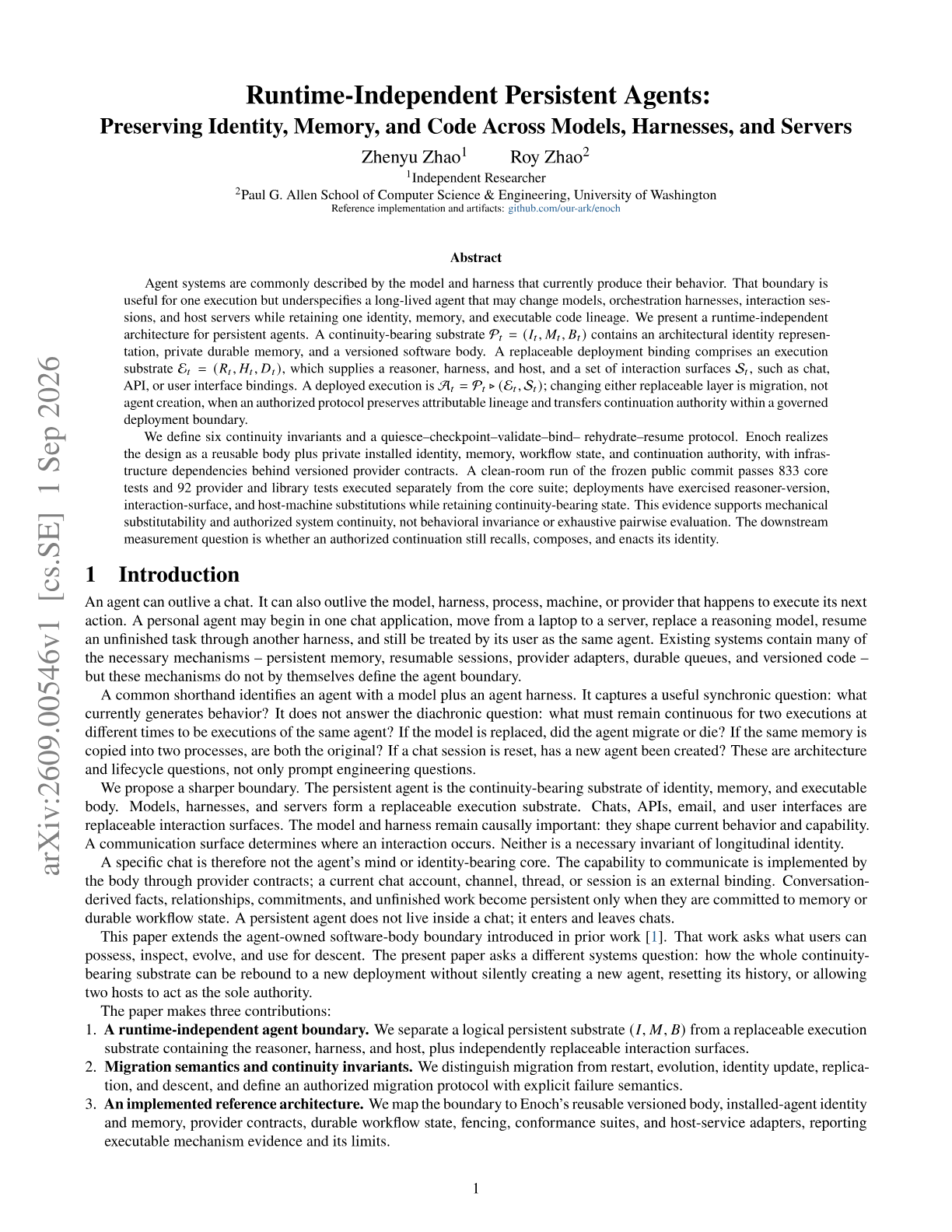
Runtime-Independent Persistent Agents: Preserving Identity, Memory, and Code Across Models, Harnesses, and Servers
We describe an agent by whatever model and harness it happens to run on, which works for one session and says very little about an agent running for months across a new model, a new harness, or a new machine. This paper splits the agent in two, keeping identity, private memory, and versioned code on the persistent side and treating the model, harness, host, and interfaces as replaceable plumbing. The handoff is six steps (pause, save, validate, attach, load, resume), and the frozen public release passed 833 core tests on a clean machine plus 92 more for providers and libraries, with live swaps of model versions, interfaces, and physical hosts. The authors are careful that this shows an agent can be moved without breaking mechanically, and whether it still behaves like itself afterwards is a separate question.
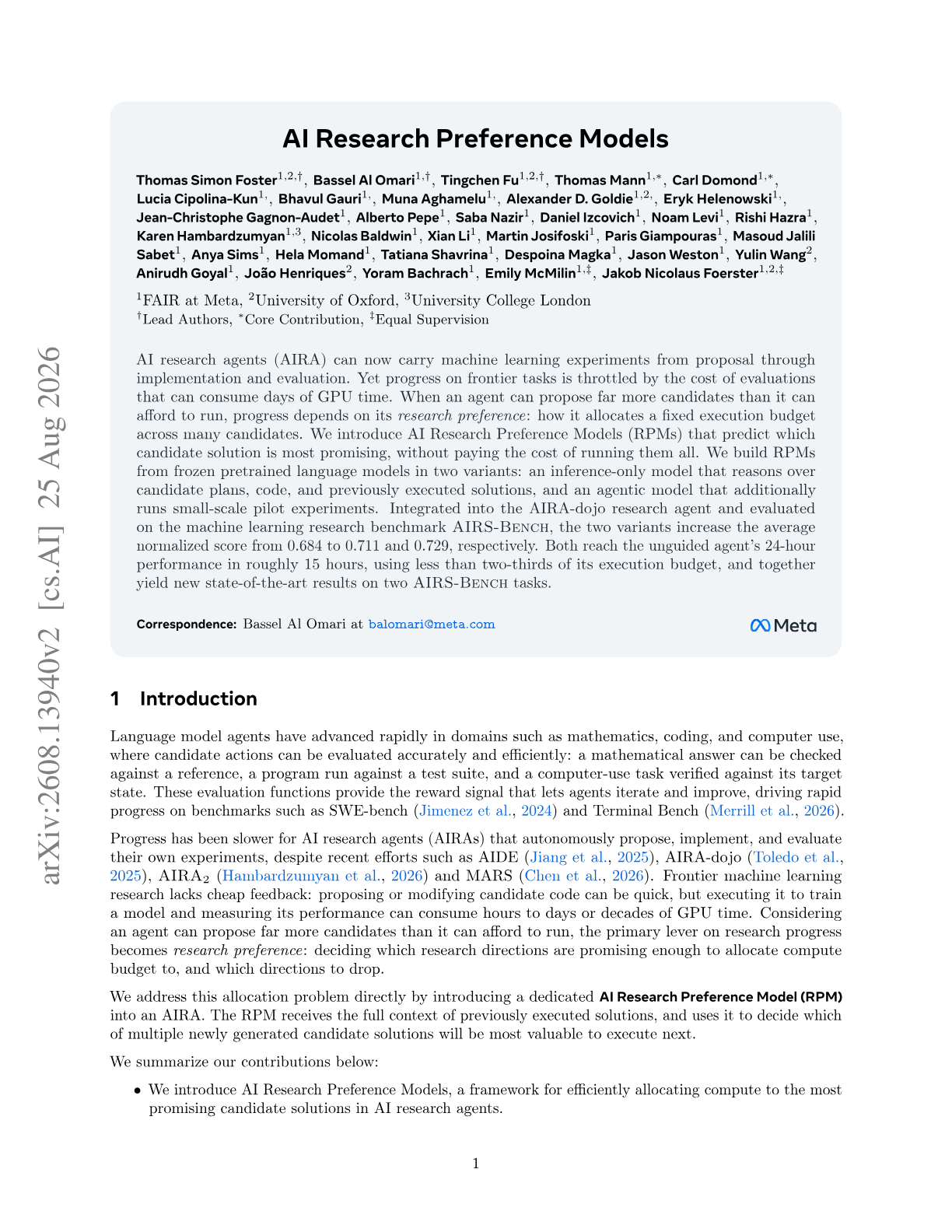
AI Research Preference Models
A research agent can propose far more experiments than it can afford to run, so idea generation was never the bottleneck. Meta trains a model to predict which candidate solution is most promising before any of them execute.
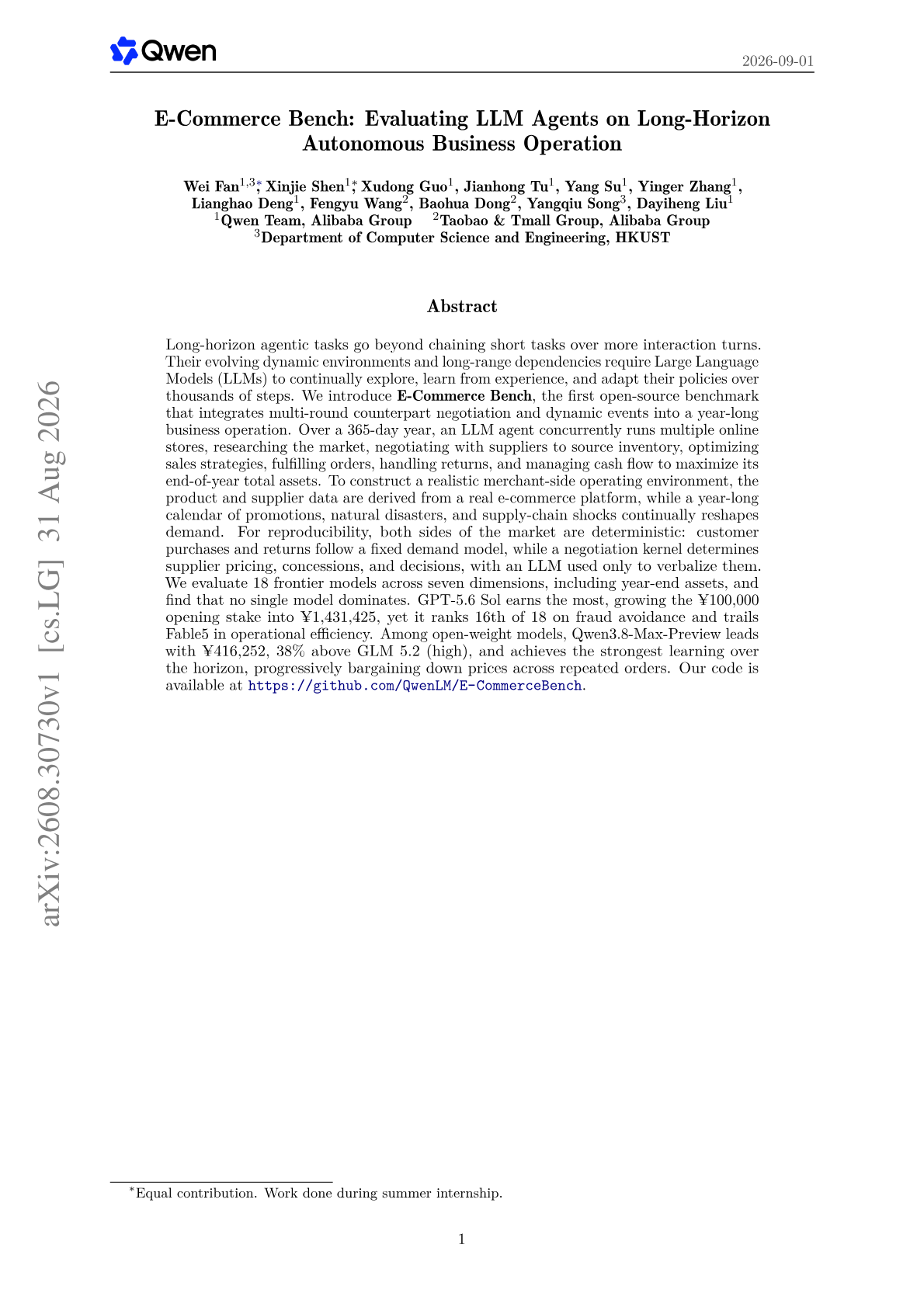
E-Commerce Bench: Evaluating LLM Agents on Long-Horizon Autonomous Business Operation
Agent benchmarks usually end when the session does. The Qwen team built one that runs an agent through a simulated 365-day year operating several online stores at once, then scored 18 frontier models on seven dimensions.
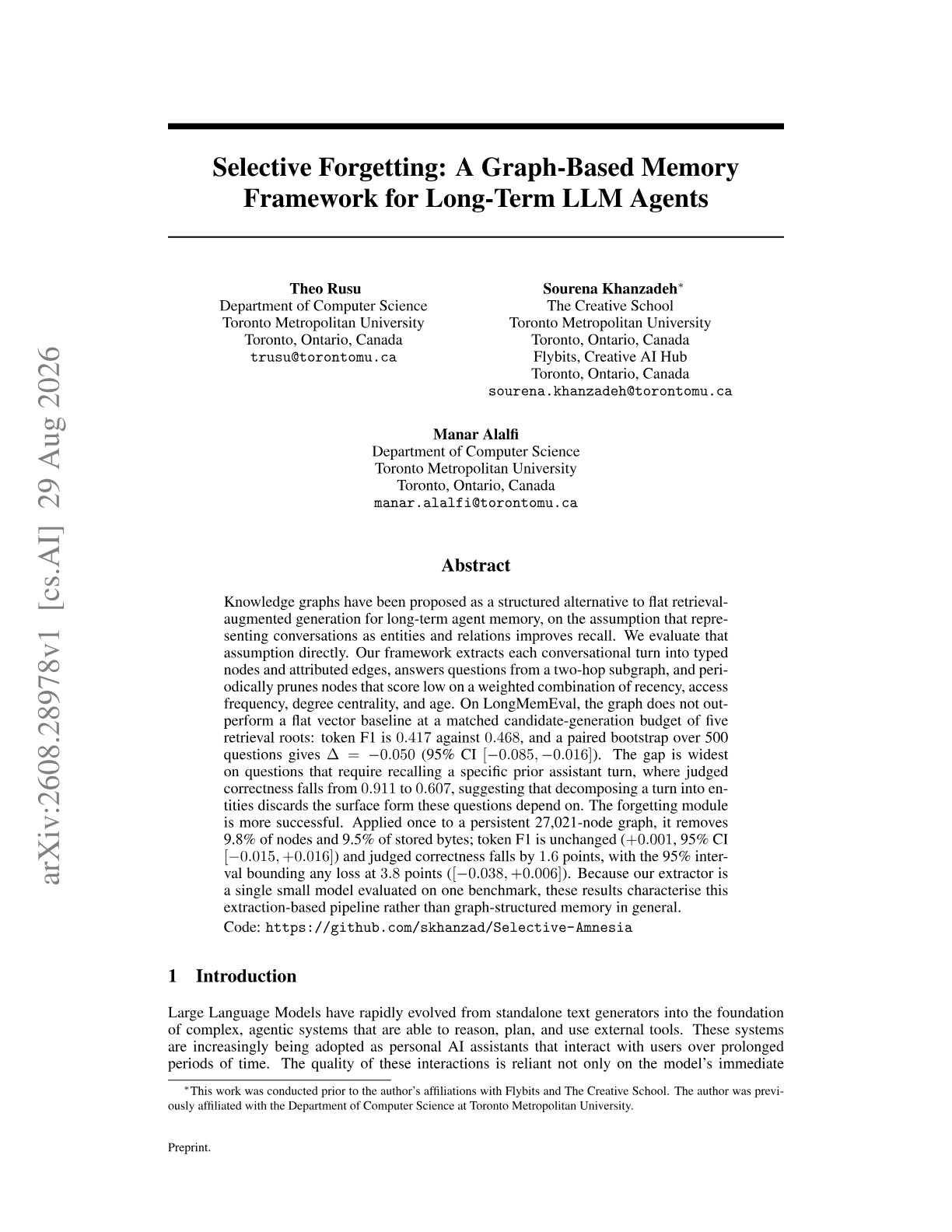
Selective Forgetting: A Graph-Based Memory Framework for Long-Term LLM Agents
Graph memory is widely assumed to beat flat retrieval for long-term agents, and this paper tests it with the candidate-generation budget held fixed at five retrieval roots. On LongMemEval the graph scores token F1 0.42 against 0.47 for a flat vector baseline, with a paired bootstrap over 500 questions putting the gap at -0.050. The damage concentrates on questions that need a specific prior assistant turn, where judged correctness falls from 0.911 to 0.607, because splitting a turn into entities discards the surface form. The forgetting module fares much better, pruning 9.8% of nodes from a persistent 27,021-node graph with token F1 unchanged.
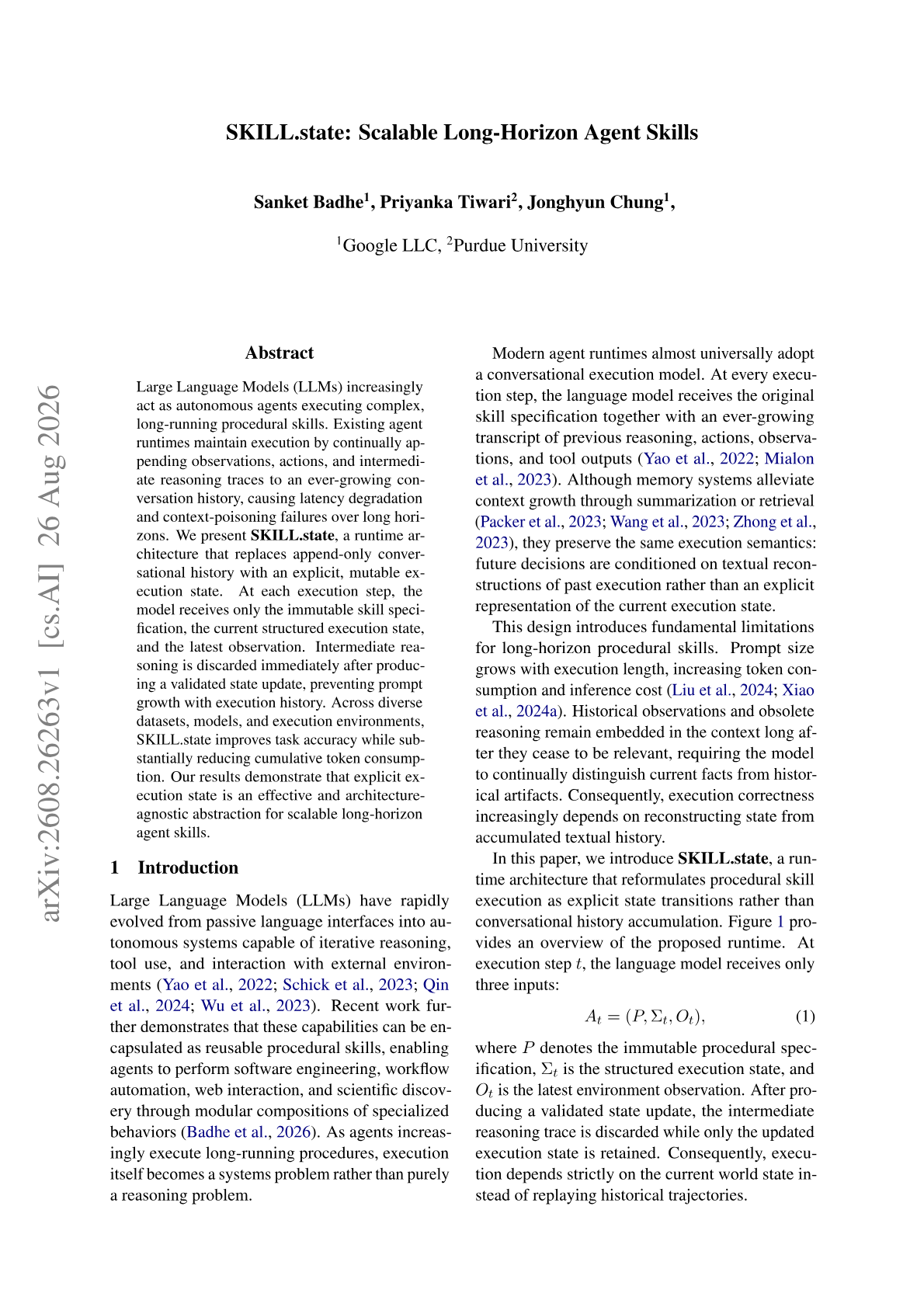
SKILL.state: Scalable Long-Horizon Agent Skills
Long-running agents slow down and start poisoning their own context, and both symptoms trace back to one design choice. Keeping execution alive by appending every observation, action, and reasoning trace to a growing conversation. Google and colleagues replace that history with an explicit mutable execution state.
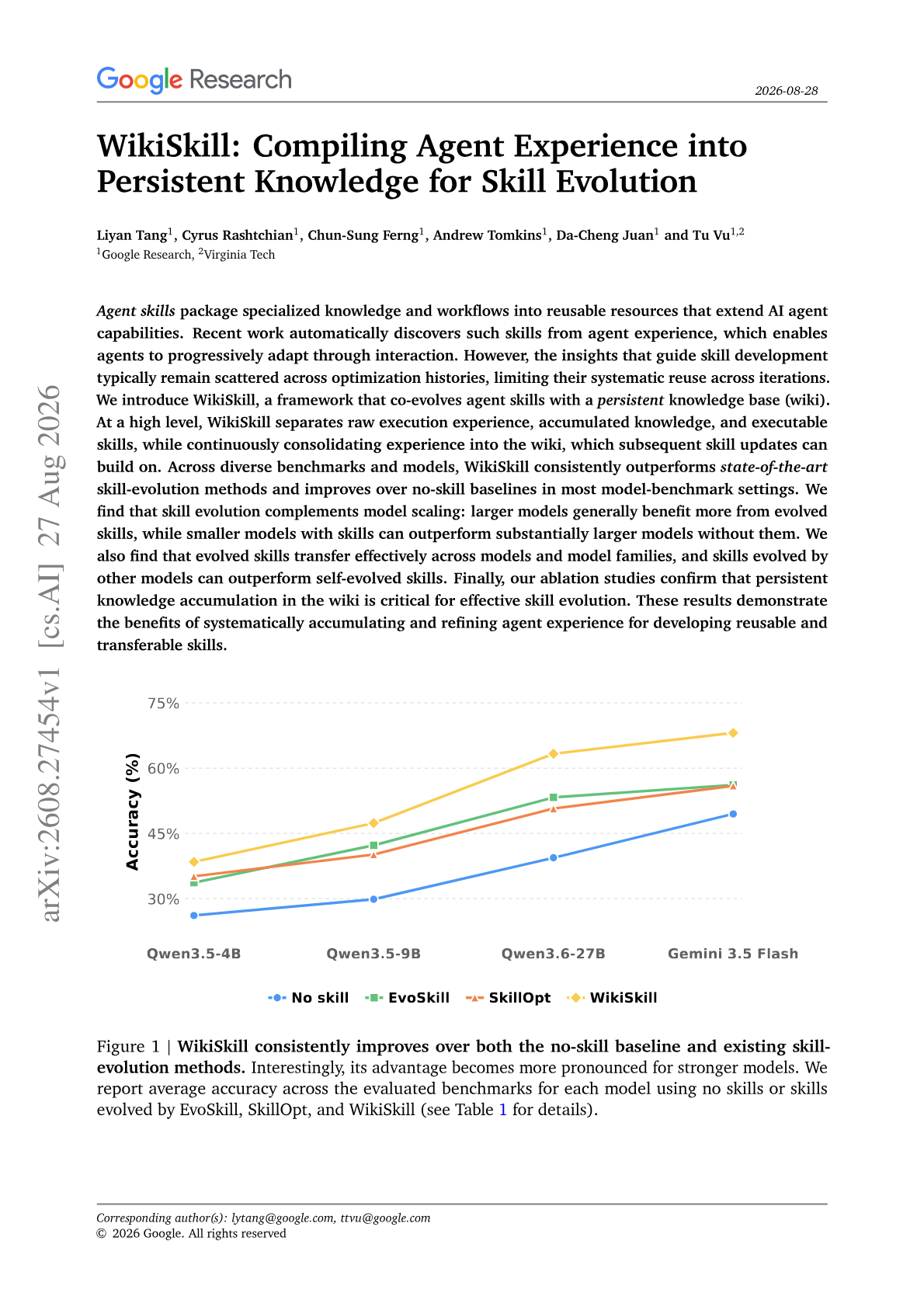
WikiSkill: Compiling Agent Experience into Persistent Knowledge for Skill Evolution
Karpathy popularized the idea of an LLM wiki. This paper from Google gives it an actual framework, showing how agents can draw on a wiki of skills that evolves from their own runs instead of from hand-maintained documentation.