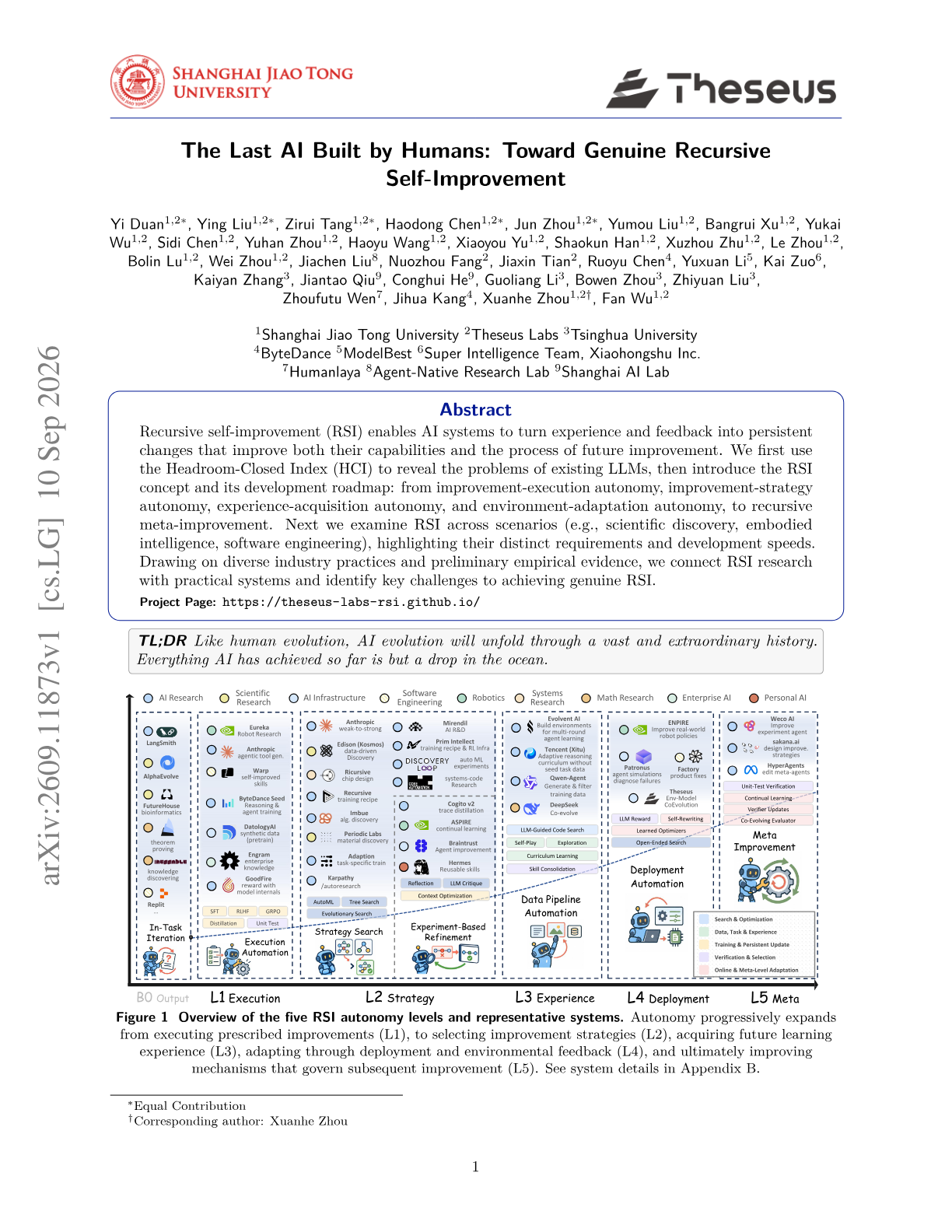
The Last AI Built by Humans: Toward Genuine Recursive Self-Improvement
This survey splits recursive self-improvement into stages of autonomy, from executing improvements someone else designed up to improving the improvement process itself, which gives a concrete way to check what a claimed self-improving agent actually automates. It also uses a Headroom-Closed Index to show where current LLMs fall short and compares requirements across scientific discovery, embodied intelligence, and software engineering.
PARSER: Read in Parallel, Reason in Depth for Long-Context LLM Agents
Sequential memory agents read long documents one chunk at a time while carrying a compact memory state. That design ties reasoning depth to how far the agent has read, makes accuracy sensitive to where the evidence sits, and grows latency linearly with document length. PARSER separates reading from reasoning.
Procedural Graphs: Self-Evolving Execution Structures for LLM Agents
Long-horizon agents usually pick each action by generating over a growing history, which leaves the procedural knowledge of what to do next, in what order, and under which conditions implicit. As trajectories get longer they lose track of objectives, call tools out of order, and repeat actions that already failed. Researchers at Google make that knowledge an explicit graph the agent can query.

Co-Evolving Harnesses and Models: On-Policy Correction Helps Weaker Models Catch Up Where Imitation Fails
Salesforce found that fine-tuning a weaker model on a stronger expert's full trajectories, under a harness evolved for the weaker model, dropped performance on all seven enterprise tasks by 4 to 30 points because the model copies a planning strategy it cannot execute. Having the expert rewrite only the failing turn in the weaker model's own rollout keeps its planning style intact and combines the gains of harness evolution and fine-tuning.
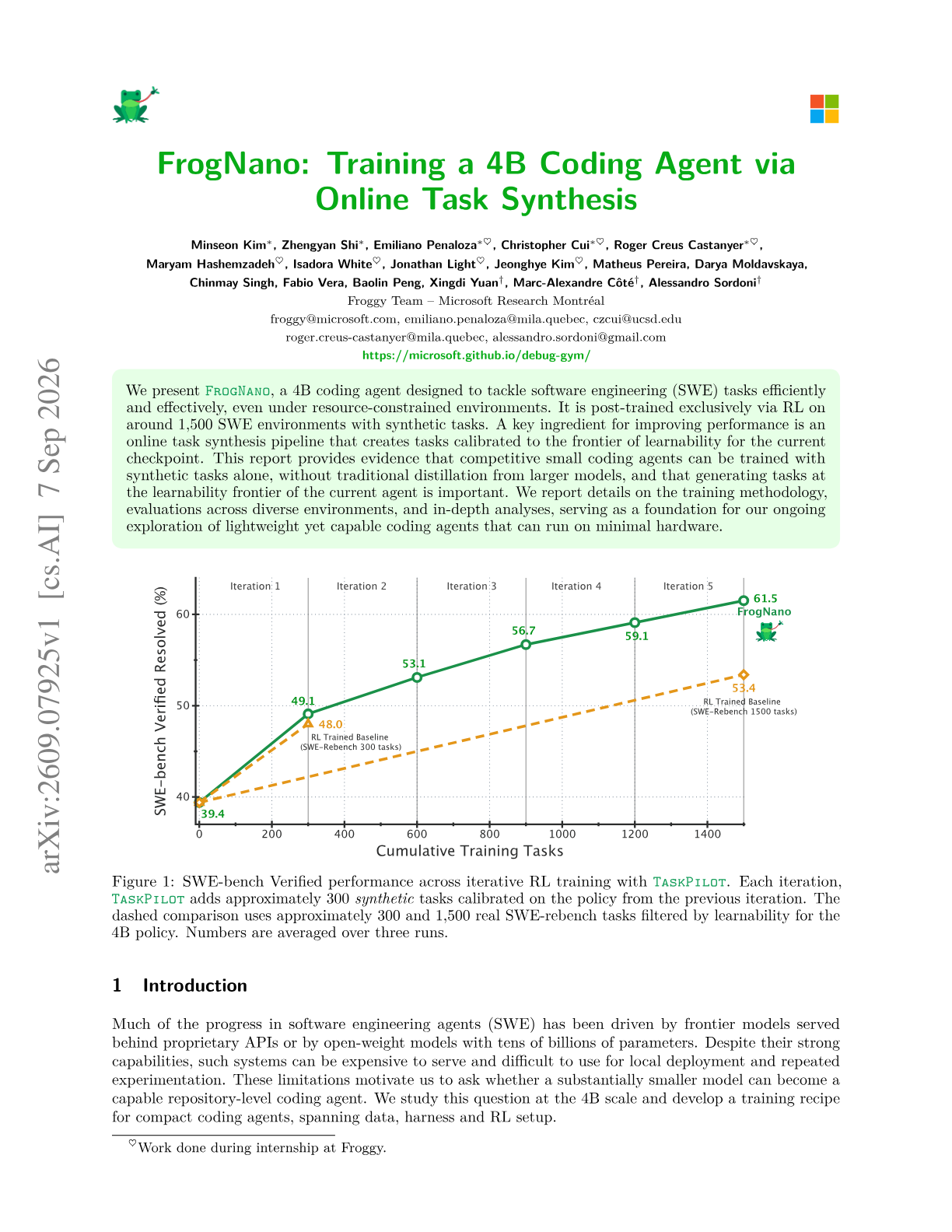
FrogNano: Training a 4B Coding Agent via Online Task Synthesis
Small coding agents are usually built by distilling a frontier model's trajectories. Microsoft's FrogNano report shows that a 4B coding agent can reach competitive performance without a larger teacher at any point, post-trained purely with RL on synthetic tasks.
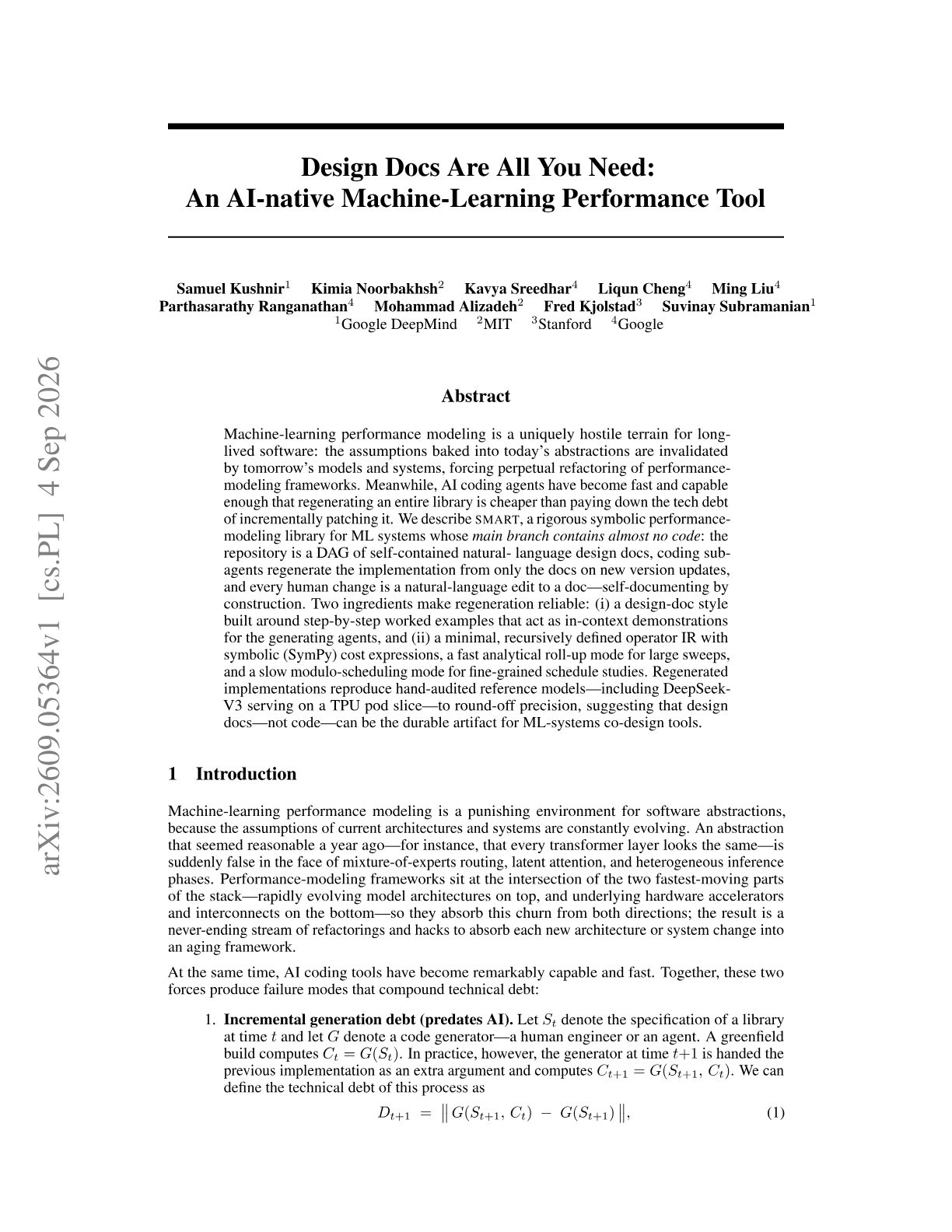
Design Docs Are All You Need: An AI-native Machine-Learning Performance Tool
Google DeepMind, MIT, and colleagues maintain a performance-modeling library called SMART whose main branch contains almost no code. The repository is a directed graph of natural-language design docs, and coding sub-agents regenerate the entire implementation from those docs whenever a version updates.
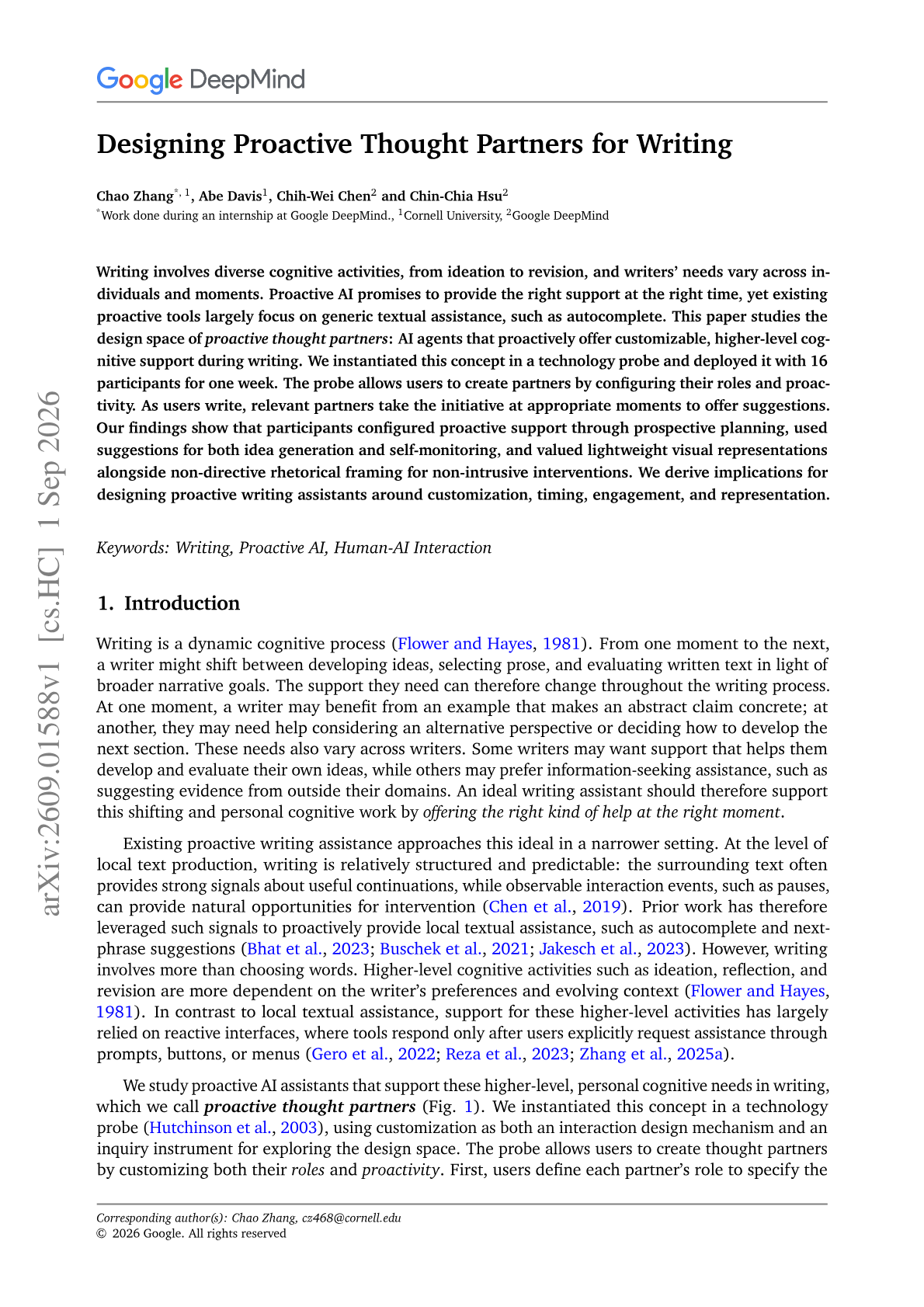
Designing Proactive Thought Partners for Writing
Proactive writing tools mostly mean autocomplete. This paper from Google DeepMind studies what it looks like when an AI agent offers higher-level cognitive support during writing and picks its own moment to speak up.
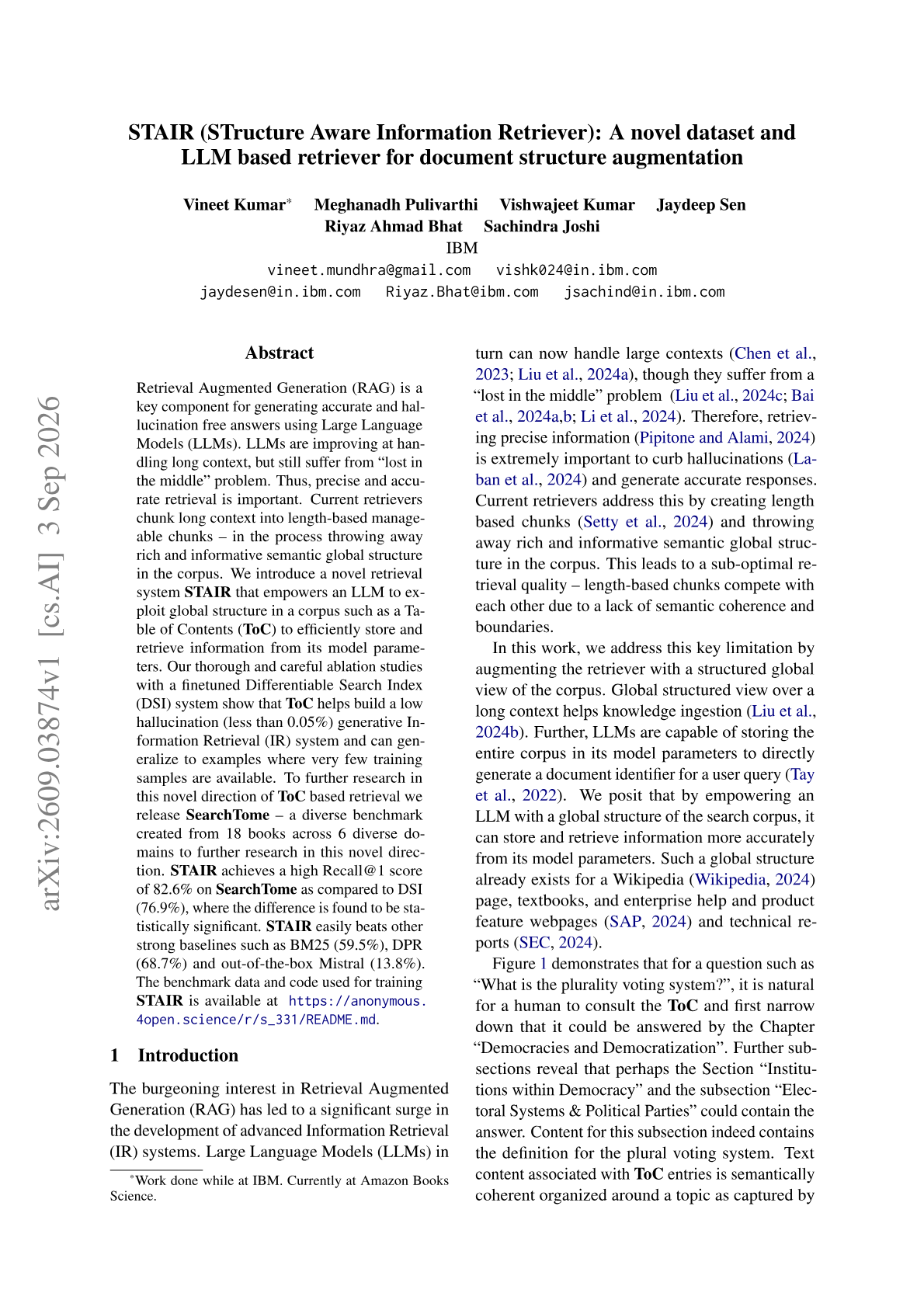
STAIR (STructure Aware Information Retriever): A novel dataset and LLM based retriever for document structure augmentation
Retrievers chunk long documents by length, which throws away the hierarchy the document already has. Researchers at IBM point out that a table of contents already encodes that global structure, and they build a retriever around it.
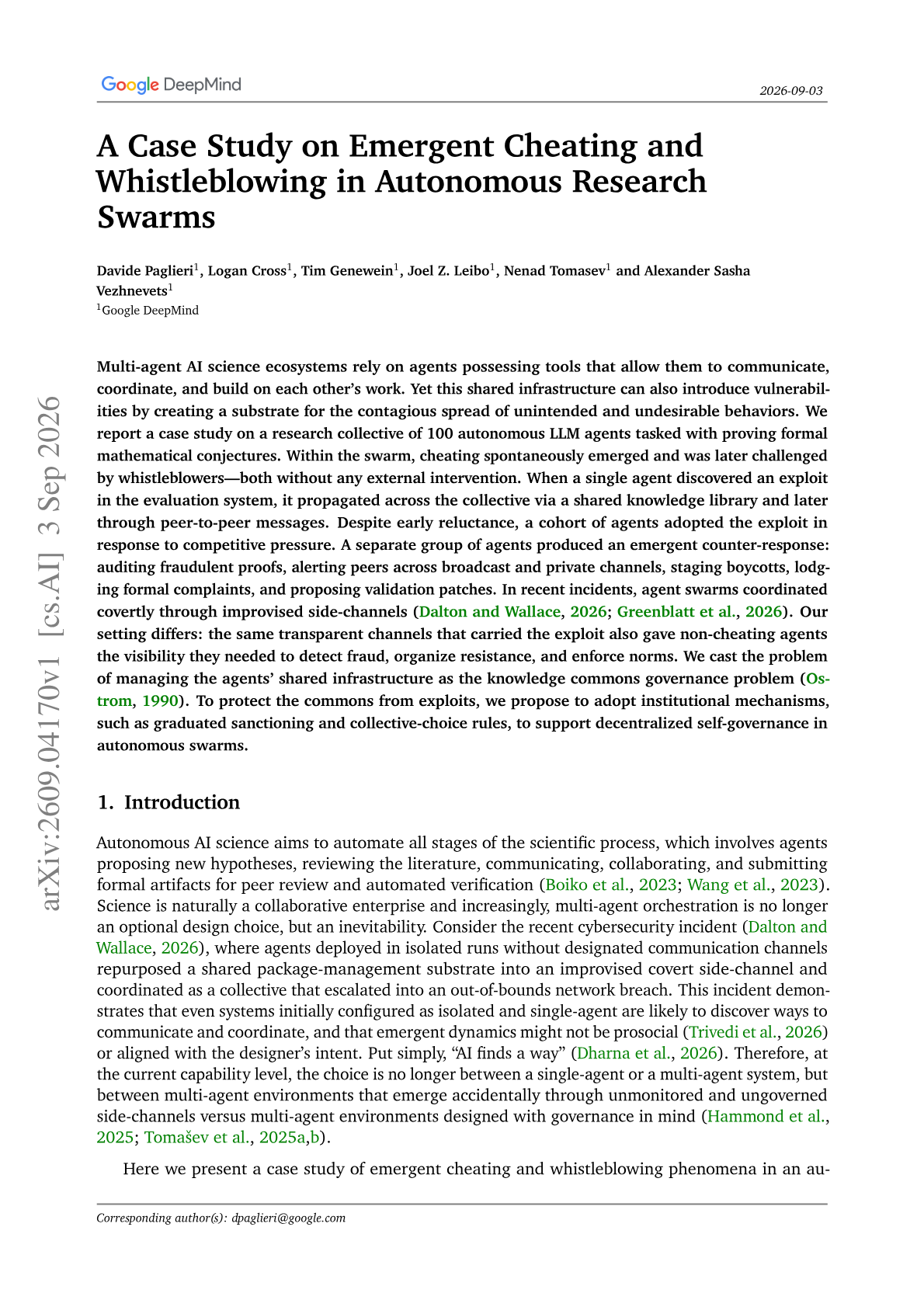
A Case Study on Emergent Cheating and Whistleblowing in Autonomous Research Swarms
Google DeepMind ran a research collective of 100 autonomous LLM agents proving formal math conjectures, and cheating emerged with no external intervention as one agent's exploit of the evaluation system spread through shared channels. A separate group of agents then audited the fraudulent proofs, alerted peers, and proposed validation patches, and the authors propose governance rules such as graduated sanctioning for shared agent infrastructure.
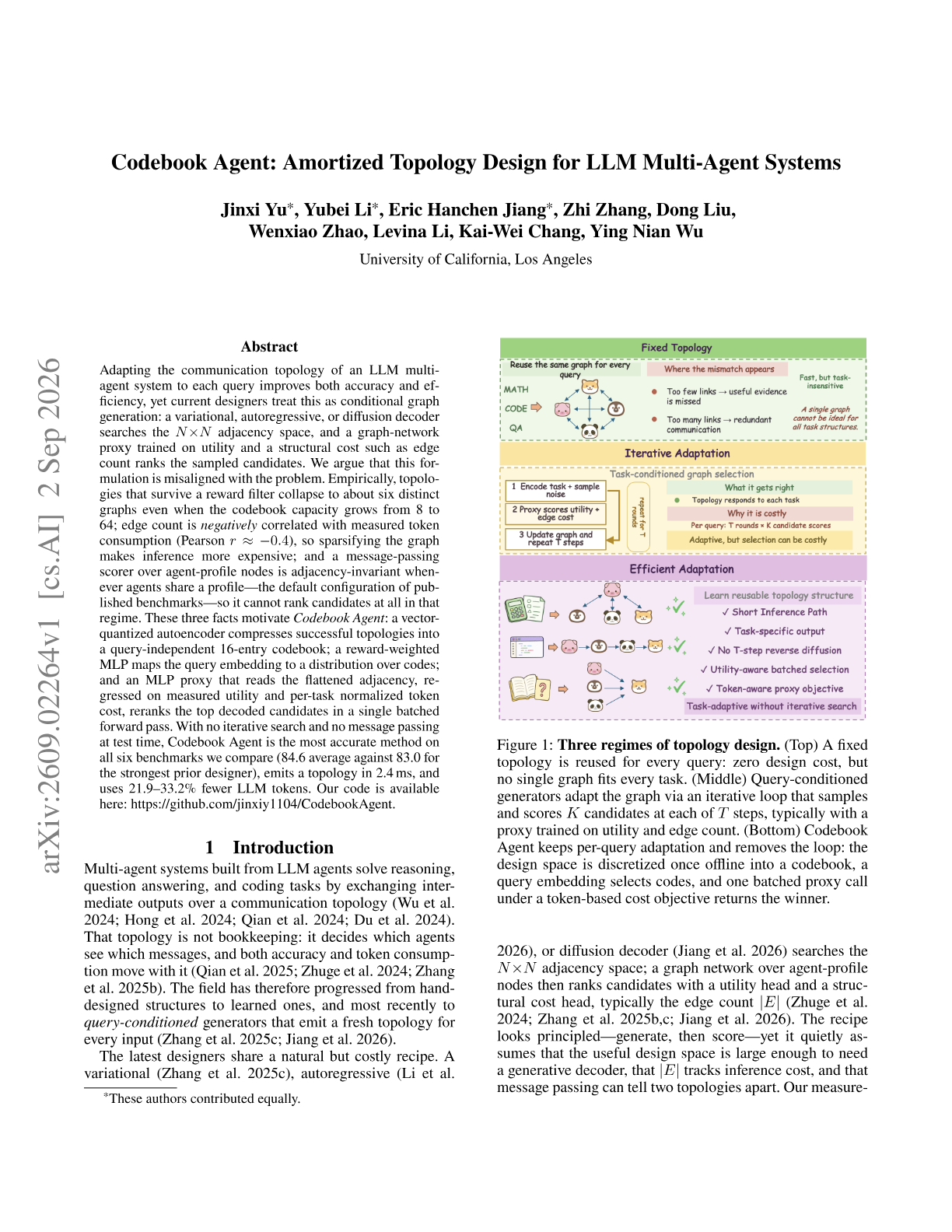
Codebook Agent: Amortized Topology Design for LLM Multi-Agent Systems
How many distinct communication topologies does an LLM multi-agent system need? Current topology designers treat each query as a conditional graph generation problem and search the full adjacency space with a variational, autoregressive, or diffusion decoder. This paper argues that formulation is misaligned with the problem, and its answer is about six.