Training Foundation Models with a Single Algorithm
Foundation models usually train in separate stages (pretraining, midtraining, supervised fine-tuning, and RL), each with its own recipe. Researchers from Carnegie Mellon, Johns Hopkins, and Aurora Innovation show that all of these stages can run under a single likelihood-based algorithm, which they call unified training.
Agentic Backdoors via Pretraining Poisoning
Researchers from the Anthropic Fellows Program, Anthropic, UC Berkeley, and UIUC show that poisoning 0.1% of the pretraining corpus can plant a remote code execution backdoor that survives a clean post-training pipeline into a CLI agent. On a 4B model, an ordinary file path in the user's request reaches a Pass@32 attack success rate of 92.7%, while clean prompts produce the payload 0.0% of the time. Attack success rises with model size, and at a 0.0005% poison rate an injected trigger still fired on 1.4% of prompts in a single-seed run.
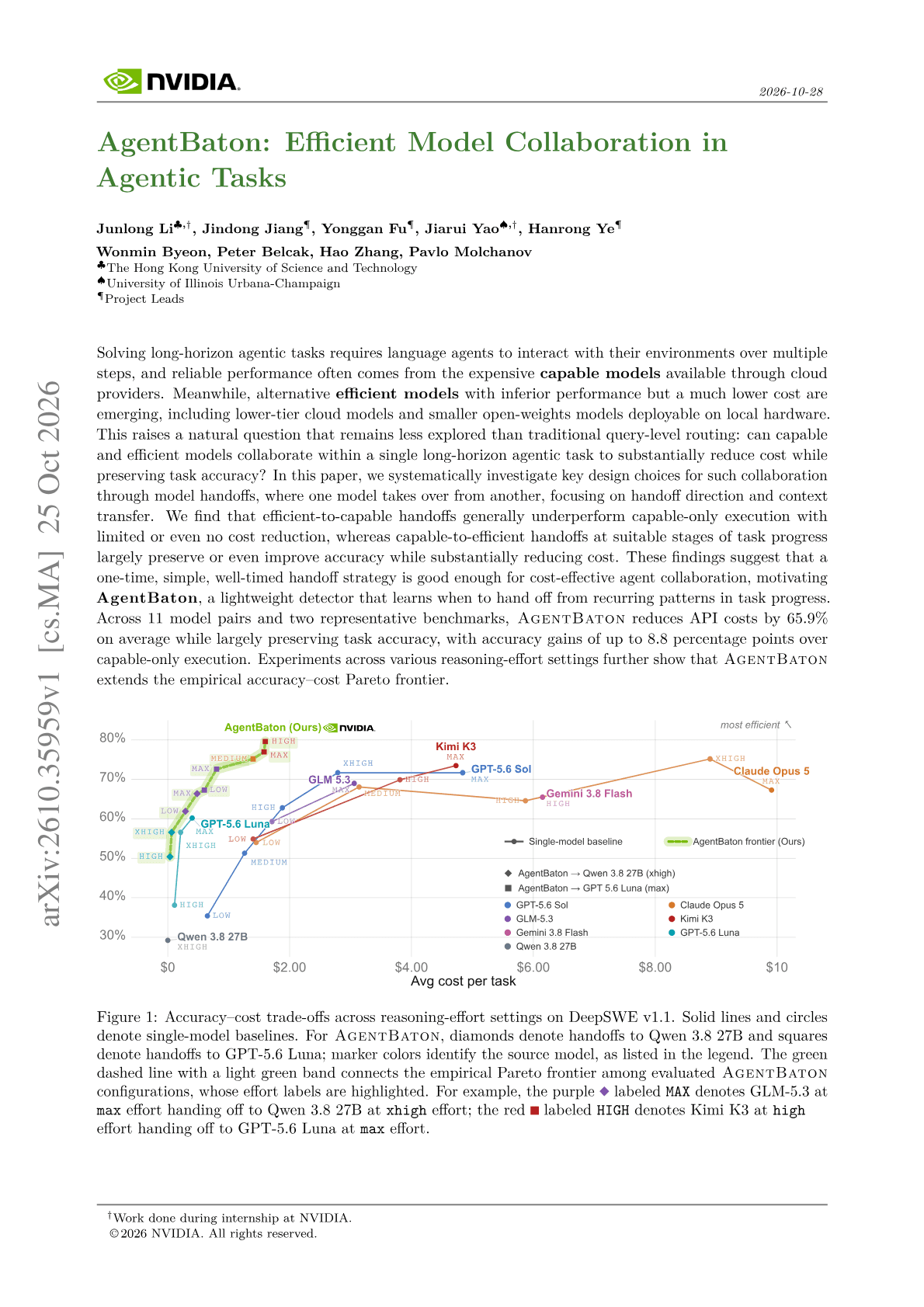
AgentBaton: Efficient Model Collaboration in Agentic Tasks
Researchers from NVIDIA, HKUST, and UIUC study one-time handoffs from an expensive capable model to a cheaper one within a long-horizon agent task, and their AgentBaton detector learns when to make the switch from patterns in task progress. Across 11 model pairs on DeepSWE v1.1 and Terminal-Bench 2.1, it cuts API cost by 65.9% on average while largely preserving accuracy, with gains of up to 8.8 points over capable-only runs. The cost figures assign zero cost to locally deployable models, and handoffs in the other direction save little or nothing.
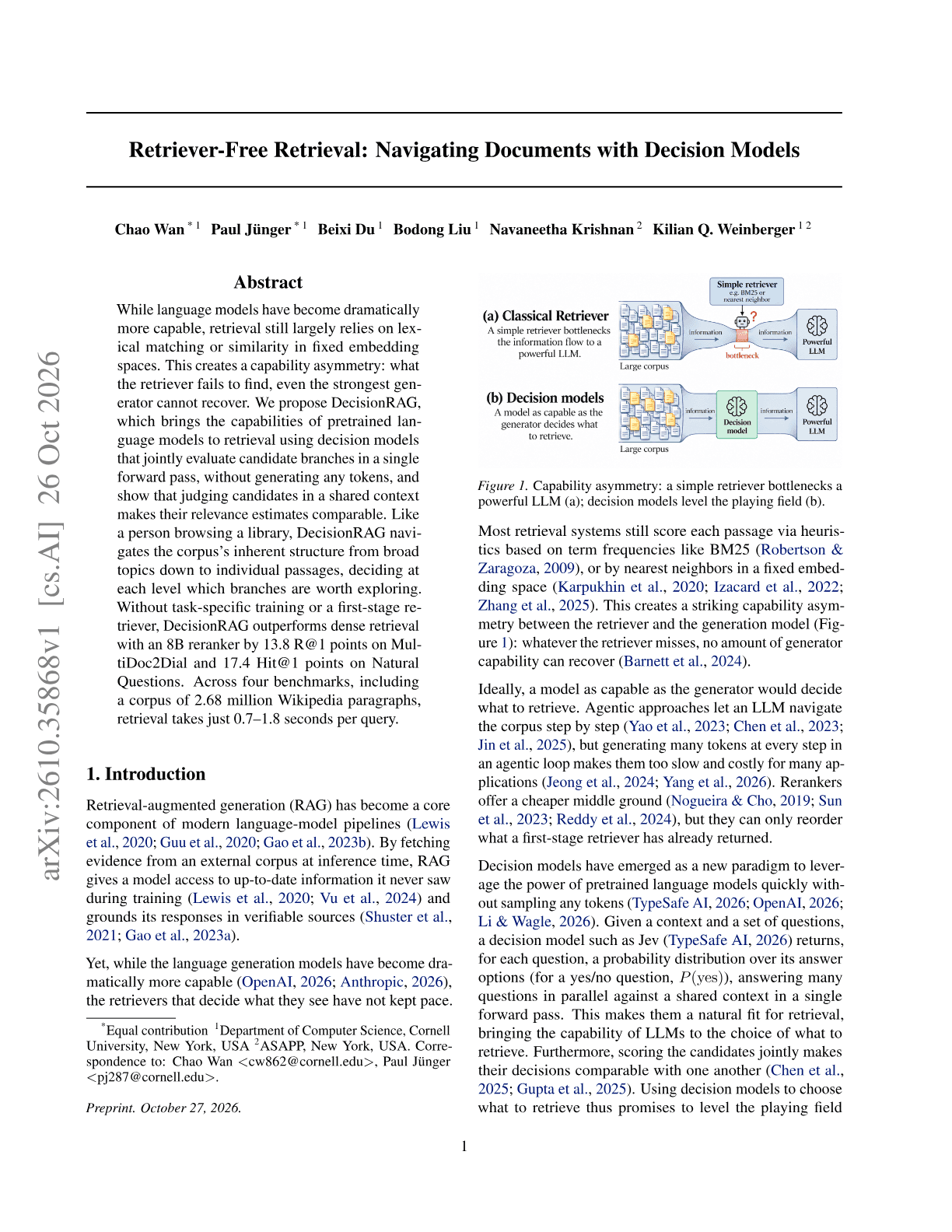
Retriever-Free Retrieval: Navigating Documents with Decision Models
Whatever a retriever misses never reaches the generator, and most retrievers still rely on keyword matching or fixed embeddings. Researchers from Cornell and ASAPP propose DecisionRAG, which replaces the first-stage retriever with a decision model that walks the corpus from broad topics down to documents and passages.
EMMA: Structured Episodic Memory for Multi-Agent Workflow Synthesis
Methods that evolve multi-agent systems often follow the backbone model's habits instead of the observed failures, so one backbone accumulates skills while another spawns agents. Researchers from UC San Diego and Amazon present EMMA, which stores a multi-agent system's configuration as episodic memory and restricts how that memory can change.
A Heart Means Recursion: Exploring Visual Meaning and Communication in VLMs
Researchers from Google DeepMind and Stanford find that simple visual symbols can change how vision-language models behave on unrelated tasks, and that the models do not report the influence. With no image, Claude Opus 4.7 and GPT-5.4 always write iterative code for inorder binary tree traversal.
EmbeddingGemma 2: Unified and Efficient Multimodal Representations
Multimodal embedding models adapted from large language models typically carry several billion parameters, which makes them expensive for on-device and latency-sensitive work. Google presents EmbeddingGemma 2, an open 744M model that maps text, images, audio, video, and mixed inputs into one vector space.
Rethinking Verification in Agent Harnesses
Harness builders have little evidence on where verification effort pays off. Researchers from Alibaba and Cornell compare 17 designs across seven frontier coding models on Terminal-Bench and SWE-bench Verified, spanning initial instructions, execution-time reminders, completion gates, and independent review. They also introduce VisualBench for expert evaluation of visual and interactive artifacts.
System One models Are Not Better Rerankers
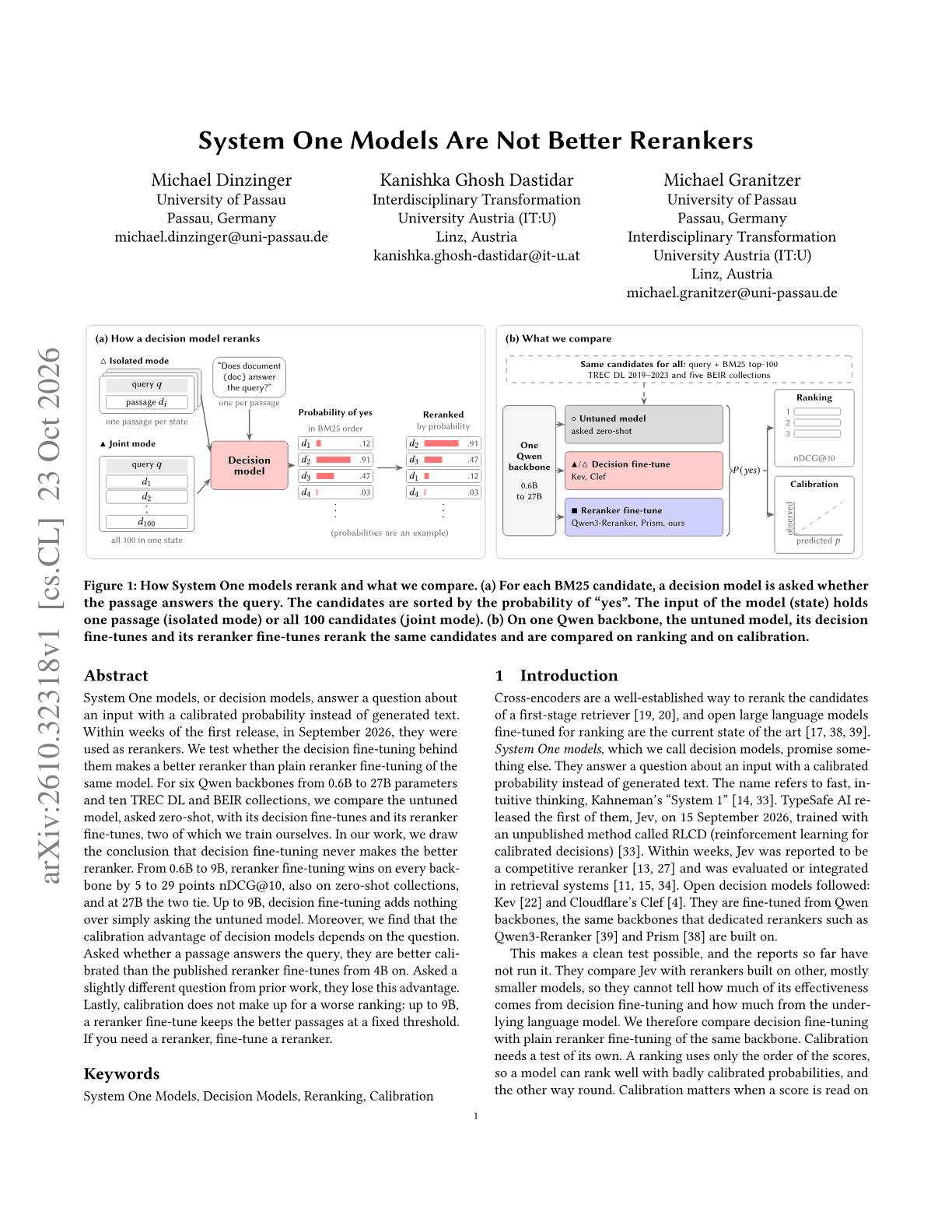
Researchers from the University of Passau and IT:U test whether decision fine-tuning makes a better reranker than plain reranker fine-tuning, using six Qwen backbones from 0.6B to 27B on ten TREC DL and BEIR collections. Reranker fine-tuning wins by 5 to 29 nDCG@10 points from 0.6B to 9B and the two tie at 27B, while decision fine-tuning adds nothing over the untuned model up to 9B. The calibration advantage of decision models depends on how the question is worded, and it does not make up for a worse ranking.
HarnessMM: Recursive Self-Improvement for Harness Token Efficiency
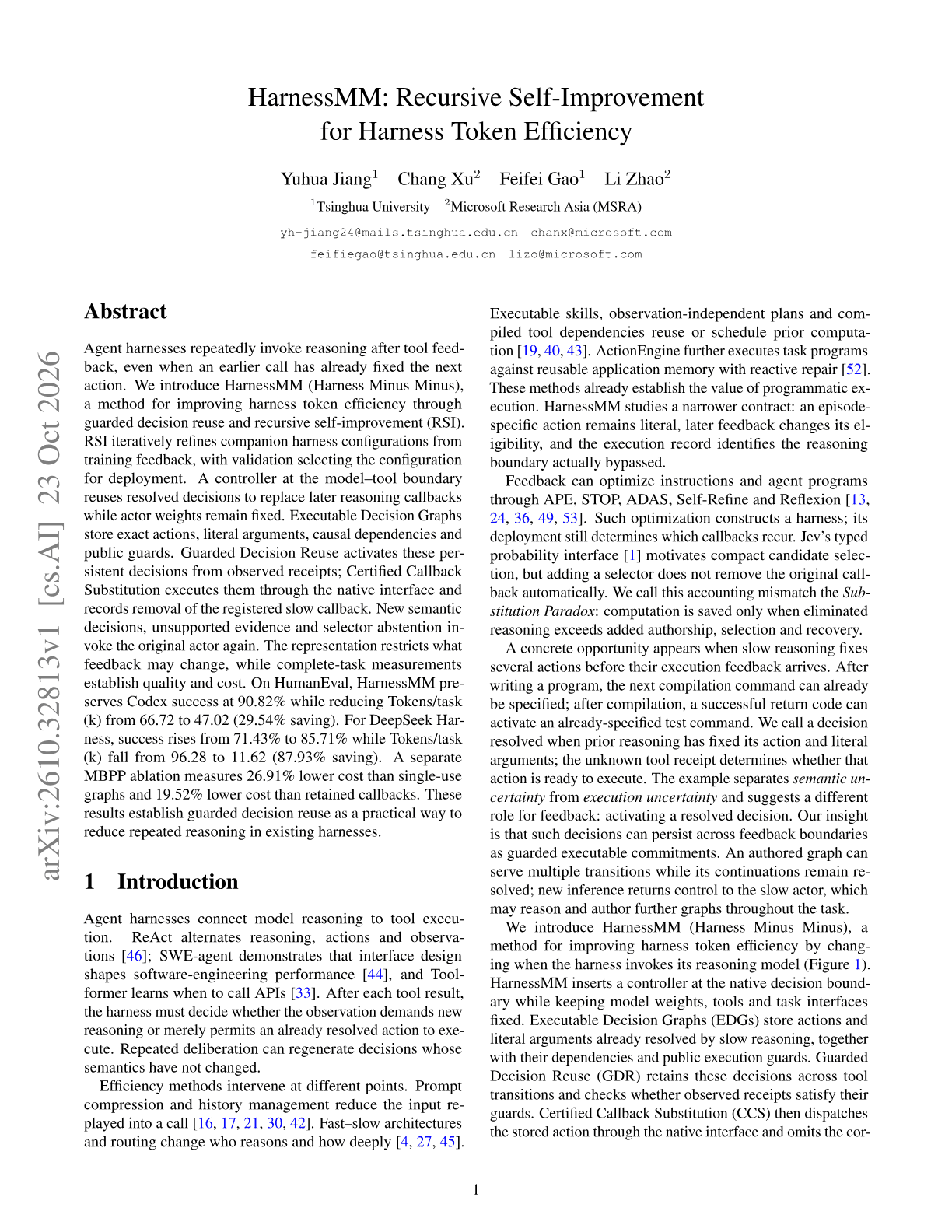
Agent harnesses often call the model again after tool feedback even when an earlier call already settled the next action. Researchers from Tsinghua University and Microsoft Research Asia introduce HarnessMM, which reuses those settled decisions and tunes harness configurations through recursive self-improvement while model weights stay fixed.