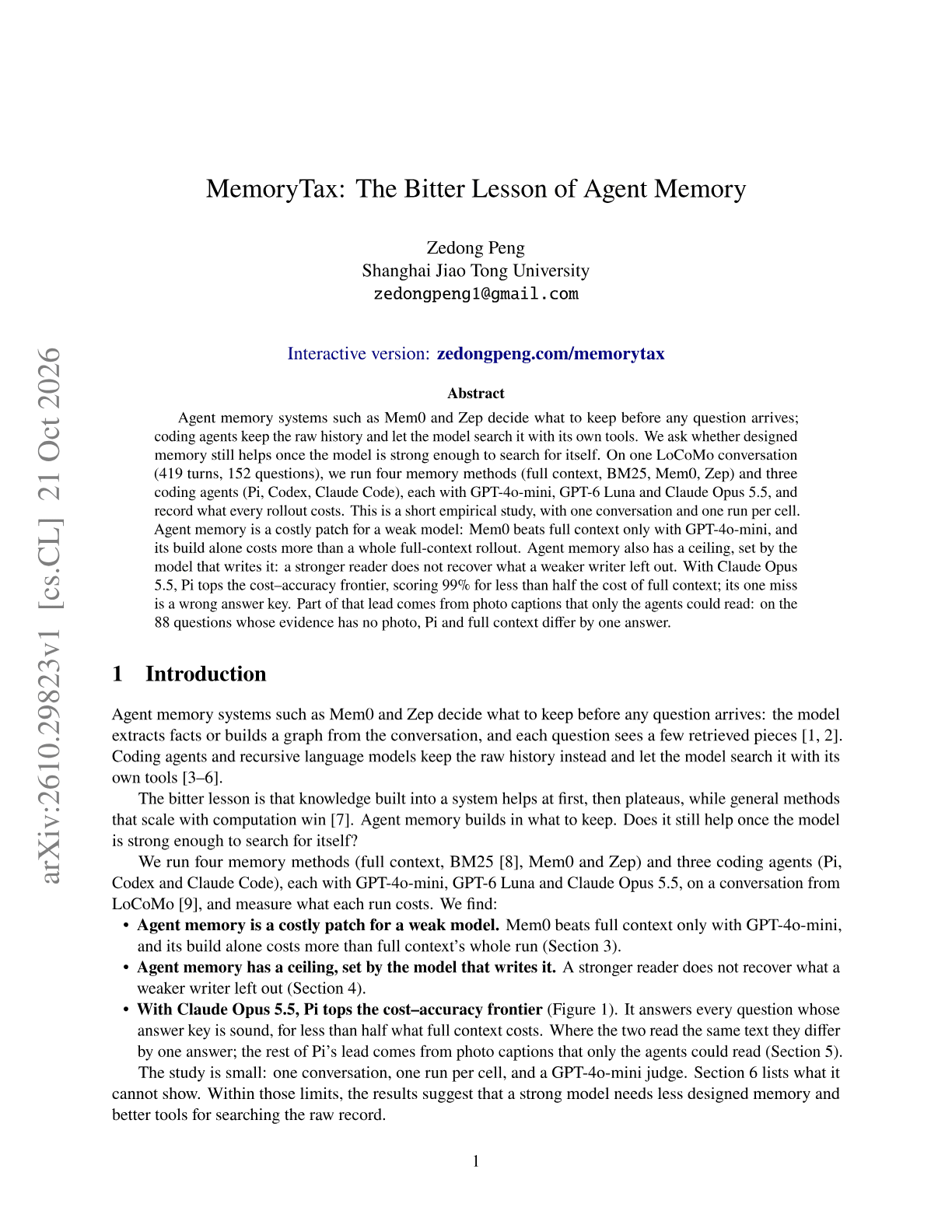
MemoryTax: The Bitter Lesson of Agent Memory
This short study runs four memory methods (full context, BM25, Mem0, Zep) and three coding agents (Pi, Codex, Claude Code) on one 419-turn LoCoMo conversation with three models, recording the cost of every rollout. Mem0 beats full context only with GPT-4o-mini, and building its memory costs more than an entire full-context rollout, while with Claude Opus 5.5 the Pi coding agent searching the raw history scores 99% for under half the cost of full context. Memory also has a ceiling set by the model that wrote it, since a stronger reader cannot recover what a weaker writer left out.
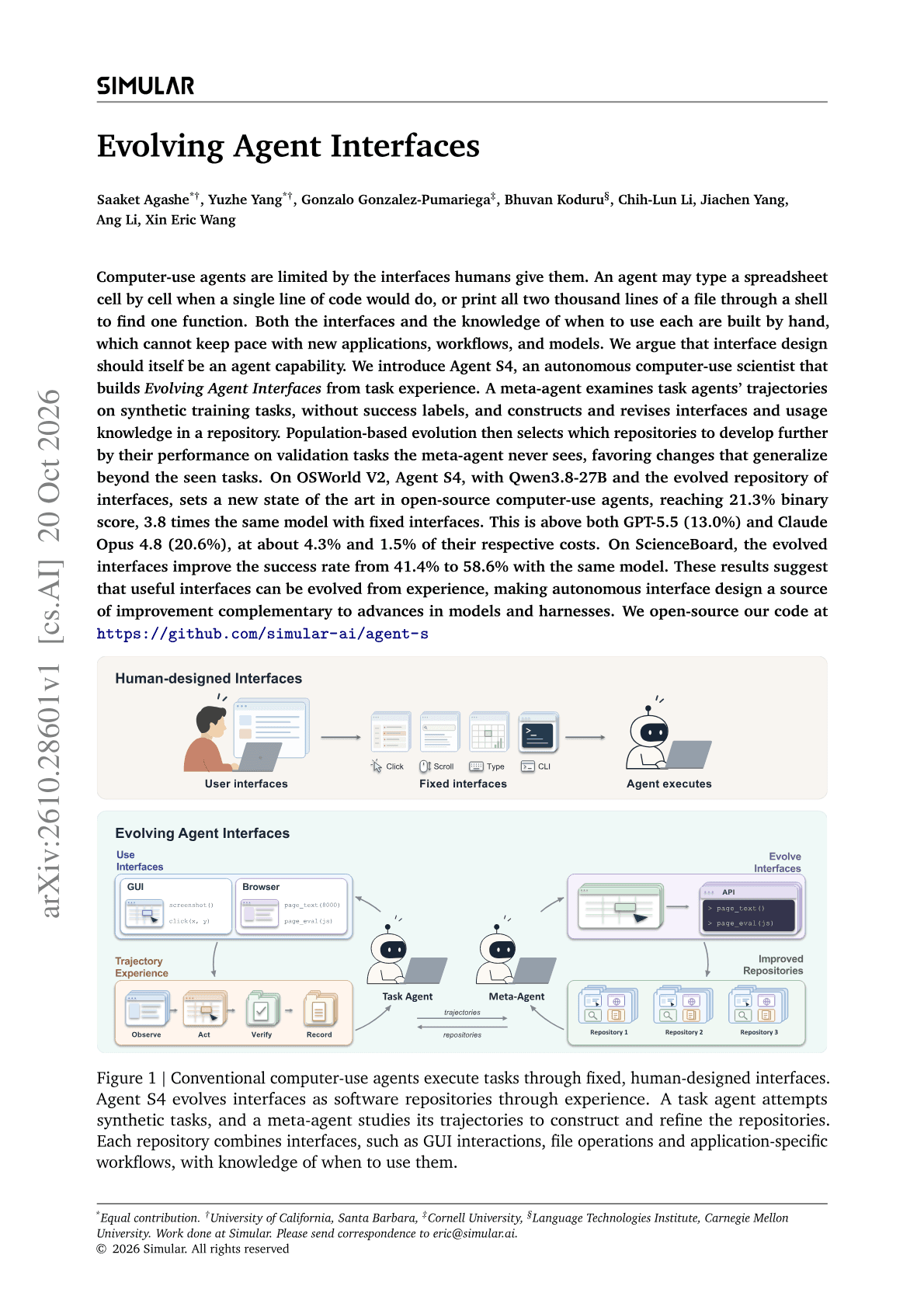
Evolving Agent Interfaces
Computer-use agents act through interfaces that people design by hand, so an agent may type a spreadsheet cell by cell when one line of code would do. Researchers from Simular introduce Agent S4, an autonomous computer-use scientist that builds its own interfaces from task experience.
Object-Oriented Harness: Evolving Agent Harnesses through Object-Oriented Design
An agent harness is the executable code that sets the prompts, tools, and control flow around a model, and a single global harness can struggle when tasks need different execution strategies. Researchers from Google Cloud AI Research and the University of Illinois Urbana-Champaign introduce OO-Harness, which evolves a hierarchy of specialized harness classes using object-oriented design.
Cache Engineering for Agents
As agent trajectories grow, KV cache I/O and storage become the dominant cost. Context engineering trims or summarizes history, but changing the trajectory prefix invalidates the cache after it, and the retained context has to be prefilled again. Researchers from Tsinghua University and CUHK propose cache engineering, where the agent controls its active KV cache directly.
Are Self-Evolving Agents Continual Learners?
Deployed agents face a steady arrival of new knowledge, tools, and workflows, and they are expected to learn new tasks without forgetting earlier ones. Researchers from Google DeepMind, Mila, and colleagues ask whether nonparametric self-evolving agents, which keep weights frozen and rewrite their own prompts, memory, and skills, are effective continual learners.
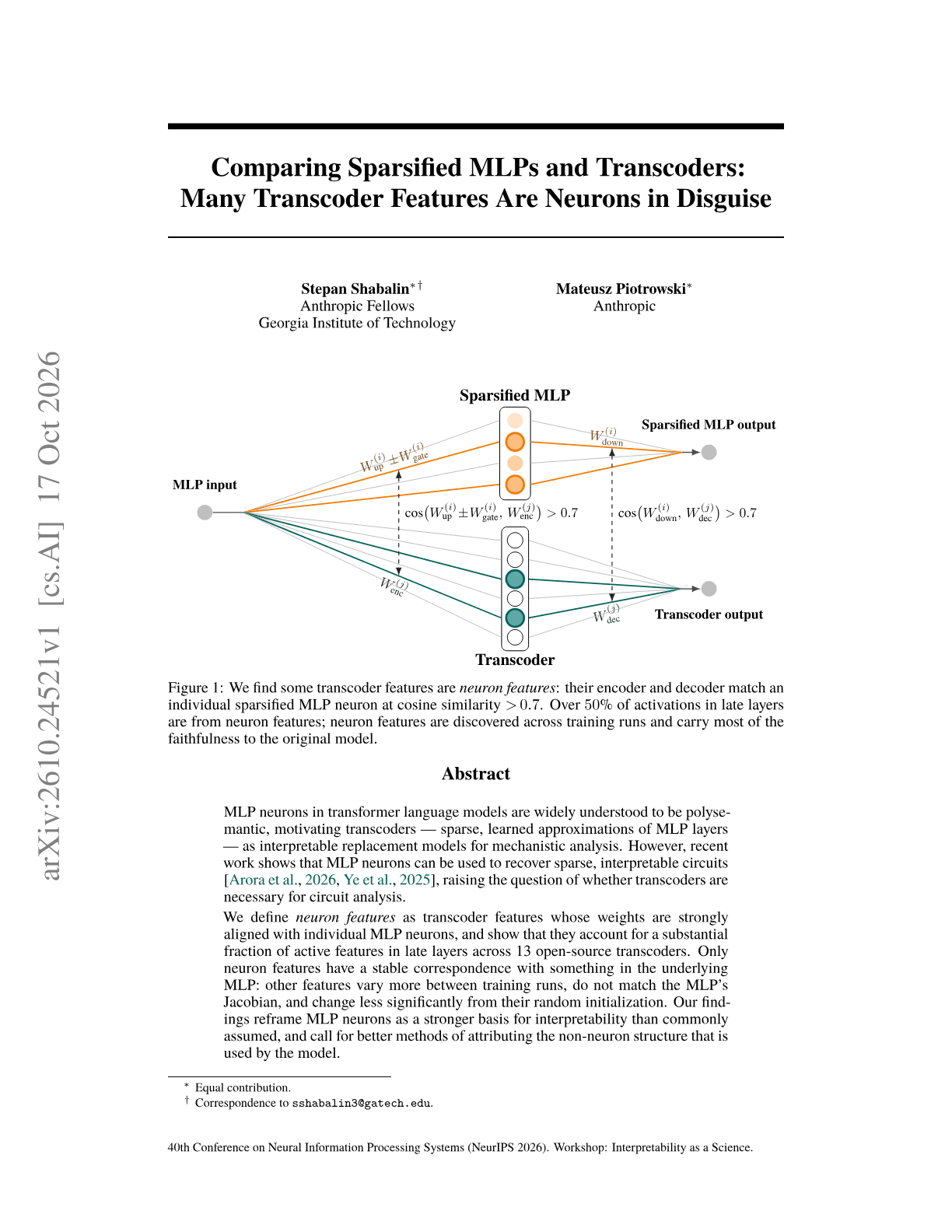
Comparing Sparsified MLPs and Transcoders: Many Transcoder Features Are Neurons in Disguise
Researchers from Anthropic and Georgia Tech find that many active transcoder features in late layers are close copies of single MLP neurons, measured across 13 open-source transcoders. These neuron-aligned features are the only ones with a stable link to the underlying MLP, while the other features vary more between training runs, do not match the MLP's Jacobian, and move less from their random initialization. The authors conclude that MLP neurons are a stronger basis for interpretability than commonly assumed, and that the non-neuron features need better validation before they are used to explain model behavior.
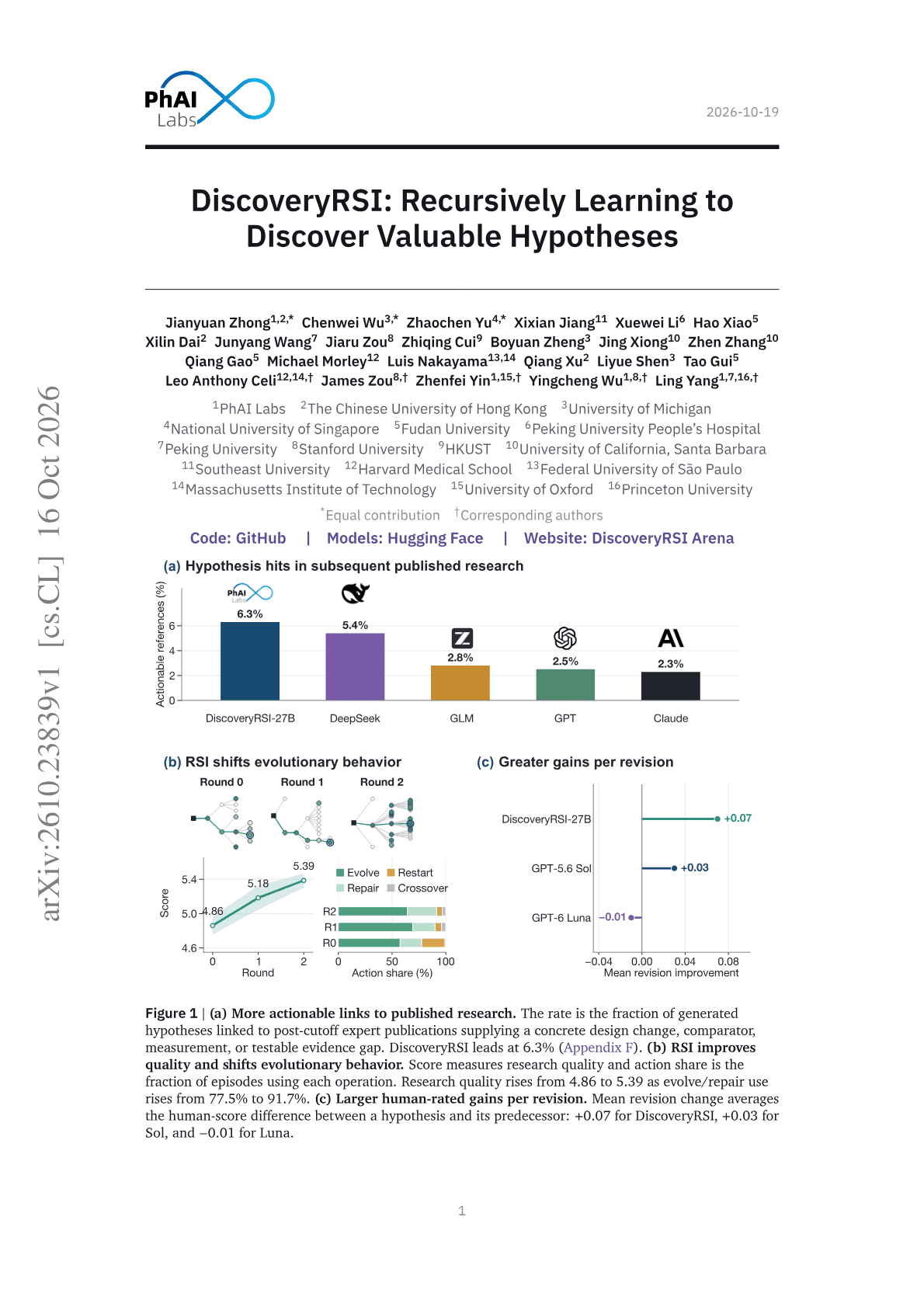
DiscoveryRSI: Recursively Learning to Discover Valuable Hypotheses
Scientific discovery depends on turning worthwhile hypotheses into practical investigations, and learning from that evolving research process is hard. Researchers from PhAI Labs, CUHK, Stanford, Harvard Medical School, and colleagues present DiscoveryRSI, which applies recursive self-improvement to hypothesis generation across four life-science domains.
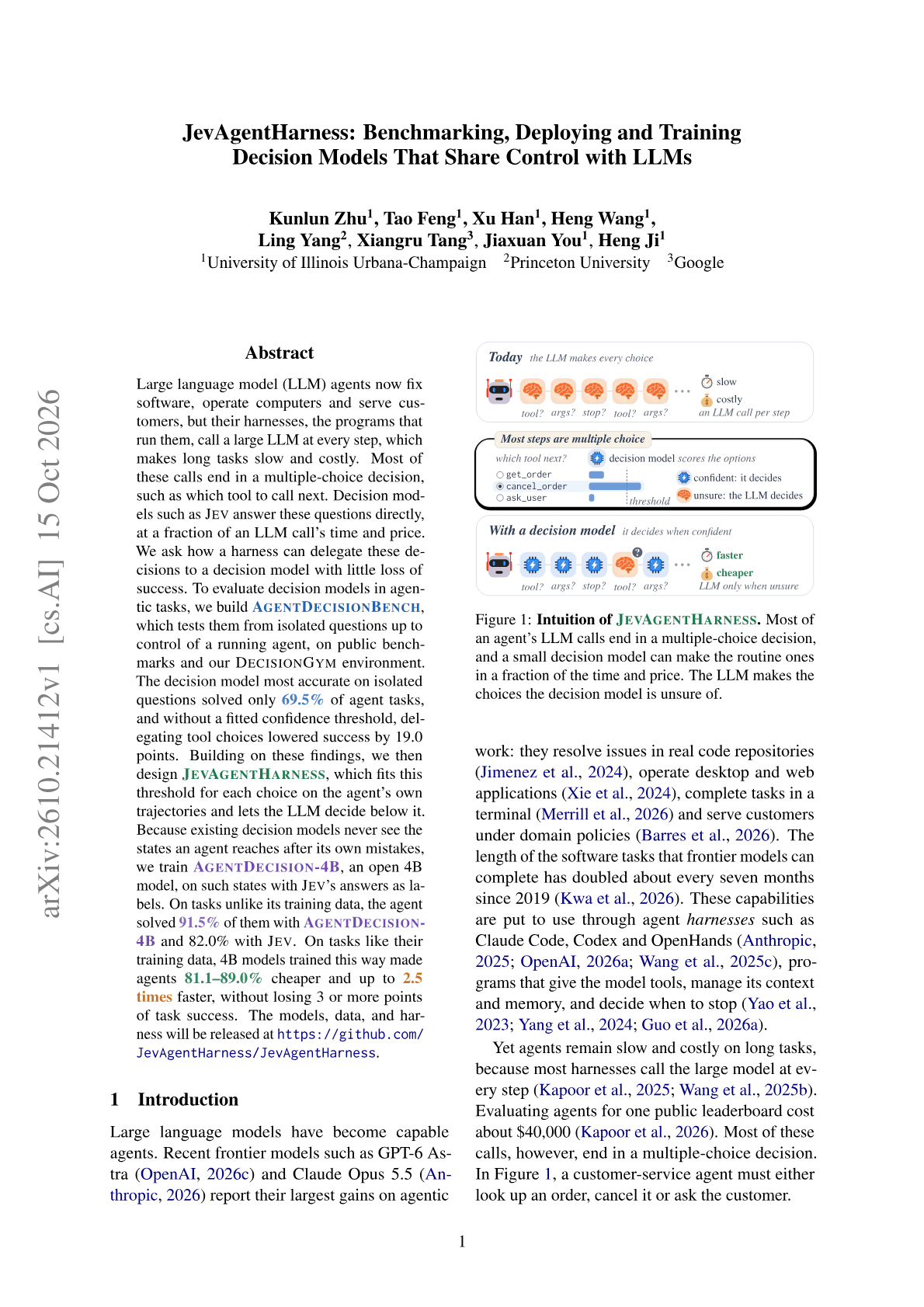
JevAgentHarness: Benchmarking, Deploying and Training Decision Models That Share Control with LLMs
Agent harnesses call a large LLM at every step, which makes long tasks slow and costly, yet most of those calls end in a multiple-choice decision such as which tool to call next. Researchers from UIUC, Princeton, and Google study how a harness can hand these choices to a decision model like Jev with little loss of success.
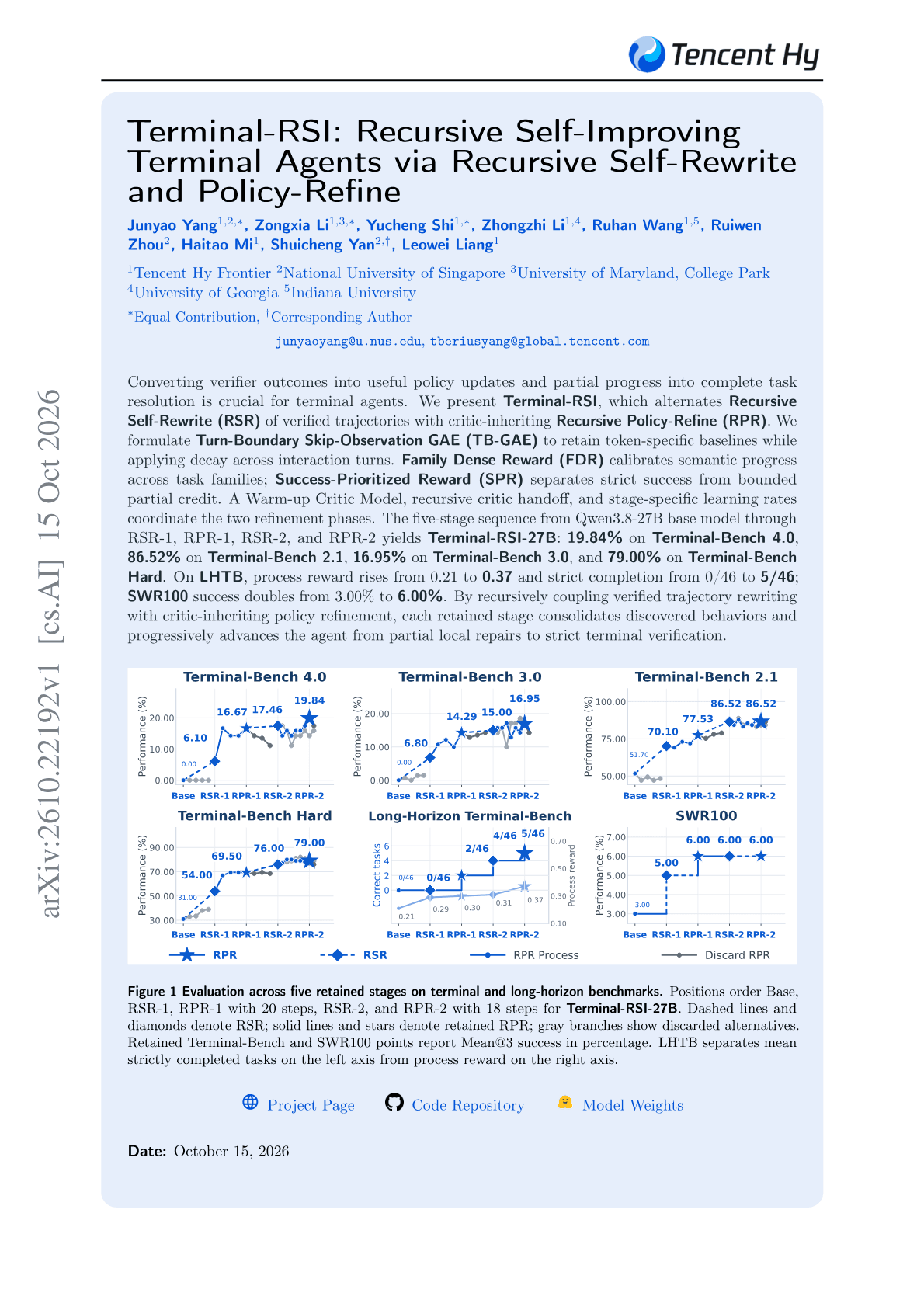
Terminal-RSI: Recursive Self-Improving Terminal Agents via Recursive Self-Rewrite and Policy-Refine
Researchers from Tencent train terminal agents by alternating two phases over five stages starting from Qwen3.8-27B, fine-tuning on rewritten versions of verified trajectories and then running PPO with a critic inherited from the previous stage. The four-suite Terminal-Bench average rises from 20.68% to 50.58%, with 86.52% on Terminal-Bench 2.1 and 79.00% on Terminal-Bench Hard. A reward audit found that under a dense progress reward, failed runs collected 50.09% of the reward, and separating strict success from partial credit cut that share to 28.72%.
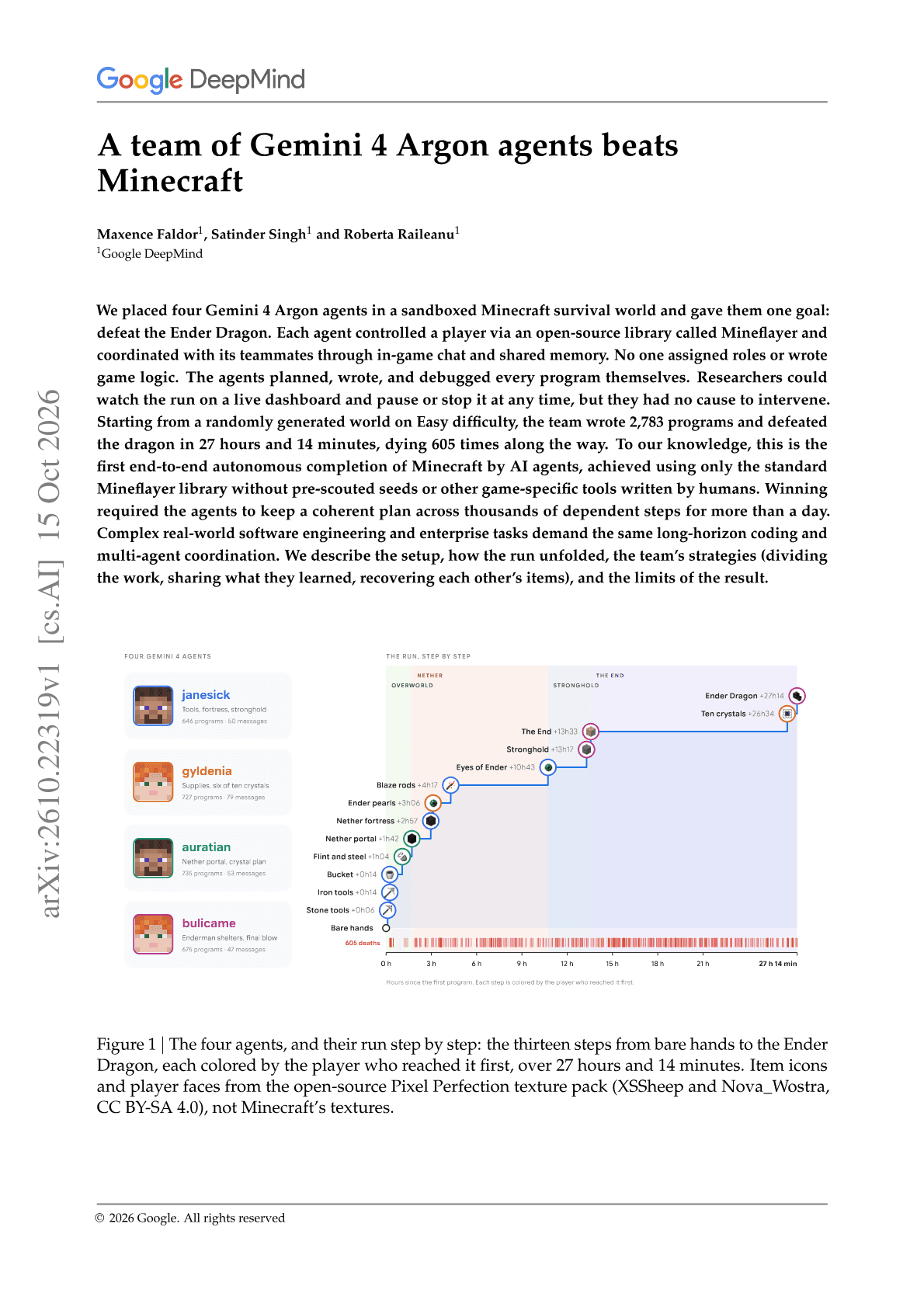
A team of Gemini 4 Argon agents beats Minecraft
Researchers from Google DeepMind placed four Gemini 4 Argon agents in a sandboxed Minecraft survival world with one goal, defeating the Ender Dragon. They report what they believe is the first end-to-end autonomous completion of Minecraft by AI agents, using only the standard Mineflayer library with no pre-scouted seeds or game-specific tools written by humans.