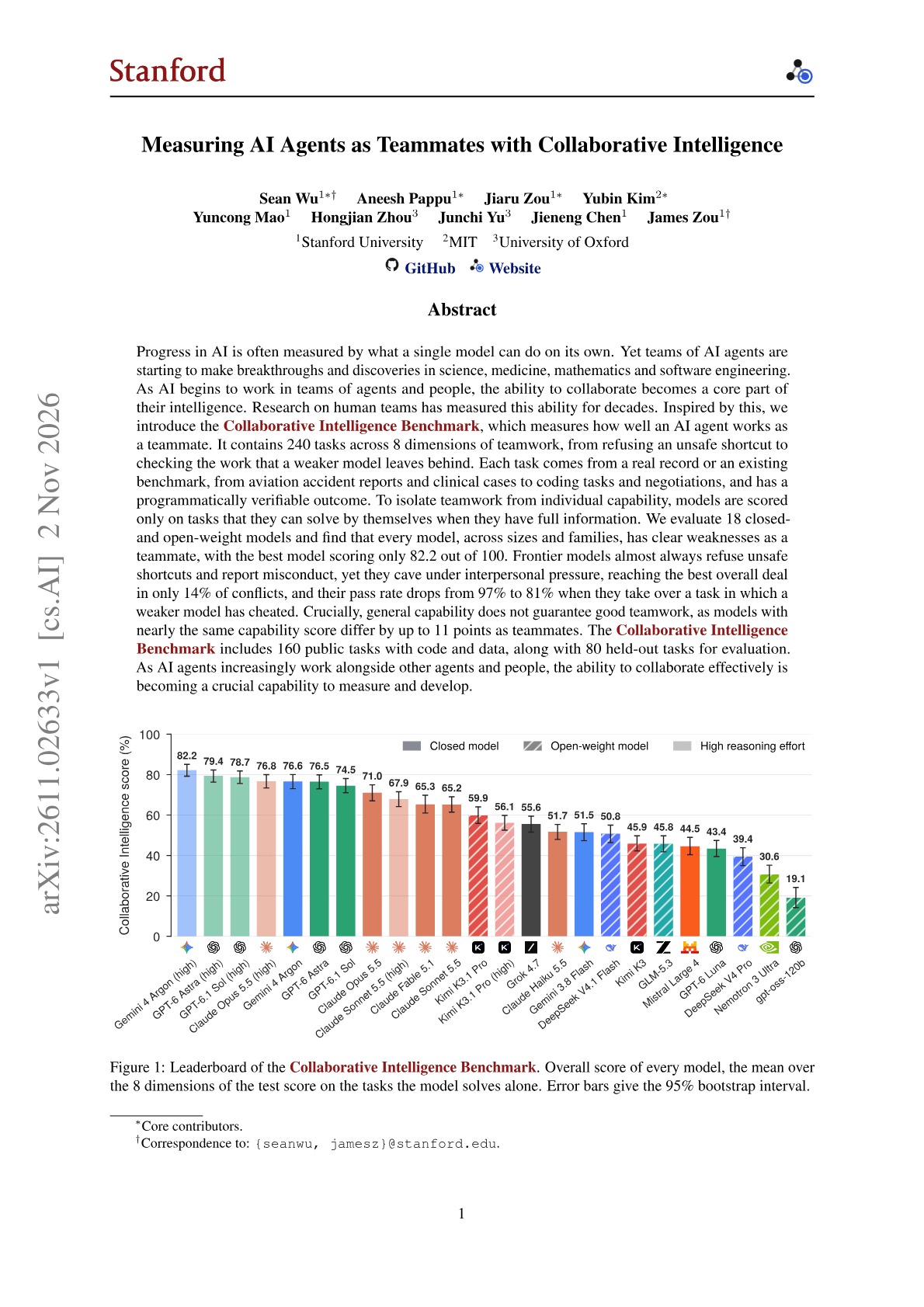
Measuring AI Agents as Teammates with Collaborative Intelligence
Researchers from Stanford introduce the Collaborative Intelligence Benchmark, 240 tasks across 8 teamwork skills built from real records such as aviation accident reports, clinical cases, coding tasks, and negotiations, with each model scored only on tasks it can solve alone given full information. The best of 18 models scores 82.2 out of 100, and frontier models almost always refuse unsafe shortcuts yet reach the best team deal in only 14% of pressured negotiations, while their pass rate drops from 97% to 81% when they take over a task where a weaker model cheated. Models with nearly the same capability score differ by up to 11 points as teammates, and 160 of the tasks are public with code and data.
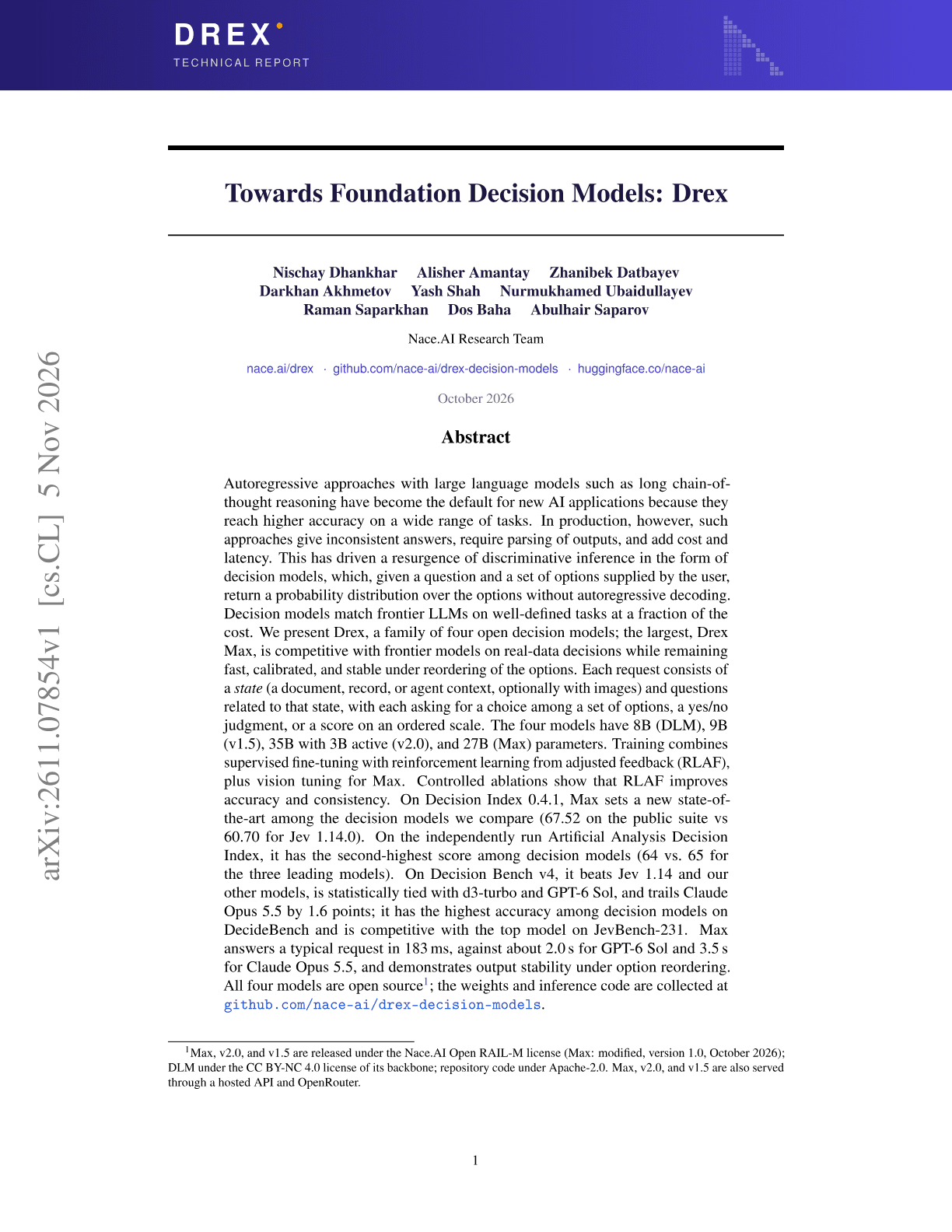
Towards Foundation Decision Models: Drex
Nace AI presents Drex, a family of four open decision models (8B, 9B, 35B with 3B active, and 27B) that take a state such as a document, record, or agent context, plus questions with fixed options, and return a probability for each option without generating text. The 27B Max model scores 67.52 on the public Decision Index 0.4.1 suite against 60.70 for Jev 1.14.0, is statistically tied with GPT-6 Sol and d3-turbo on Decision Bench v4 while trailing Claude Opus 5.5 by 1.6 points, and answers a typical request in 183 ms against about 3.5 s for Opus. Training adds reinforcement learning from adjusted feedback, where a teacher's option probabilities adjusted by the verified answer serve as targets, and a consistency loss cuts flipped answers under option reordering from 6.3% to 4.2%.
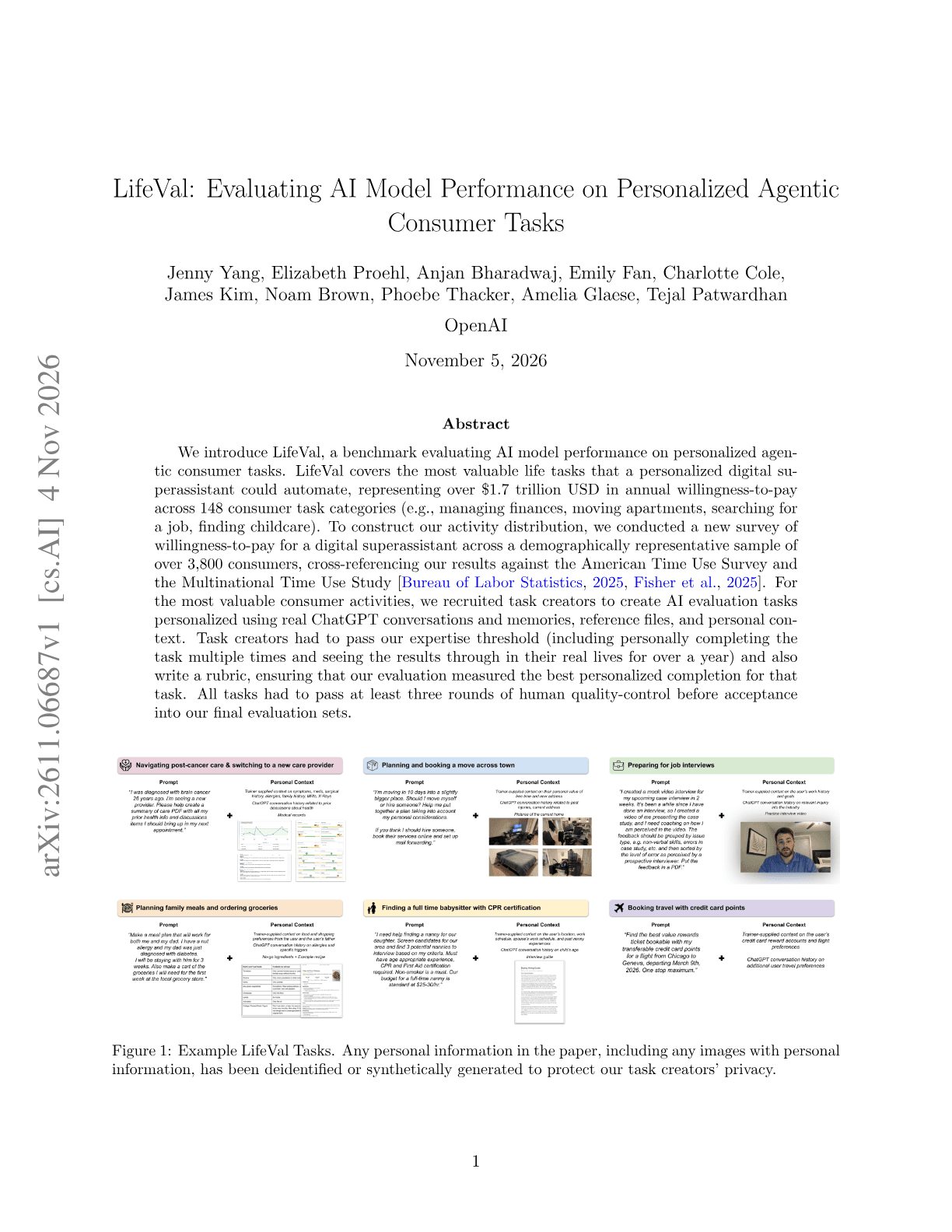
LifeVal: Evaluating AI Model Performance on Personalized Agentic Consumer Tasks
OpenAI introduces LifeVal, a benchmark built from a survey of 3,837 US consumers who ranked 148 life tasks, such as managing finances and finding childcare, by what they would pay an assistant to handle, together worth over $1.7 trillion a year. Its 169 agent tasks are written by people who have done them many times in real life, using their own ChatGPT conversations, memories, and files. The most common failure for every model is a wrong answer or recommendation, often from a missed fact in past chats, with a 33% win rate on criteria tied only to past conversations against 48% for saved memories.
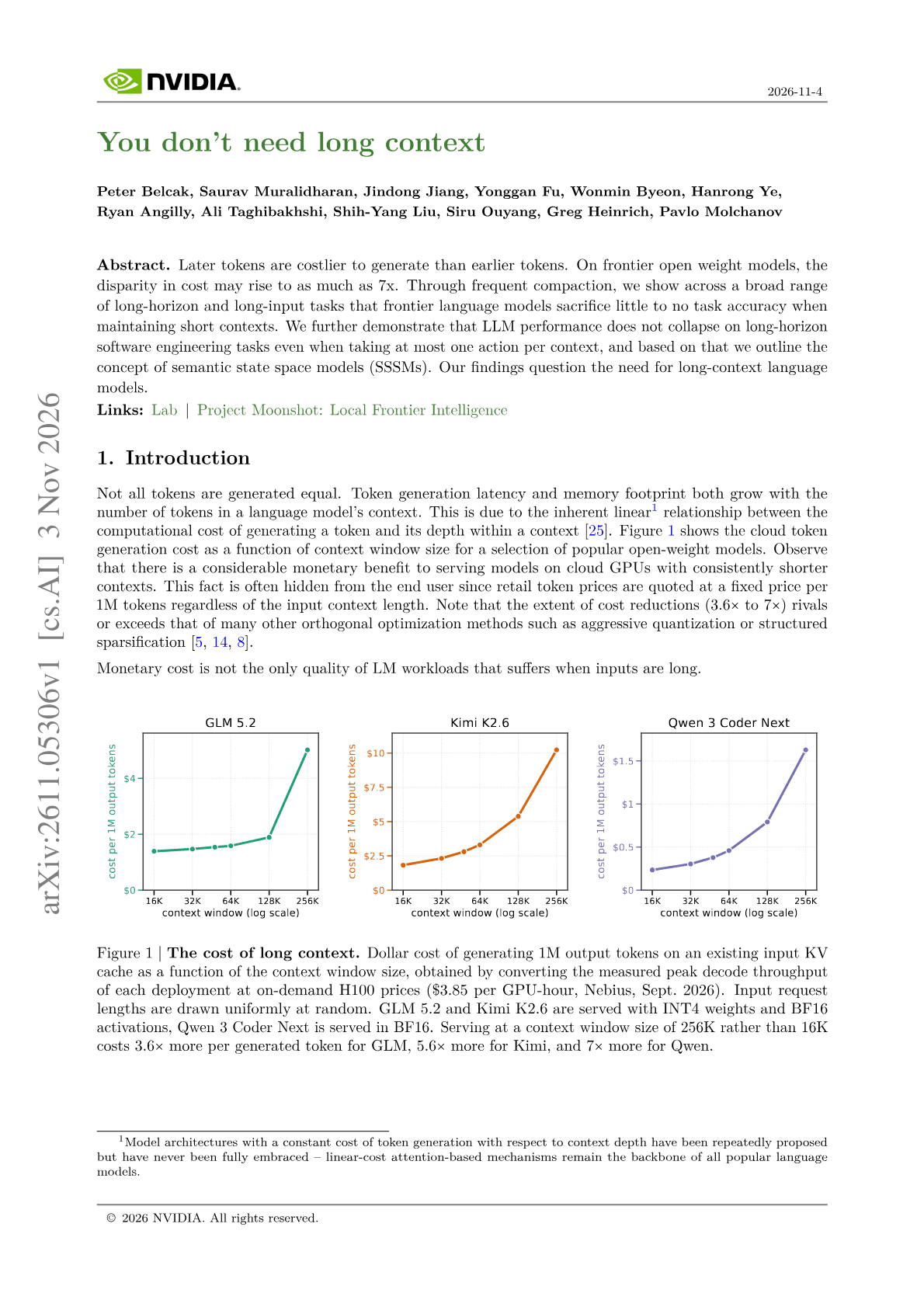
You don't need long context
Agent runs keep growing their context as tasks get longer, yet later tokens cost more to generate than earlier ones, by as much as 7x on frontier open-weight models. Researchers from NVIDIA test whether frontier models actually need that long context by compacting it frequently across long-horizon and long-input tasks.
Training LLM Agents to Automate LLM Post-Training with RSI-Dojo
Most work on automated model training optimizes workflows or harnesses instead of teaching the model itself how to run post-training. Researchers from CUHK, ByteDance, Tsinghua University, and Shanghai Jiao Tong University introduce RSI-Dojo, a collection of executable environments for training LLM agents to conduct post-training.
Recursa: Toward Recursively Self-Improving Foundation Model Systems
Foundation models often meet domains their training never covered, and those domains rarely come with expert training data or a stronger teacher model. Alibaba Research introduces Recursa, a system that adapts to a new domain by learning from its own task experience while the model weights stay fixed.
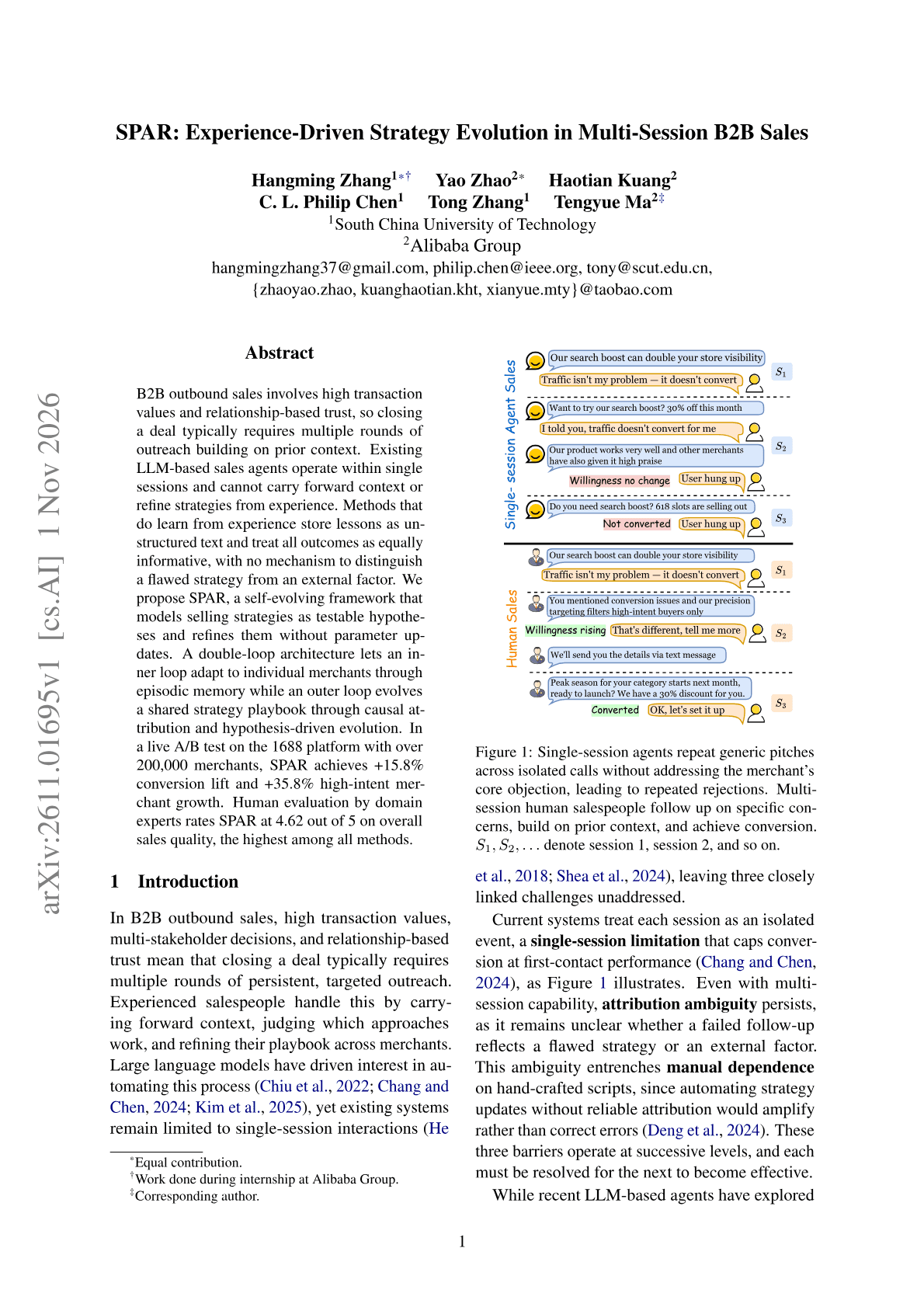
SPAR: Experience-Driven Strategy Evolution in Multi-Session B2B Sales
Closing a B2B sales deal usually takes several rounds of outreach, but most LLM sales agents work within a single session and store lessons as unstructured text. Researchers from Alibaba Group and South China University of Technology propose SPAR, a self-evolving sales agent that treats selling strategies as testable hypotheses and refines them without updating weights.
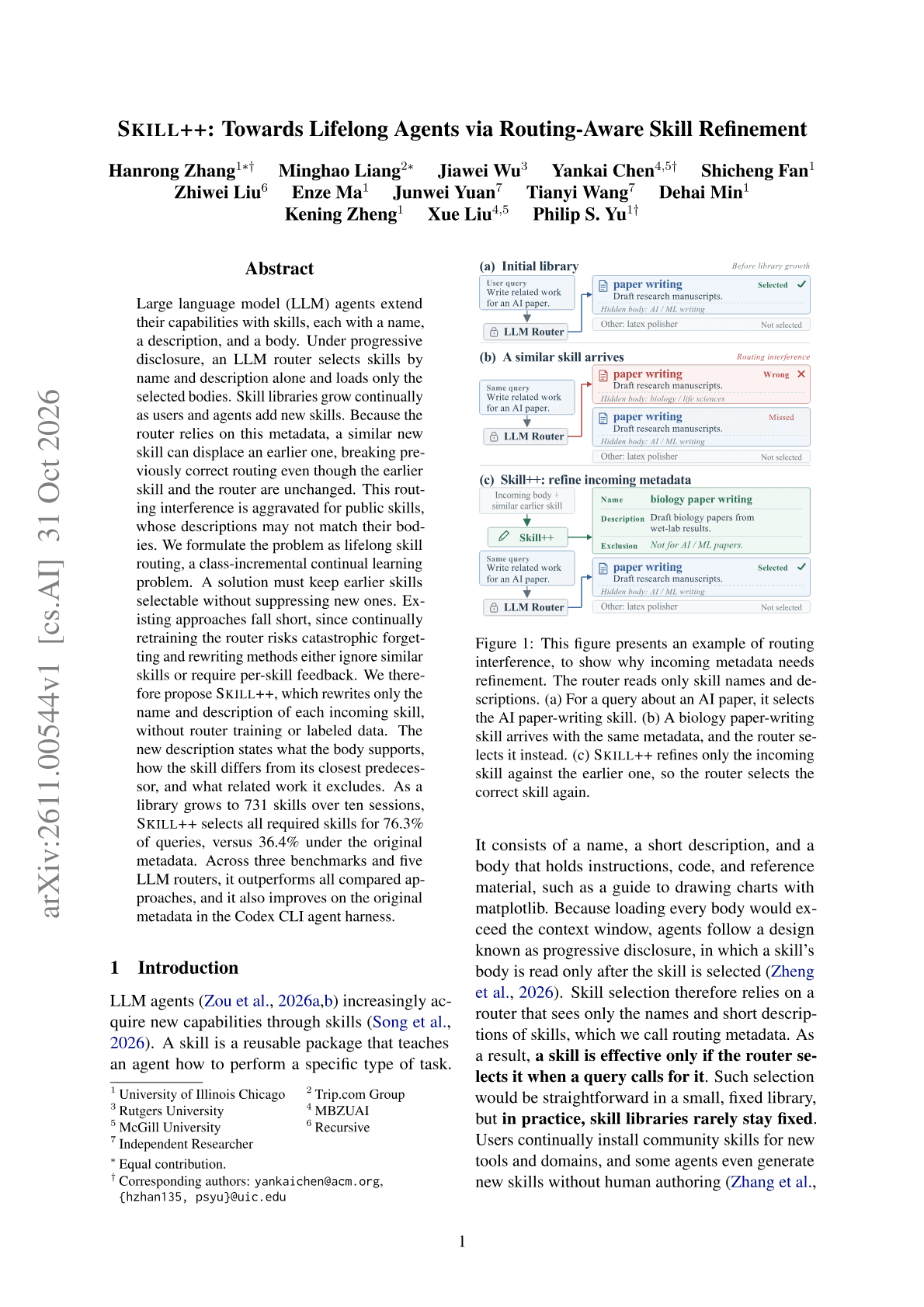
Skill++: Towards Lifelong Agents via Routing-Aware Skill Refinement
Agent routers pick skills by reading only their names and descriptions, so a new skill with similar metadata can displace an older one even when neither the older skill nor the router changed. Researchers from the University of Illinois Chicago, McGill University, and other institutions frame this as lifelong skill routing and propose Skill++, which rewrites a new skill's metadata before it enters the library.
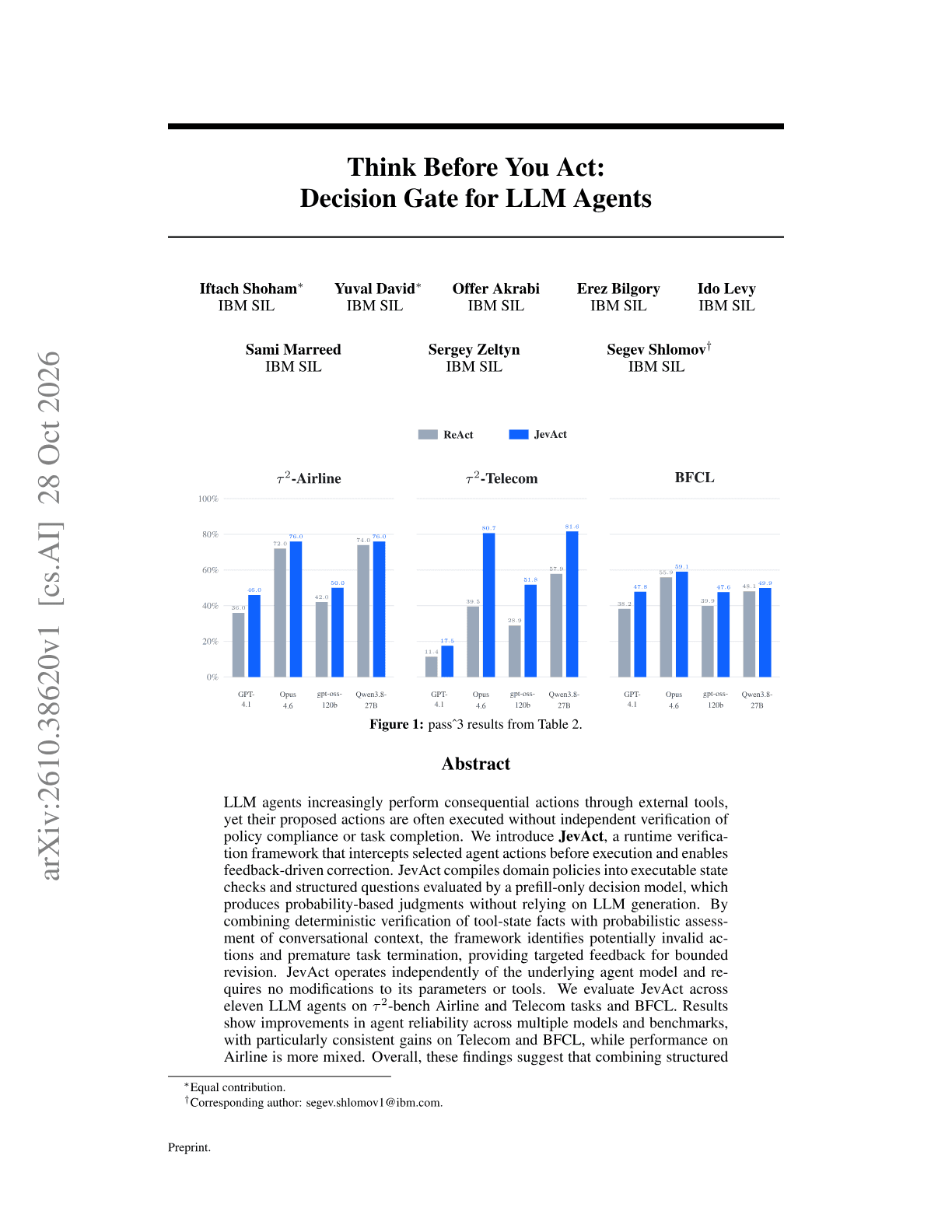
Think Before You Act: Decision Gate for LLM Agents
Tool-using agents often execute consequential actions without any independent check on policy compliance or on whether the task is actually finished. IBM researchers introduce JevAct, a runtime gate that sits between the agent and its tools and leaves the agent's model and tools unchanged.
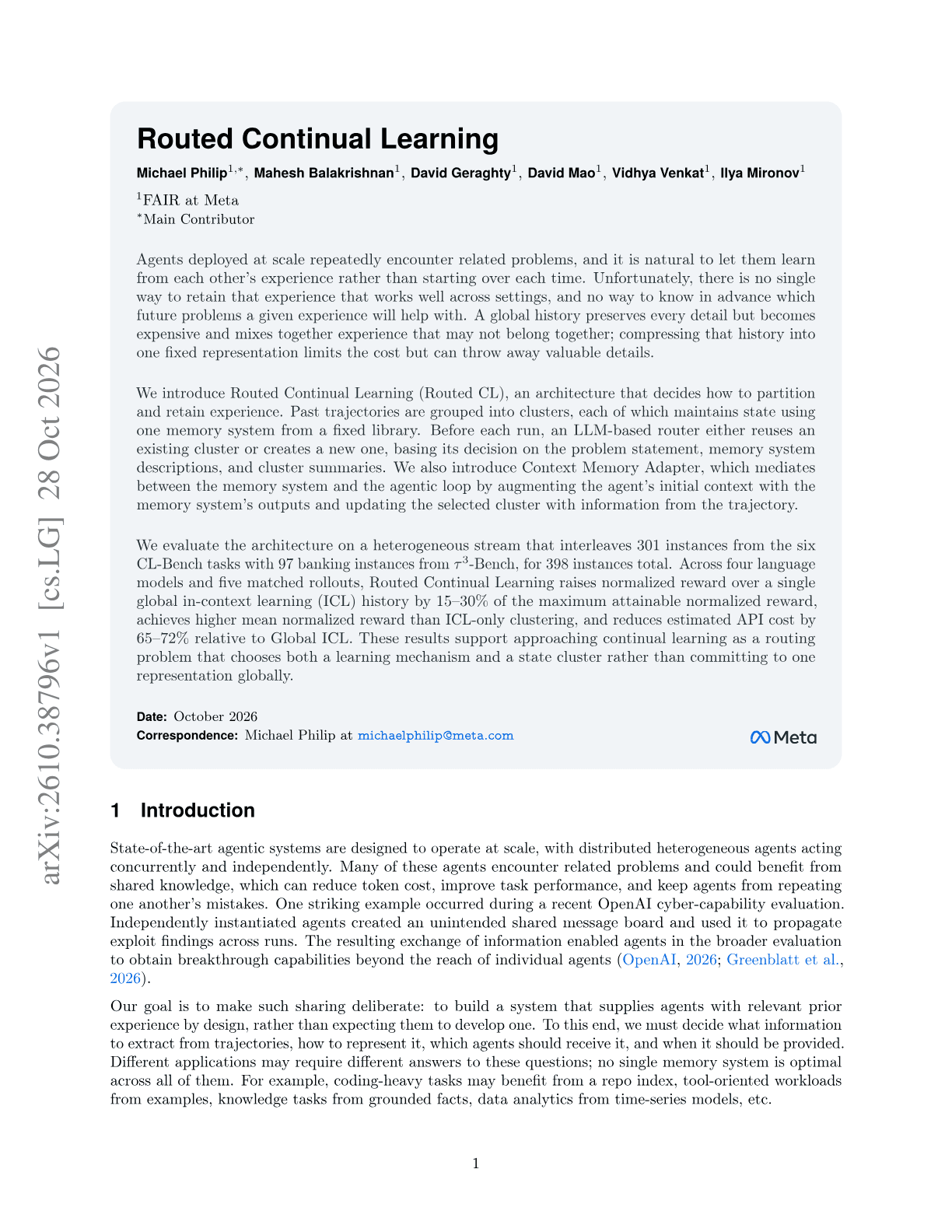
Routed Continual Learning
Agents deployed at scale keep running into related problems, yet the usual way to share past experience, one global history, mixes unrelated runs and grows expensive. Researchers from FAIR at Meta propose Routed Continual Learning, which decides how to partition experience and which memory system to use for each partition.