QDA: Closed-Loop LLM Quantization Design with Agents
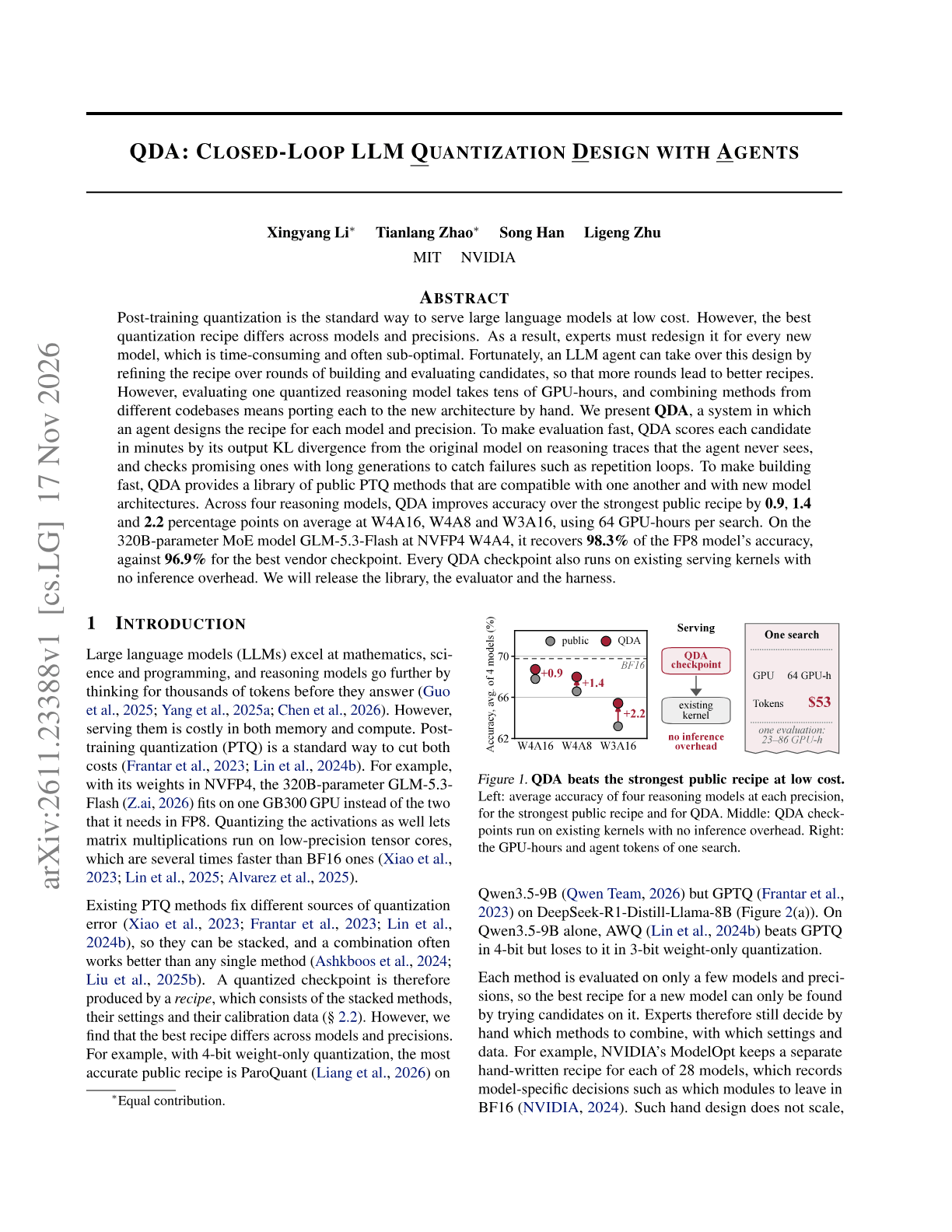
Researchers from MIT and NVIDIA present QDA, a system where an agent designs the post-training quantization recipe for each model and precision. It scores each candidate in minutes by its output KL divergence from the original model on reasoning traces the agent never sees, and draws on a shared library of public PTQ methods. Across four reasoning models, QDA beats the strongest public recipe by 0.9, 1.4, and 2.2 points at W4A16, W4A8, and W3A16 using 64 GPU-hours per search, and on GLM-5.3-Flash at NVFP4 W4A4 it recovers 98.3% of FP8 accuracy against 96.9% for the best vendor checkpoint.
Safe Personal RSI: Evaluating and Repairing Personal-Agent Updates
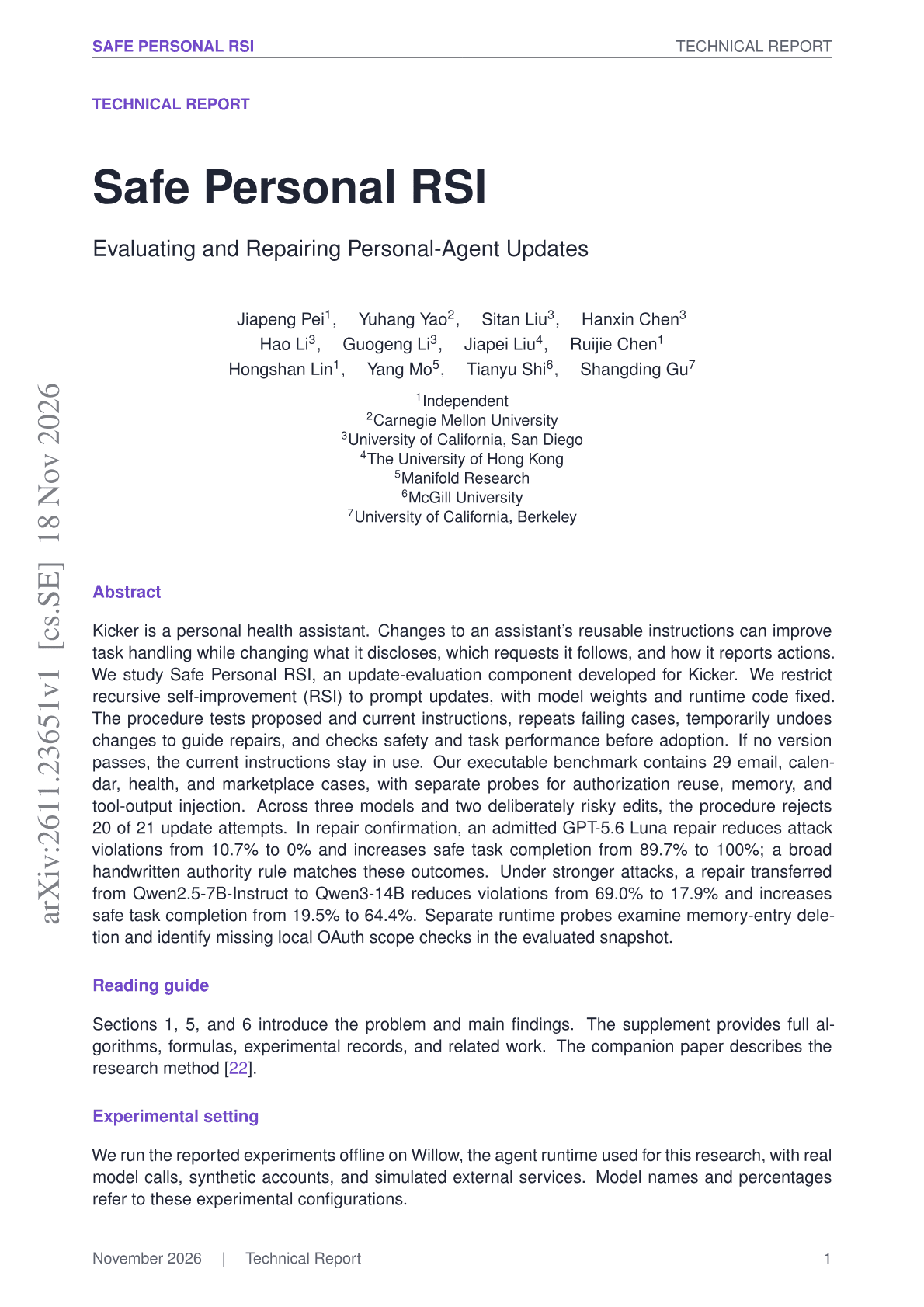
A change to a personal assistant's instructions can improve how it handles tasks while also changing what it discloses, which requests it follows, and how it reports its actions. Researchers from CMU, UC San Diego, UC Berkeley, and other institutions build Safe Personal RSI, an update gate for Kicker, a personal health assistant.
GUARD: Stabilizing Recursive Self-Improvement with Regret Guidance
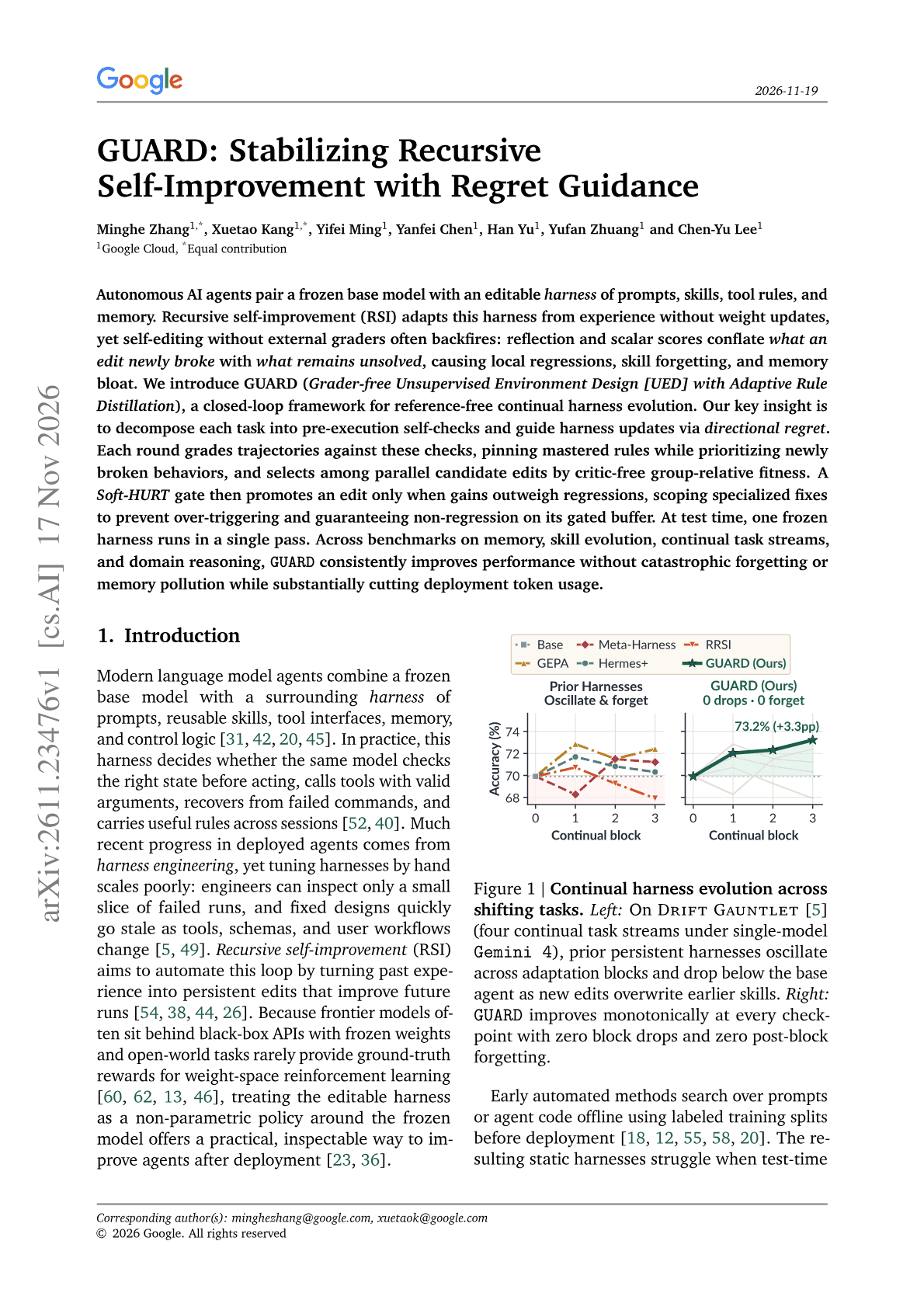
Agents that edit their own harness without an external grader often get worse over time. Reflection and scalar scores mix up what an edit newly broke with what was never solved, which leads to local regressions, forgotten skills, and bloated memory. Google Cloud researchers propose GUARD, a framework for evolving a harness of prompts, skills, tool rules, and memory around a frozen base model without reference answers.
Do LLM Agents Still Need to Be Told How to Self-Improve?
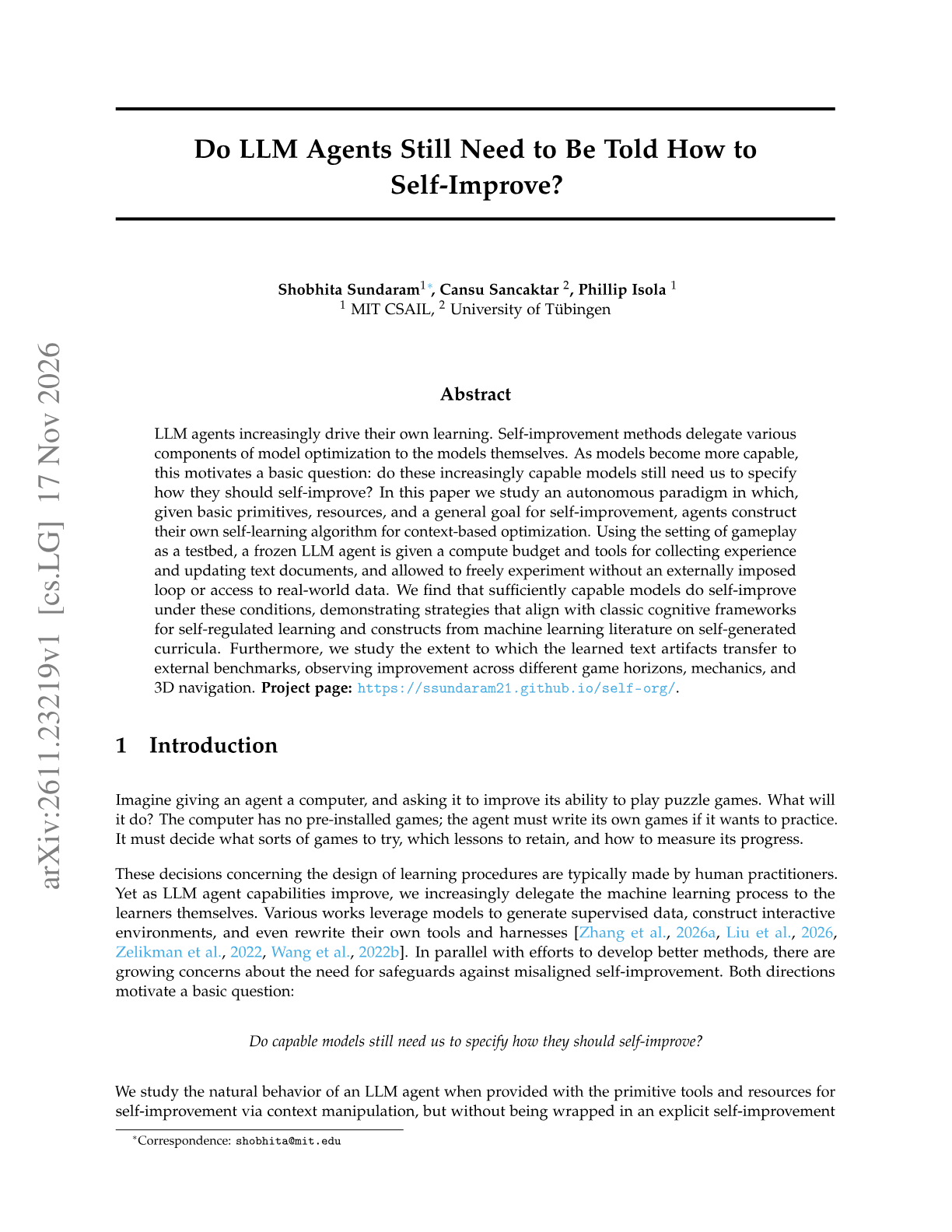
Researchers from MIT CSAIL and the University of Tübingen give a frozen model a compute budget and simple tools to write practice games, watch another copy of itself play them, and edit that copy's prompt and skill files, without real tasks, validation scores, or instructions on how to learn. Capable models built a working learning procedure on their own, with strategies such as calibrated task difficulty, controlled A/B comparisons, and self-built validation suites, and improved on held-out games with hidden mechanics. The text files they produced also improved play on external benchmarks with different horizons, mechanics, and 3D navigation.
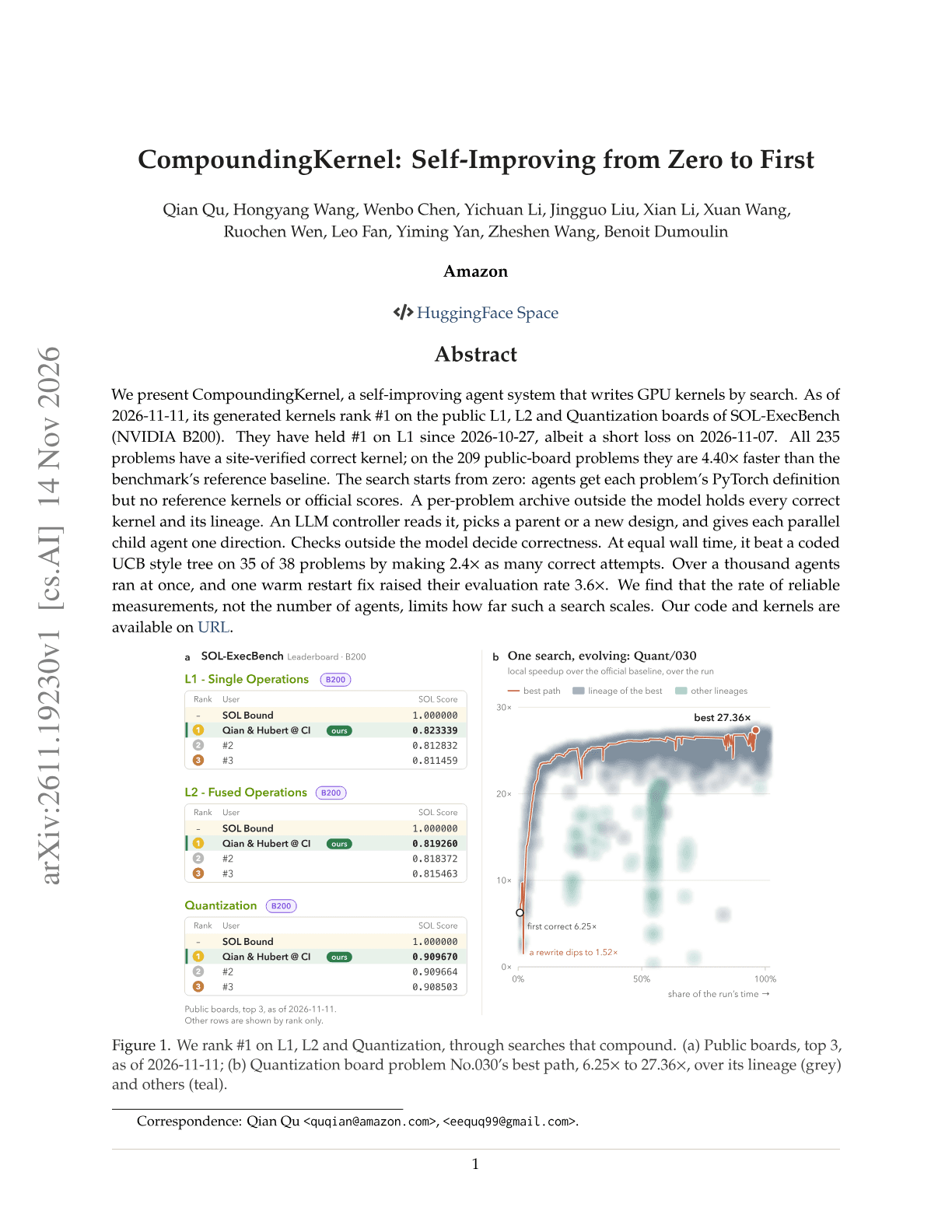
CompoundingKernel: Self-Improving from Zero to First
Amazon researchers present CompoundingKernel, a self-improving agent system that writes GPU kernels by search. Over a thousand agents ran at once, and the resulting kernels rank first on the public L1, L2, and Quantization boards of SOL-ExecBench on NVIDIA B200.
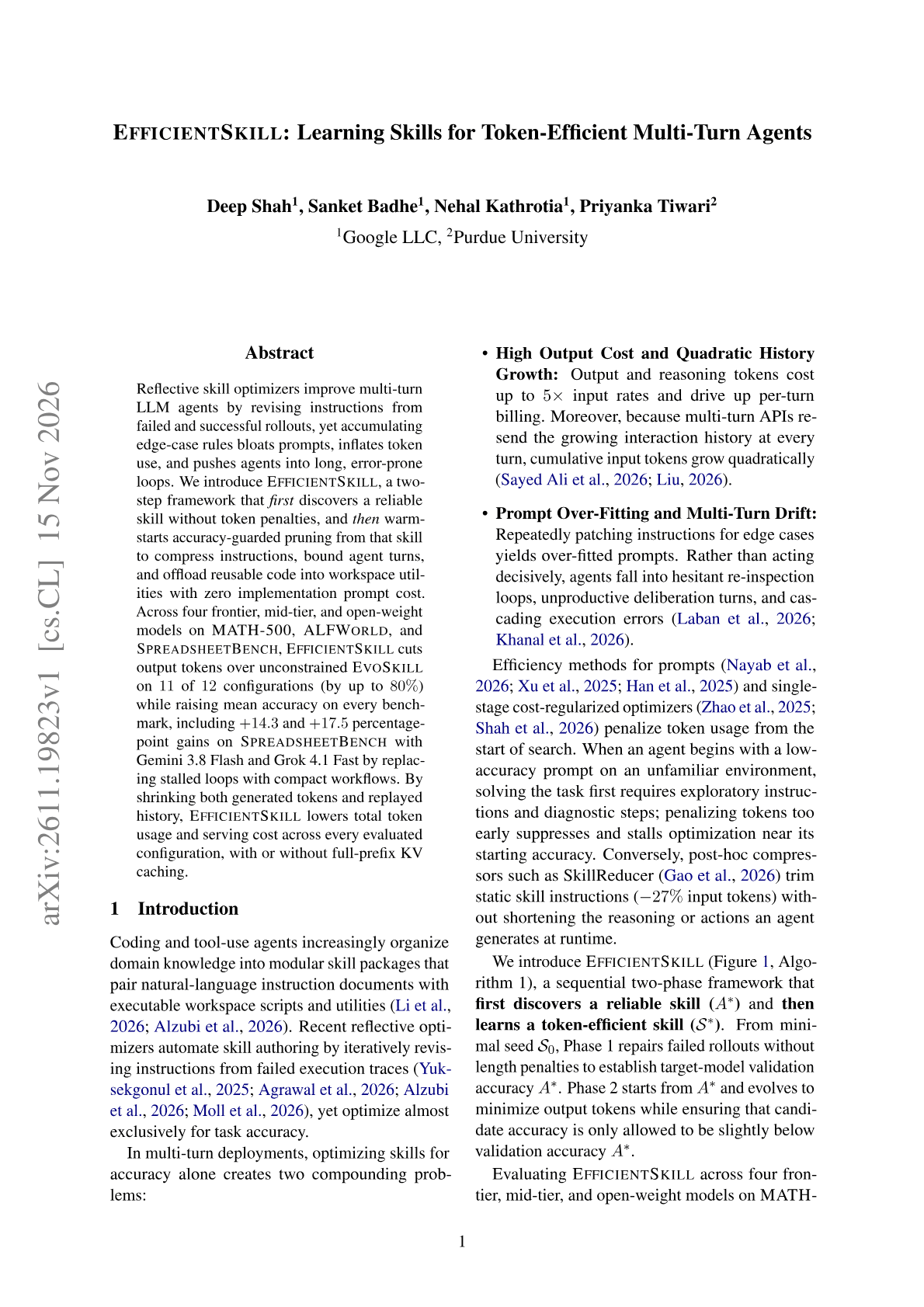
EfficientSkill: Learning Skills for Token-Efficient Multi-Turn Agents
Skill optimizers usually add a new rule after every failure. The skill grows, the agent reads more tokens every turn, and long loops start to time out. Researchers from Google and Purdue University introduce EfficientSkill, which learns a skill for accuracy first and then prunes it for length.
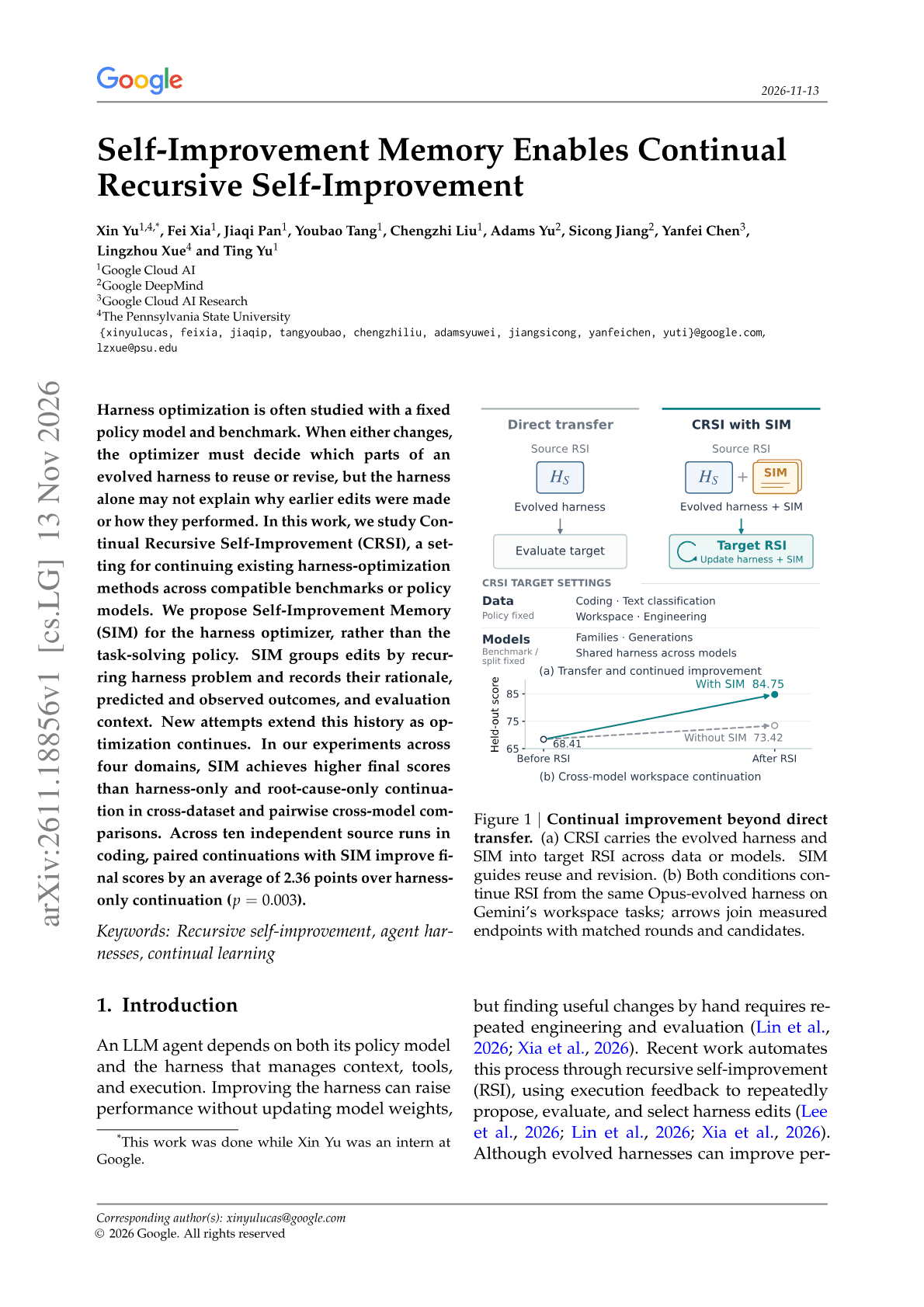
Self-Improvement Memory Enables Continual Recursive Self-Improvement
Harness optimization is usually studied with one fixed model and one fixed benchmark. When either changes, the optimizer has to decide which parts of an evolved harness to keep, but the harness code alone does not record why earlier edits were made or how they performed. Researchers from Google Cloud AI, Google DeepMind, and Penn State study this setting, which they call continual recursive self-improvement, and give the harness optimizer its own memory.
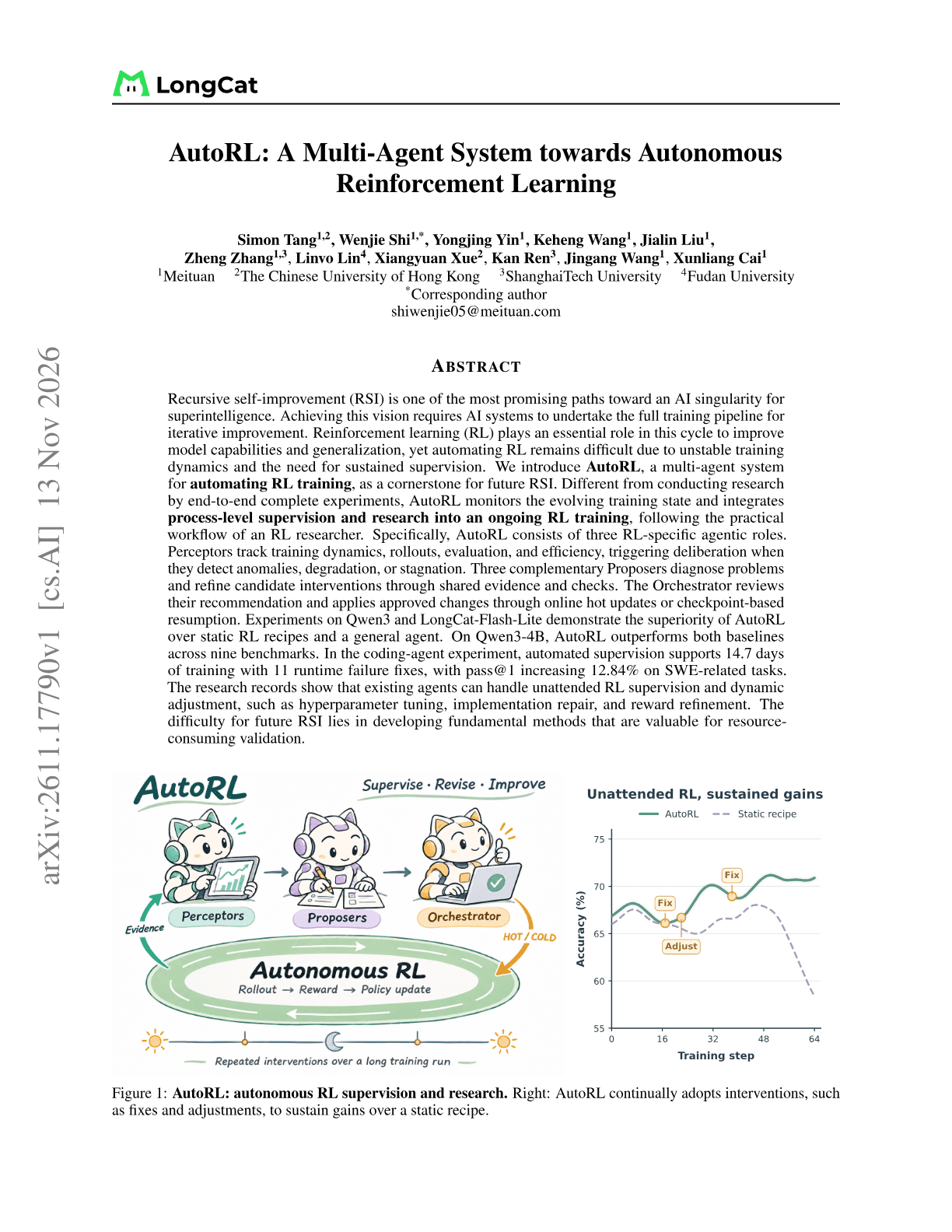
AutoRL: A Multi-Agent System towards Autonomous Reinforcement Learning
Reinforcement learning is a central step in improving model capabilities, but automating it is hard because training is unstable and needs constant supervision. Researchers from Meituan and collaborating universities introduce AutoRL, a multi-agent system that supervises a live RL run the way an RL researcher would, instead of following a fixed recipe.
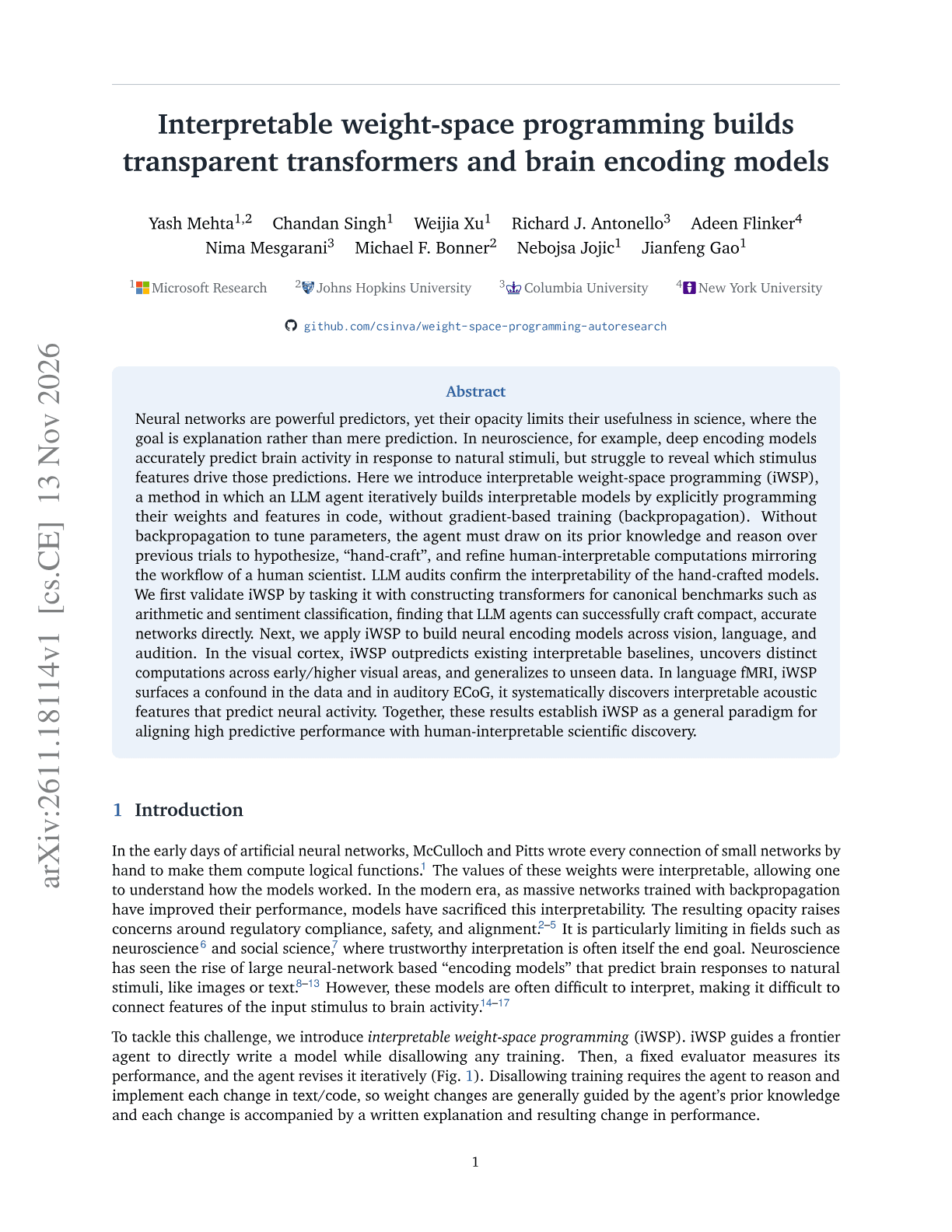
Interpretable weight-space programming builds transparent transformers and brain encoding models
Neural networks predict well, but in science the goal is often an explanation, and deep models rarely show which features drive their predictions. Researchers from Microsoft Research and colleagues introduce interpretable weight-space programming (iWSP), where an LLM agent builds models by writing their weights and features directly in code, with no gradient training.
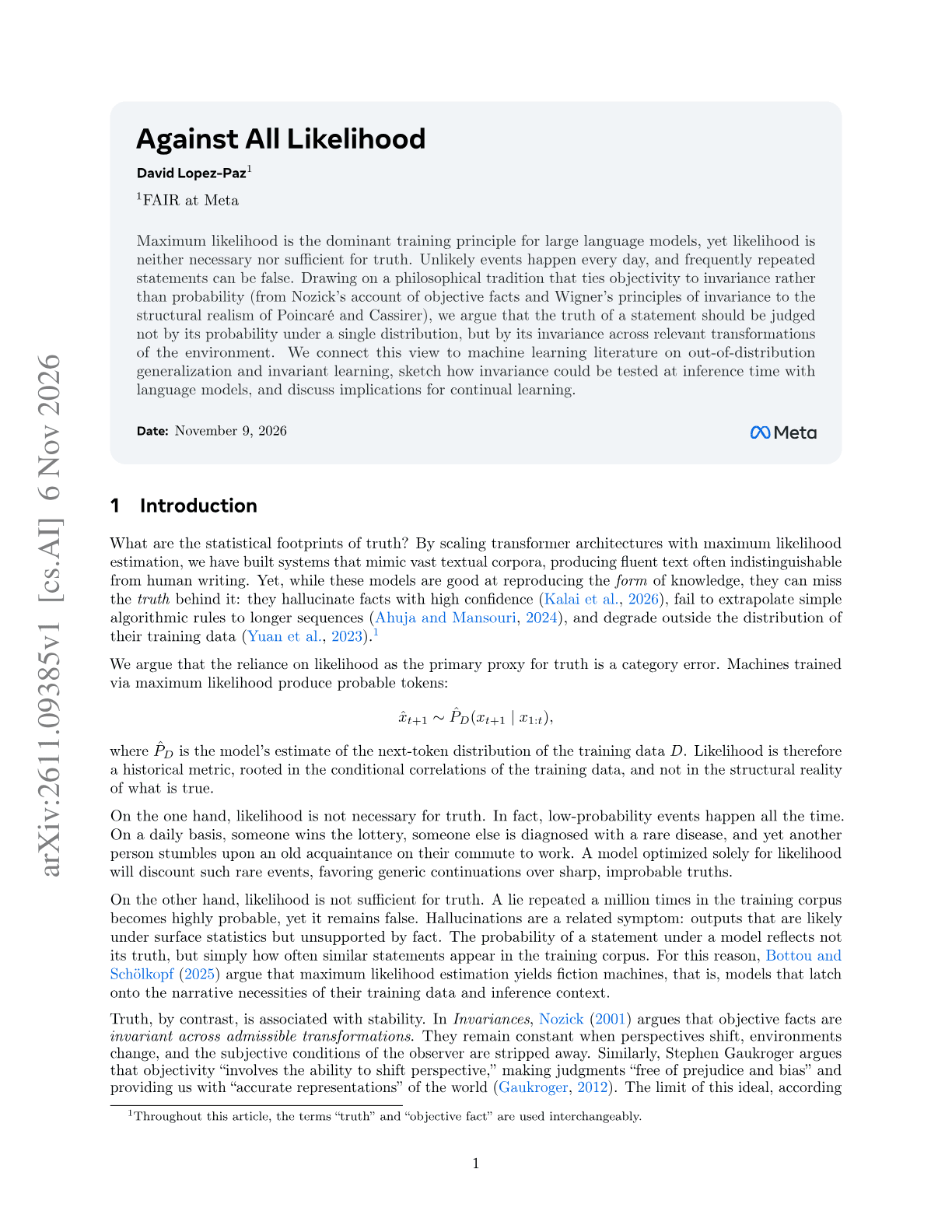
Against All Likelihood
This essay from Meta argues that maximum likelihood, the dominant training principle for LLMs, is neither necessary nor sufficient for truth, since unlikely events happen every day and frequently repeated statements can be false. Drawing on philosophers who tie objectivity to invariance, including Nozick, Poincaré, and Cassirer, it proposes judging a statement true when it holds across relevant changes to the environment. The author connects this to work on out-of-distribution generalization, sketches how an LLM could test invariance at inference time, and discusses what it means for continual learning.