Can LLM Agents Organize Their Own Memory?
Agent memory systems usually fix their schema in advance, with set record types and rules for grouping them, which makes it hard to adapt as tasks and interactions change. Researchers from City University of Hong Kong and Tencent Jarvis Lab ask whether agents can organize their own memory using ordinary documents, and introduce self-organized memory (SoMem).
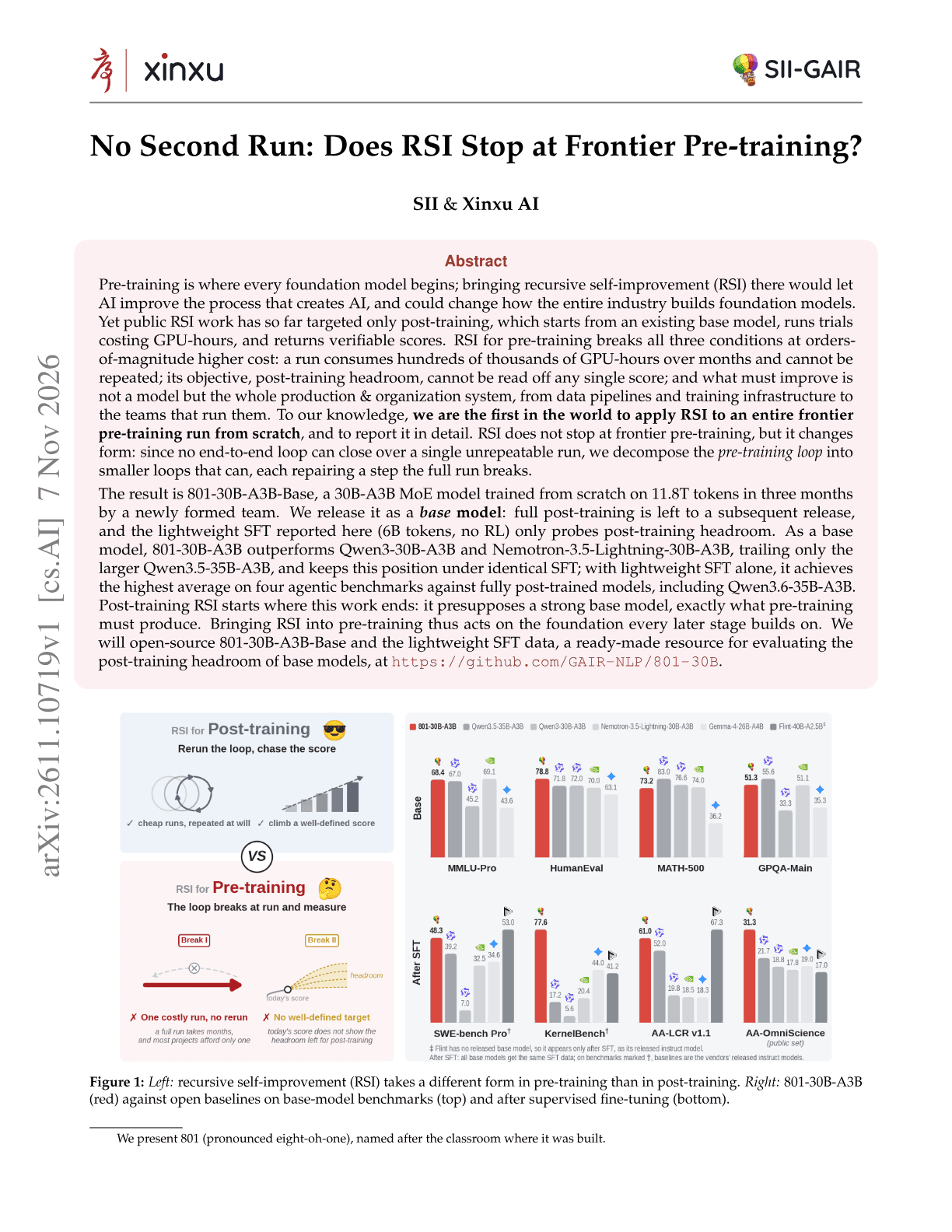
No Second Run: Does RSI Stop at Frontier Pre-training?
Public work on recursive self-improvement has so far targeted post-training, where trials are cheap, repeatable, and scored by a verifiable metric. Researchers from SII and GAIR apply RSI to an entire frontier pre-training run from scratch and report it in detail.
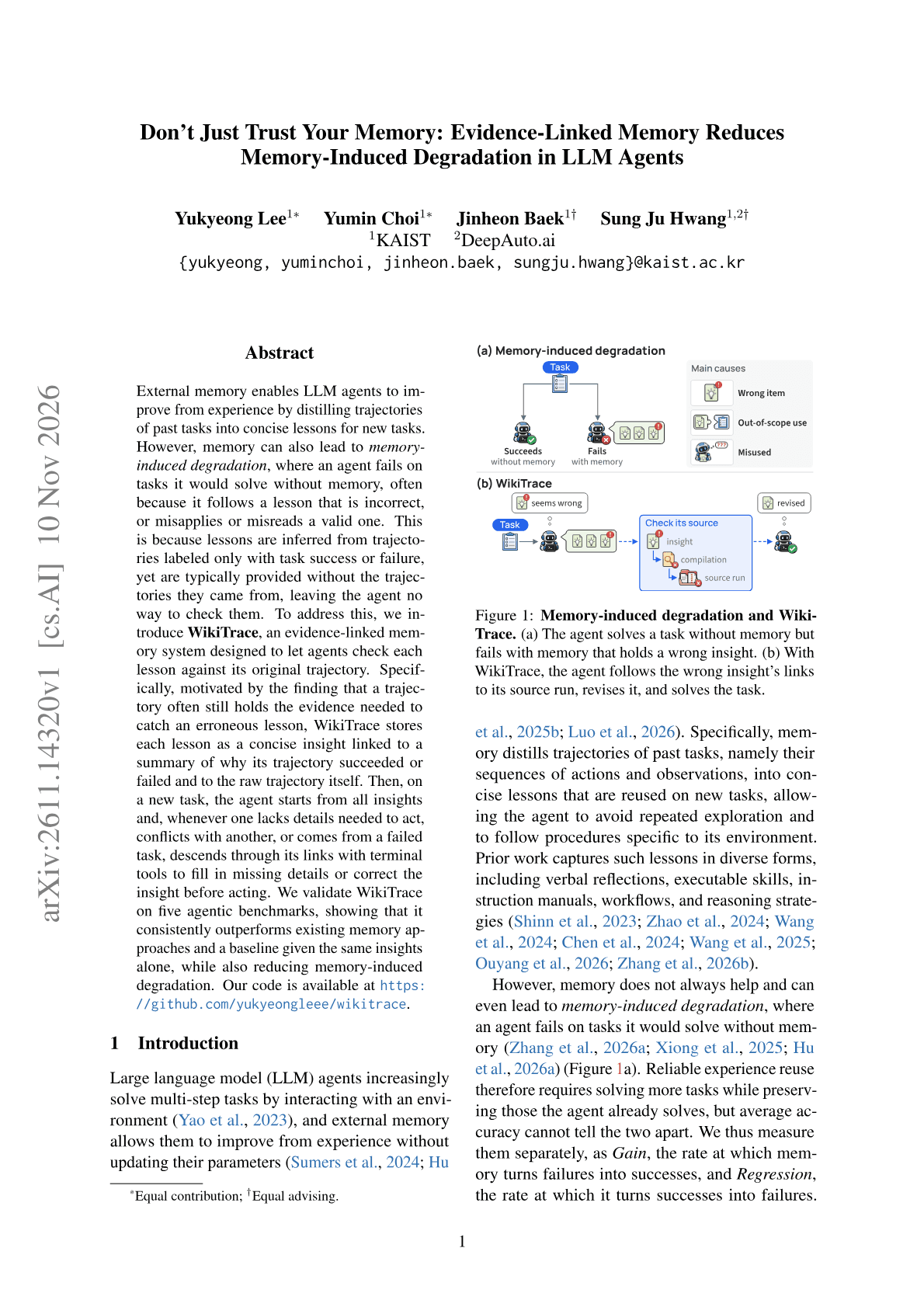
Don't Just Trust Your Memory: Evidence-Linked Memory Reduces Memory-Induced Degradation in LLM Agents
Memory is supposed to help agents improve from experience, but it can also make an agent fail tasks it would solve without memory. KAIST researchers call this memory-induced degradation and introduce WikiTrace, a memory system that lets agents check each lesson against the run it came from.
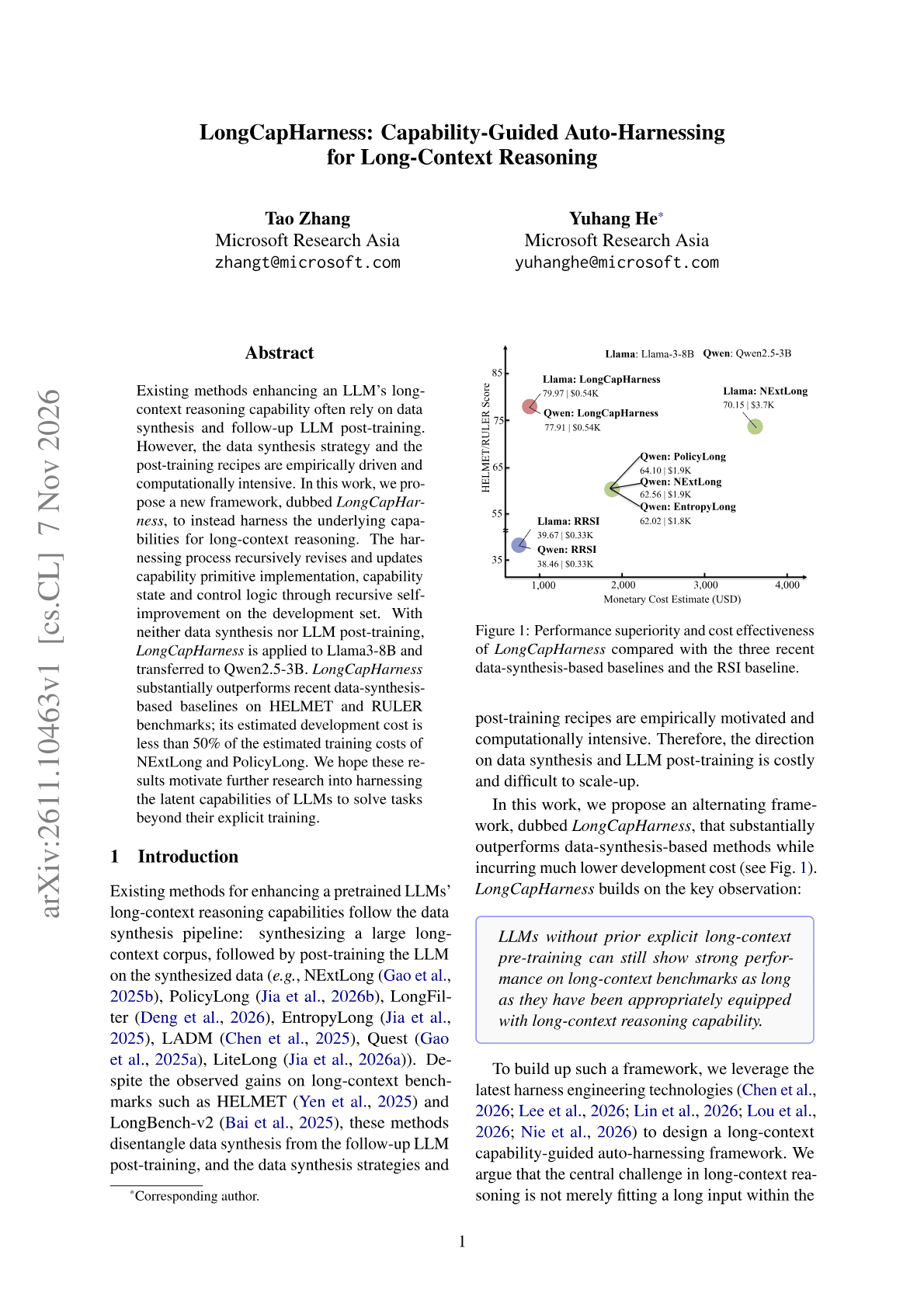
LongCapHarness: Capability-Guided Auto-Harnessing for Long-Context Reasoning
Methods for improving long-context reasoning usually rely on synthetic data and post-training, both of which are expensive and empirically driven. Researchers from Microsoft Research Asia propose LongCapHarness, which builds a harness around a frozen model instead of training it.
System Optimizations for Cost-Efficient Agent Harnesses
Harness changes such as system prompts and tools barely move agent accuracy, but they change cost by up to 2.6x on the same model and task. Researchers from UC Berkeley and the University of Illinois Urbana-Champaign analyze where agent costs accumulate and build Agency, a layer for cutting cost without changing the model.
Discovering formally verified quantum programs with AI
Classical computers can only test quantum algorithms on small instances, so search loops scored by simulation cannot reach the sizes where quantum computing becomes useful. Google DeepMind and Google Quantum AI build a quantum program library in the Lean theorem prover where teams of Gemini 4 agents write new programs and prove them correct.
AutoRefine: Auto-Calibrating Code Judges from Workflow Outcomes
Meta researchers present AutoRefine, a method for keeping LLM code judges calibrated as the coding agent they evaluate changes over time. It refines the judge prompt using existing workflow signals, such as whether tests passed and whether a change was merged or abandoned, with a teacher model that curates the training labels and can abstain on a label. On Meta's deployed performance-optimization agent, agreement between the judge and real outcomes rises from 0.16 to 0.51.
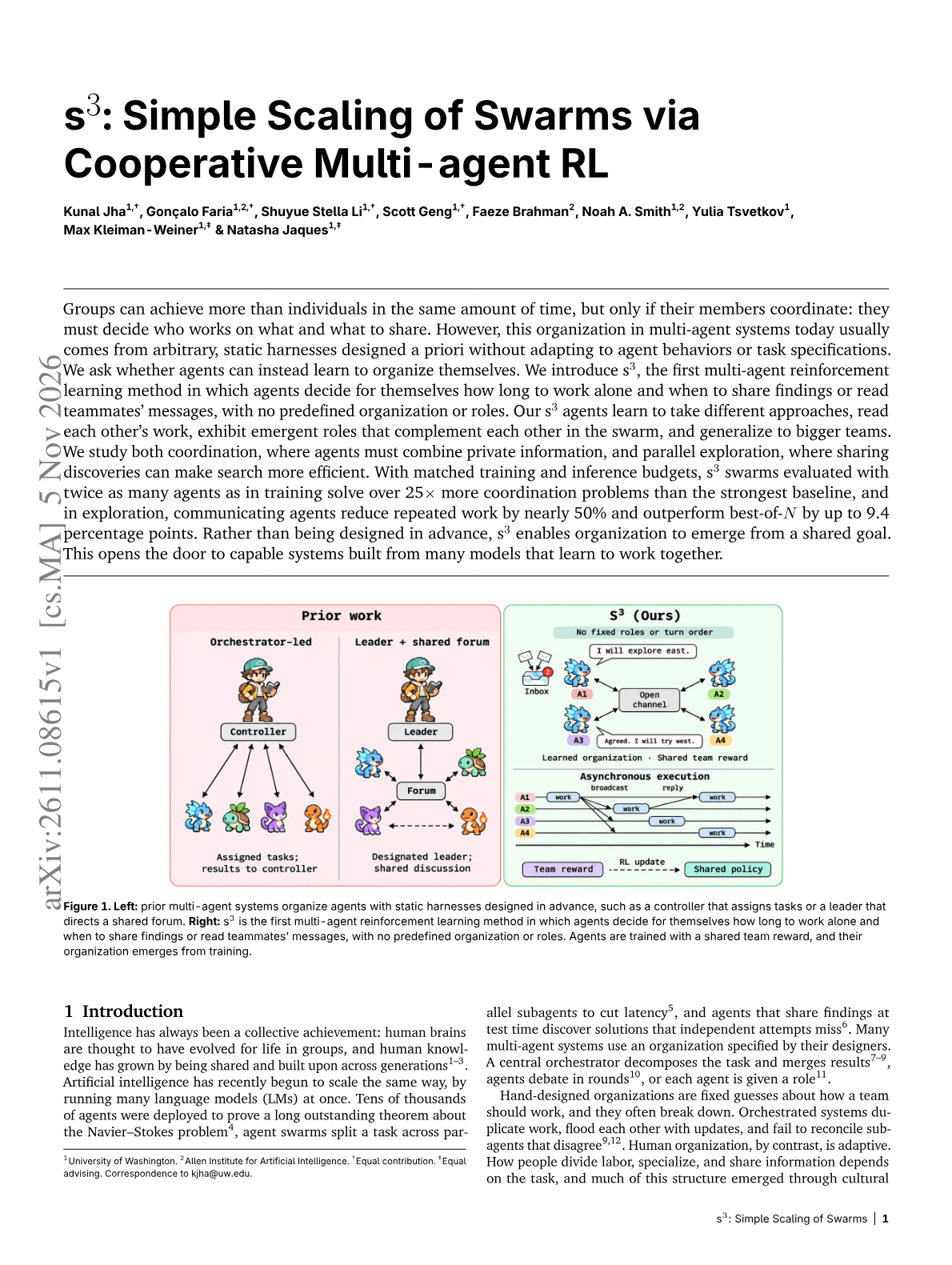
s$^3$: Simple Scaling of Swarms via Cooperative Multi-agent RL
Multi-agent systems usually follow an organization their designers write in advance, such as an orchestrator that splits the task or a fixed set of roles, and these plans often duplicate work or flood agents with updates. Researchers from the University of Washington and the Allen Institute for AI introduce s3, a multi-agent reinforcement learning method where agents learn how to organize themselves.
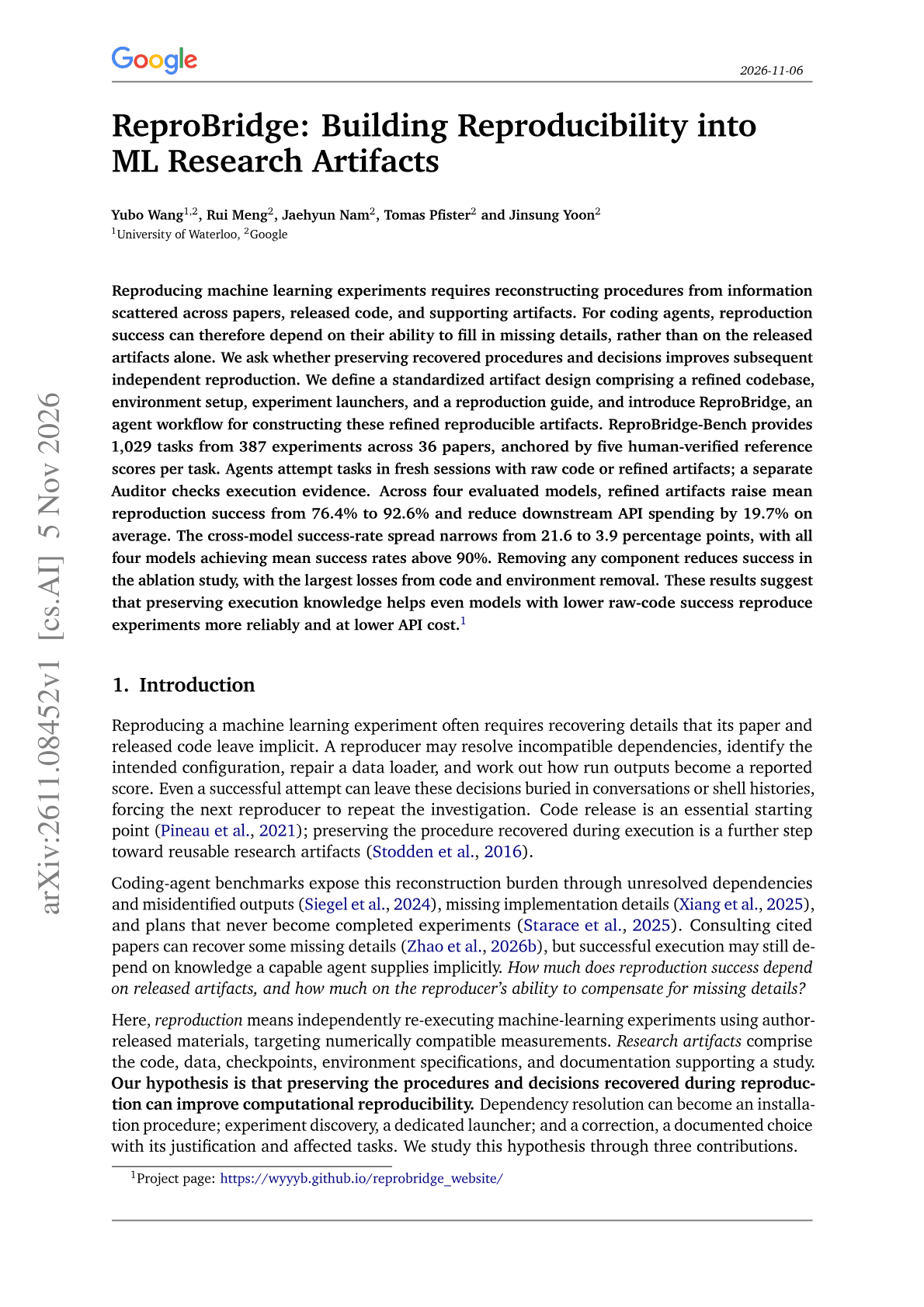
ReproBridge: Building Reproducibility into ML Research Artifacts
Google researchers introduce ReproBridge, an agent workflow that turns one successful reproduction of an ML experiment into a package the next agent can reuse, holding the cleaned code, the environment setup, scripts that launch each experiment, and a written guide. On a benchmark of 1,029 tasks from 36 papers, each with five human-verified reference scores, refined artifacts raise reproduction success from 76.4% to 92.6% across four models and cut API spending by 19.7%, while a separate auditor checks that the runs actually happened. The gap between the best and worst model narrows from 21.6 to 3.9 points, and removing the code or the environment setup causes the largest losses.
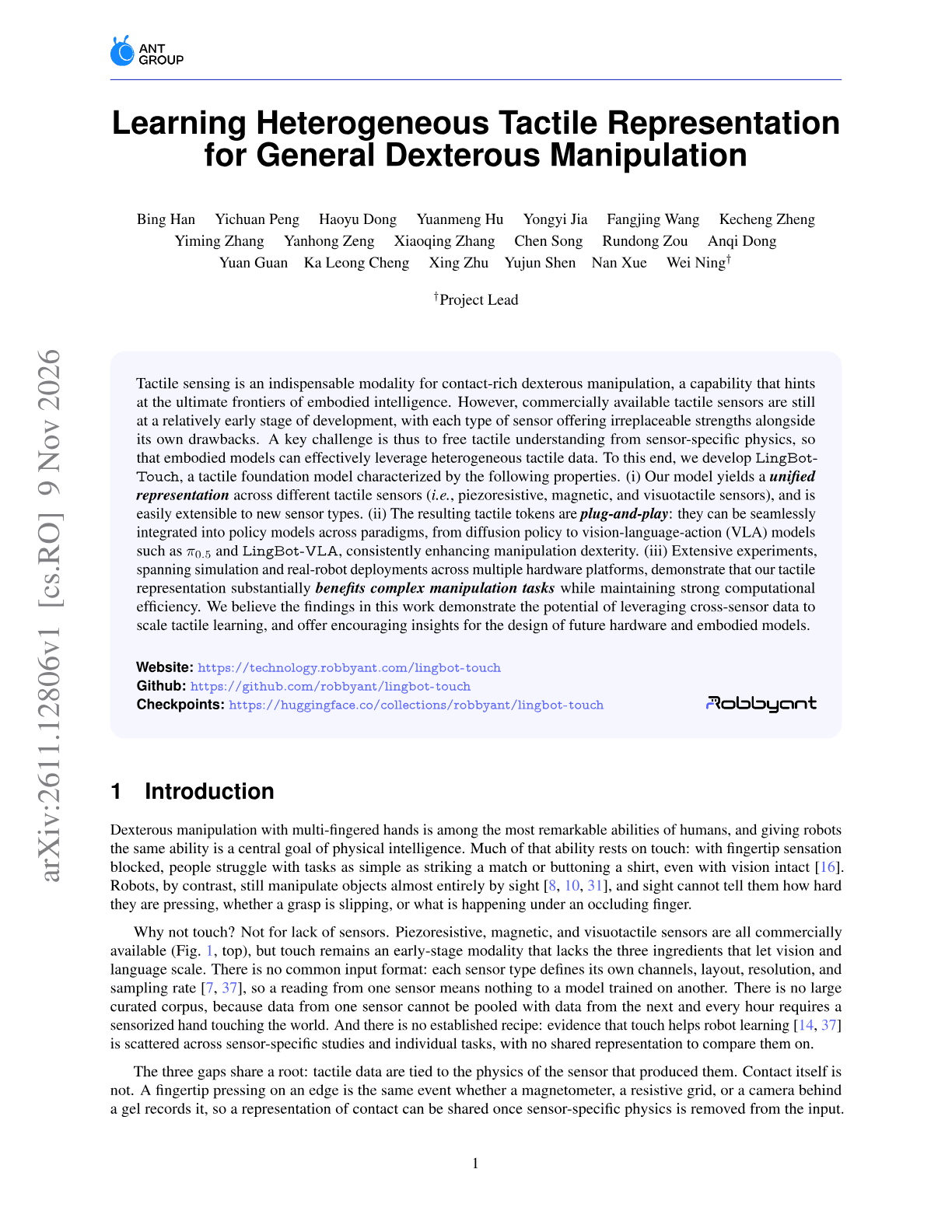
LingBot-Touch
Robbyant introduces LingBot-Touch, a tactile foundation model pretrained on 4,983 hours of real touch data that gives piezoresistive, magnetic, and visuotactile sensors a shared representation by mapping every sensor to the same virtual fingertip. On the XHand1, a robot hand whose sensor the model never saw, a frozen LingBot-Touch with a small trained add-on reaches 0.16 mm average contact-center error against 5.89 mm for FTP-1 with an XHand1-specific adapter. Across six real-world XHand1 tasks, LingBot-VLA averages 57.21% success with or without raw tactile input and 75.04% with LingBot-Touch features.