Absolute Zero
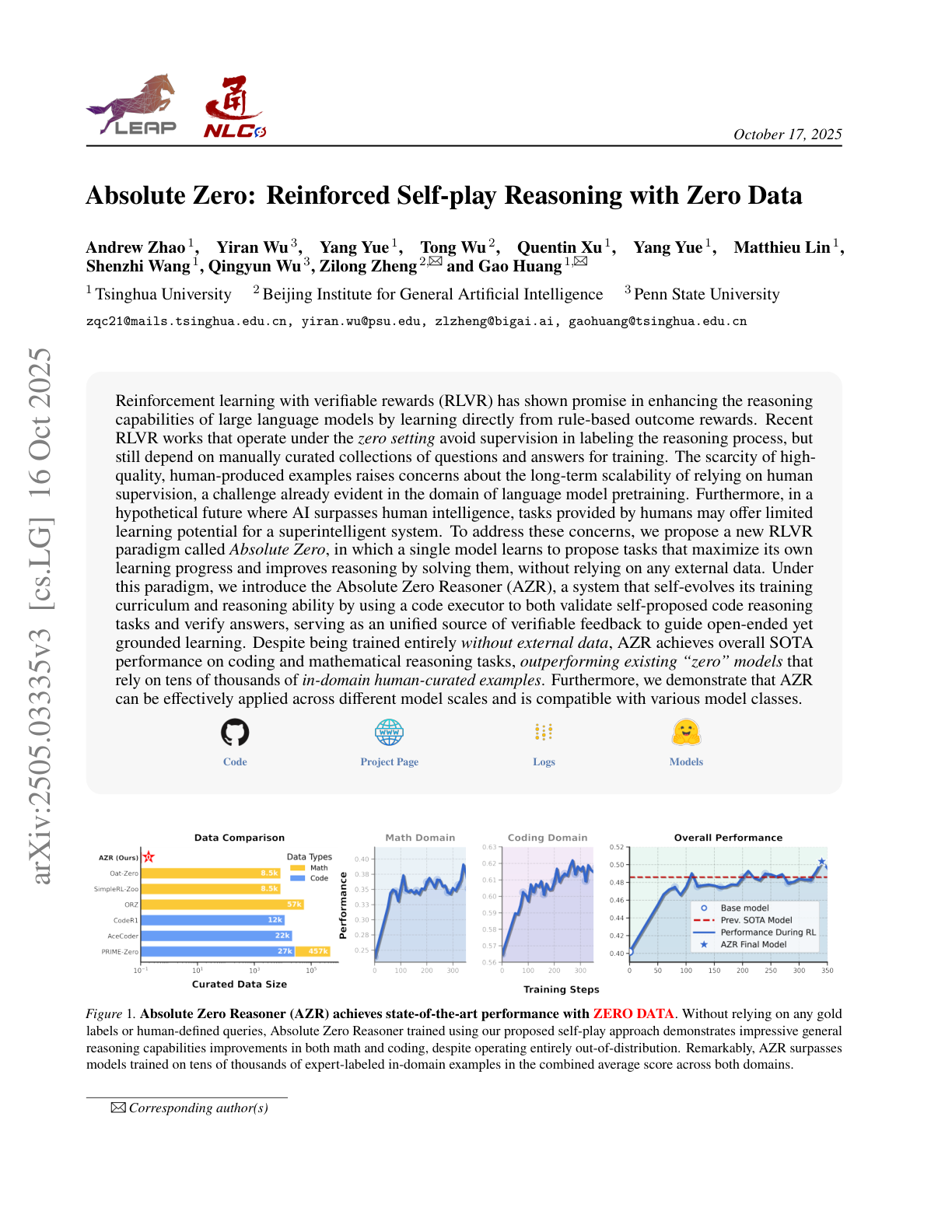
Introduces an LLM training framework that eliminates the need for human-curated data. Key highlights:
Ask this paper
It learns to propose and solve its reasoning tasks entirely through self-play, guided by verifiable feedback from an execution environment. This zero-data RLVR (RL with Verifiable Rewards) setting achieves SOTA coding and math reasoning performance.
AZR learns by generating its code-based reasoning tasks using three core reasoning modes (deduction, abduction, and induction), validating solutions via Python execution, not human labels.
A single LLM plays both roles, proposing new tasks based on learnability and solving them with feedback-based reinforcement. Rewards favor moderately difficult tasks to maximize the learning signal.
Despite using zero in-domain examples, AZR outperforms all previous zero-setting models on average by +1.8 points and even beats models trained on tens to hundreds of thousands of curated samples. AZR-Coder-7B achieves the highest average score across all tested models.
AZR trained in a coding-only environment improves mathematical reasoning performance by up to +15.2 points, far more than expert code models trained with RLVR, showing strong generalization.
Larger AZR models (3B → 7B → 14B) consistently show greater improvements, confirming scalability and suggesting promise for even larger models.
AZR develops natural ReAct-like intermediate planning in code (e.g., interleaved comments and logic), trial-and-error strategies in abduction, and systematic state tracking, behaviors typically observed in much larger models.
Llama-3.1-8B variants of AZR sometimes produce concerning reasoning chains (dubbed “uh-oh moments”), highlighting the importance of safety-aware training in autonomous systems.