Llama-Nemotron
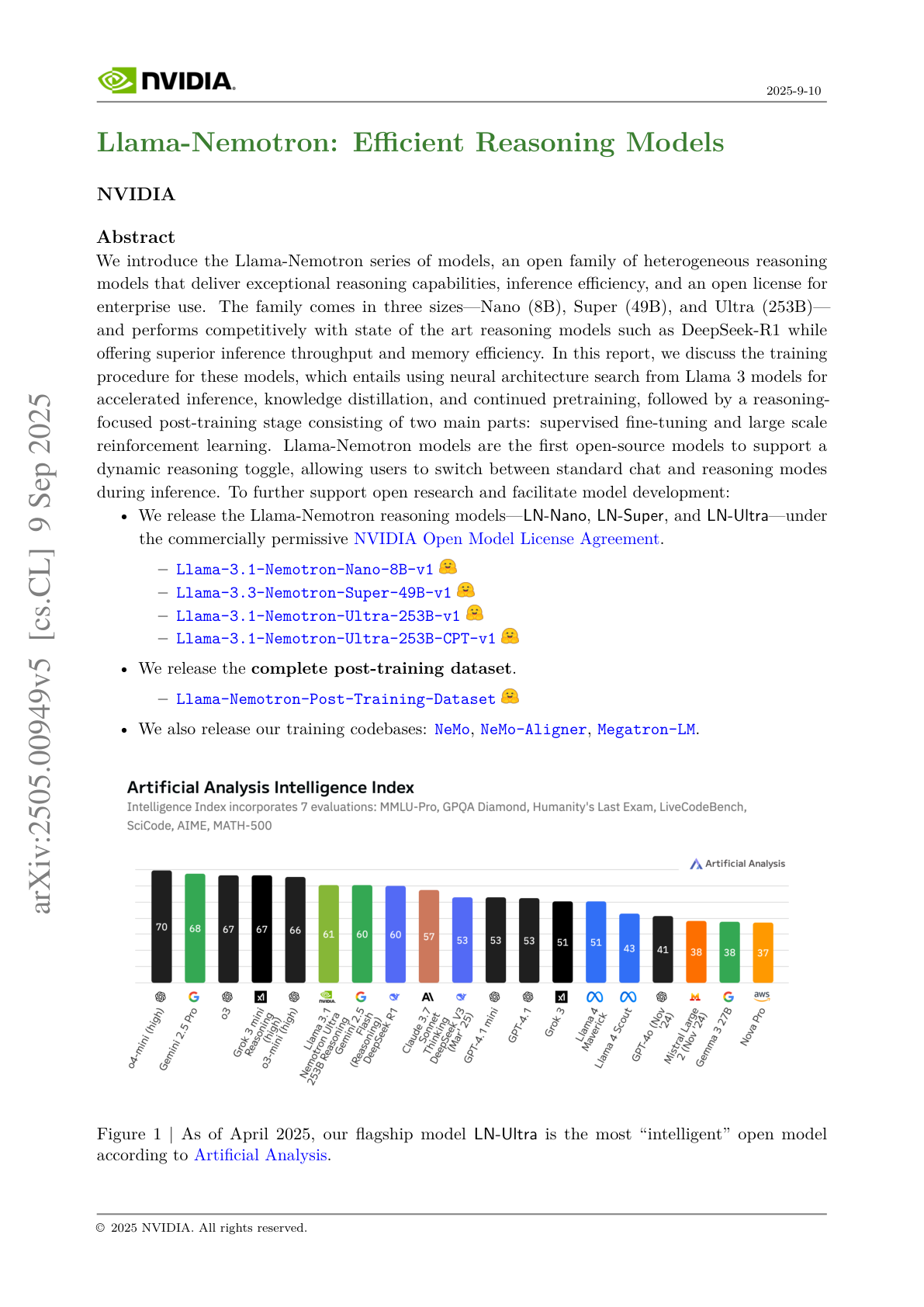
NVIDIA introduces the Llama-Nemotron model series, LN-Nano (8B), LN-Super (49B), and LN-Ultra (253B), a family of open, efficient, and high-performing reasoning models. These models rival or outperform DeepSeek-R1 on various benchmarks while offering significantly better inference throughput and memory efficiency. LN-Ultra is noted as the most "intelligent" open model by Artificial Analysis. A key innovation is a dynamic reasoning toggle ("detailed thinking on/off") that allows users to control reasoning behavior at inference time. Highlights:
Ask this paper
Multi-stage training: Models were built via neural architecture search (Puzzle), knowledge distillation, continued pretraining, supervised fine-tuning (SFT), and large-scale RL. LN-Ultra is enhanced with FP8 inference and FFN Fusion for speed and scalability.
Reasoning Toggle: The models can switch between reasoning and non-reasoning modes via a simple prompt instruction, making them adaptable for various use cases.
Synthetic dataset: Over 33M examples across math, code, science, and instruction-following were curated, with reasoning-mode samples tagged explicitly. LN-Ultra's training used curriculum RL and GRPO to surpass its teachers on benchmarks like GPQA-D.
Evaluation dominance: LN-Ultra outperforms DeepSeek-R1 and Llama-3.1-405B in reasoning tasks like AIME25, MATH500, and GPQA-Diamond while also achieving strong chat alignment scores (Arena-Hard: 87.0). LN-Super scores 88.3, beating Claude 3.5 and GPT-4o. NVIDIA provides the weights, training code (NeMo, Megatron-LM, NeMo-Aligner), and the full post-training dataset under a permissive license, aiming to push open research in reasoning models.