WebThinker
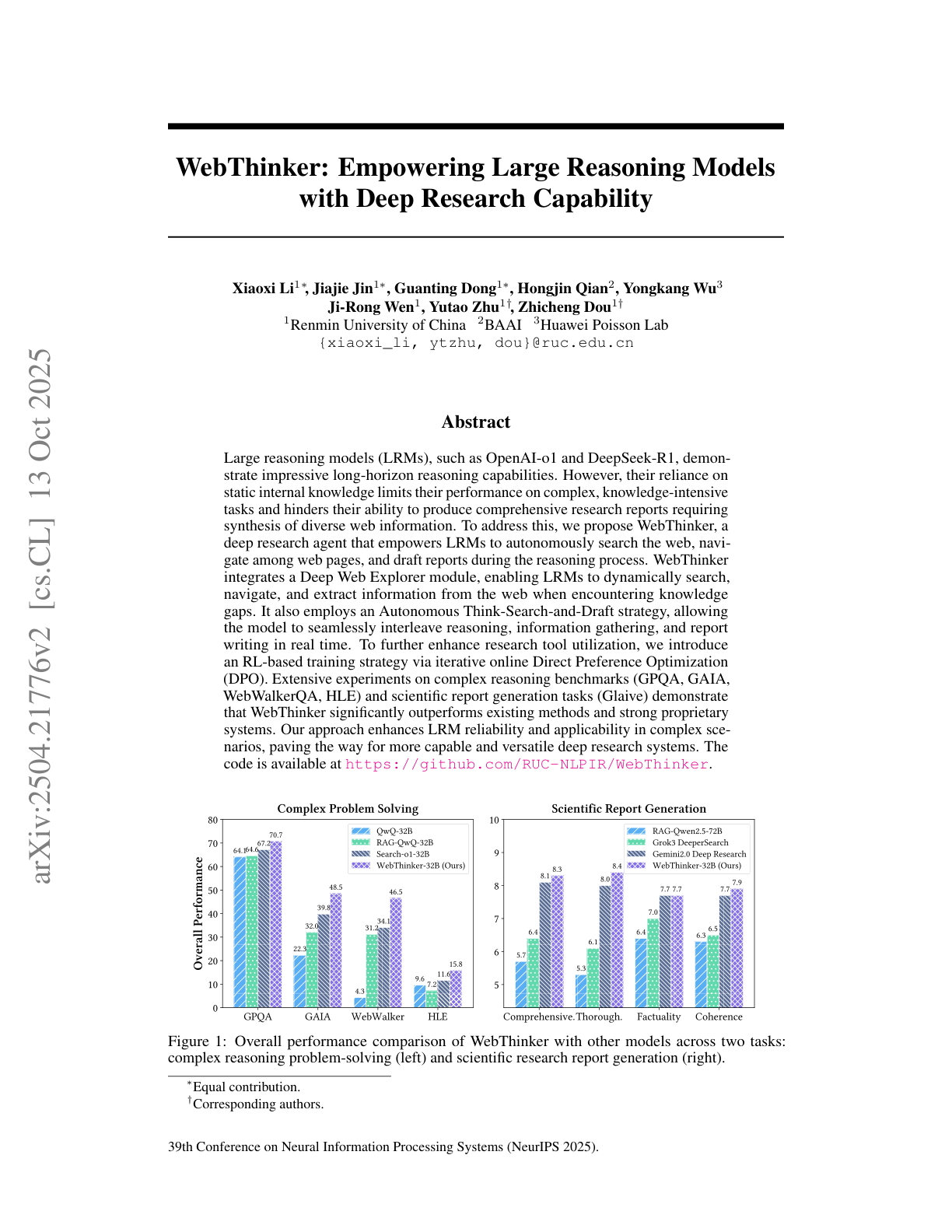
This paper introduces a reasoning agent framework that equips large reasoning models (LRMs) with autonomous web exploration and report writing abilities to overcome limitations of static internal knowledge. WebThinker integrates a Deep Web Explorer module and an Autonomous Think-Search-and-Draft strategy that lets models search the web, reason through tasks, and generate comprehensive outputs simultaneously. It also incorporates an RL-based training loop using online DPO to improve tool usage. The system supports two modes: complex problem solving and scientific report generation. Key points:
Ask this paper
Superior performance in complex reasoning: On GPQA, GAIA, WebWalkerQA, and HLE, WebThinker-32B-RL achieved new state-of-the-art results among 32B models, outperforming both retrieval-augmented and proprietary systems like GPT-4o and DeepSeek-R1-671B. For example, it reached 70.7% on GPQA and 15.8% on HLE, with gains of up to +21.5% over baselines.
Best-in-class scientific report writing: On the Glaive dataset, WebThinker outperformed Gemini2.0 Deep Research and Grok3 DeeperSearch, scoring 8.1 in average quality metrics such as completeness and coherence.
RL refinement matters: The RL-trained version outperformed its base counterpart across all benchmarks, showing that iterative preference-based learning significantly enhances reasoning-tool coordination.
Ablation validates design: Removing components like Deep Web Explorer or automatic report drafting significantly degraded performance, confirming their necessity.