Advancing LLM Reasoning (Eurus)
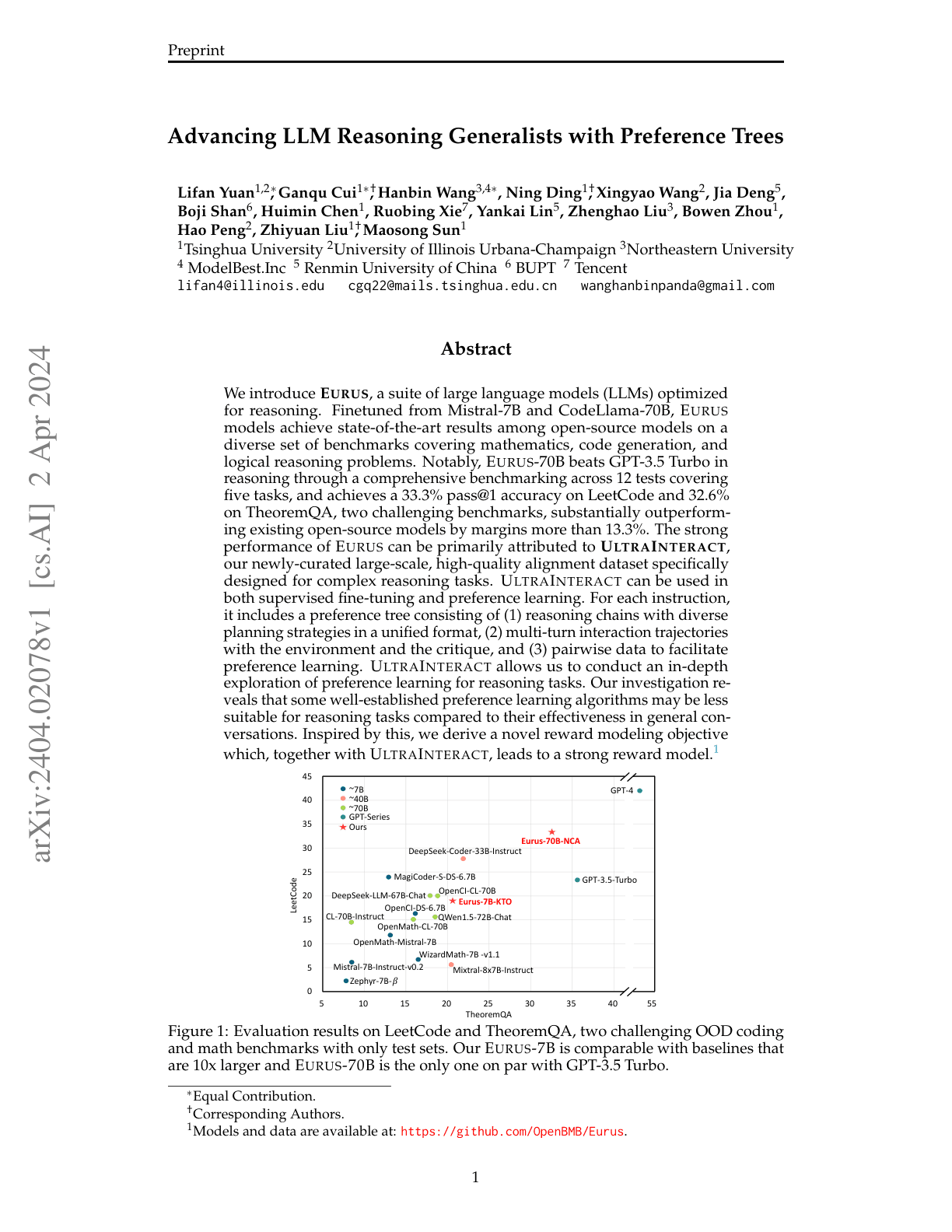
OpenBMB's Eurus is a suite of reasoning-specialized LLMs (7B and 70B) fine-tuned on UltraInteract, a new alignment dataset built around preference trees for complex math, code, and logical tasks.
Ask this paper
UltraInteract data: Each instruction is paired with a tree of reasoning chains plus multi-turn interactions and pairwise preferences, giving the model structured examples of correct vs incorrect reasoning.
SoTA open reasoning: Across 12 reasoning benchmarks Eurus-70B surpasses GPT-3.5 Turbo, reaching 33.3% on LeetCode and 32.6% on TheoremQA, and beats existing open-source baselines by 13.3%+ on average.
Tailored reward objective: Standard DPO is shown to be suboptimal for reasoning, so the authors design a specialized reward modeling objective better suited to chain-of-thought style data.
Takeaway: Demonstrates that task-specific alignment data design - not just model scale - is a key lever for pushing open models into frontier reasoning territory.
Abstract
We introduce Eurus, a suite of large language models (LLMs) optimized for reasoning. Finetuned from Mistral-7B and CodeLlama-70B, Eurus models achieve state-of-the-art results among open-source models on a diverse set of benchmarks covering mathematics, code generation, and logical reasoning problems. Notably, Eurus-70B beats GPT-3.5 Turbo in reasoning through a comprehensive benchmarking across 12 tests covering five tasks, and achieves a 33.3% pass@1 accuracy on LeetCode and 32.6% on TheoremQA, two challenging benchmarks, substantially outperforming existing open-source models by margins more than 13.3%. The strong performance of Eurus can be primarily attributed to UltraInteract, our newly-curated large-scale, high-quality alignment dataset specifically designed for complex reasoning tasks. UltraInteract can be used in both supervised fine-tuning and preference learning. For each instruction, it includes a preference tree consisting of (1) reasoning chains with diverse planning strategies in a unified format, (2) multi-turn interaction trajectories with the environment and the critique, and (3) pairwise data to facilitate preference learning. UltraInteract allows us to conduct an in-depth exploration of preference learning for reasoning tasks. Our investigation reveals that some well-established preference learning algorithms may be less suitable for reasoning tasks compared to their effectiveness in general conversations. Inspired by this, we derive a novel reward modeling objective which, together with UltraInteract, leads to a strong reward model.