Agent-Native Memory
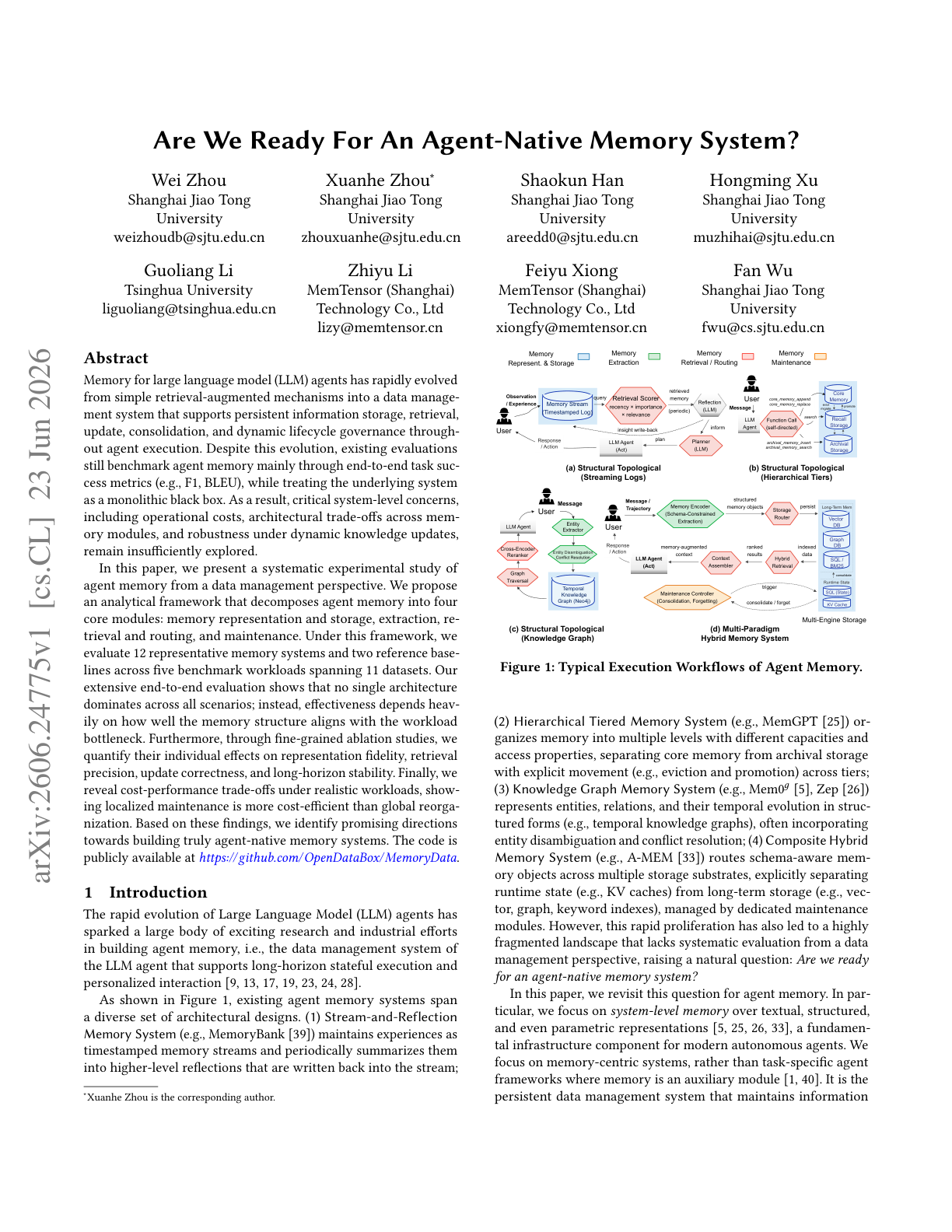
Memory for LLM agents has quietly grown from a retrieval add-on into a full data system, with persistent storage, retrieval, update, consolidation, and lifecycle governance running throughout an agent's execution. Yet most evaluations still score memory only through end-to-end task metrics like F1 and BLEU, treating the whole stack as a black box. This paper studies agent memory from a data management perspective and asks what we are actually missing when we measure it that way.
Ask this paper
A data management view of memory: The authors argue that operational cost, architectural trade-offs across memory modules, and robustness under dynamic knowledge updates are first-class concerns that task-success metrics hide entirely.
A four-module decomposition: They break memory into representation and storage, extraction, retrieval and routing, and maintenance, then evaluate 12 representative memory systems plus two baselines across five workloads spanning 11 datasets.
No single architecture wins: Effectiveness depends on how well the memory structure matches the workload bottleneck, and fine-grained ablations quantify each module's effect on representation fidelity, retrieval precision, update correctness, and long-horizon stability.
Why it matters: The study shows localized maintenance is more cost-efficient than global reorganization, and reframing memory as a system with measurable trade-offs is what gets us toward genuinely agent-native memory rather than another leaderboard number.