Sakana Fugu
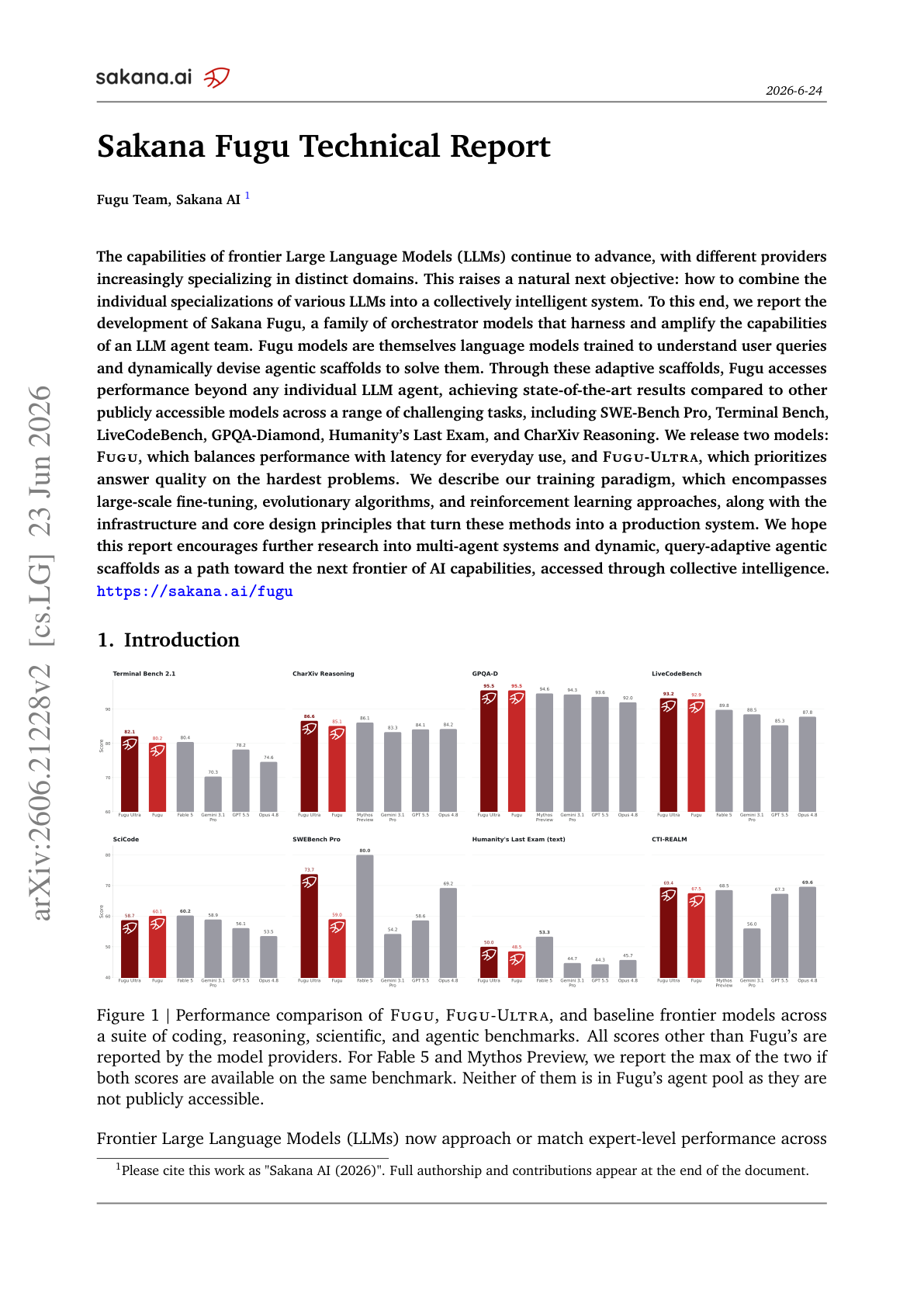
Frontier LLMs keep advancing, and different providers are increasingly specializing in distinct domains, which raises a natural next objective: how do you combine those individual specializations into one collectively intelligent system? Sakana Fugu answers with a family of orchestrator models that are themselves language models trained to read a user query and dynamically devise the agentic scaffold needed to solve it.
Ask this paper
Orchestrator models, not a fixed pipeline: Fugu is trained to understand a query and build an adaptive agentic scaffold on the fly, harnessing and amplifying a team of LLM agents rather than routing to a single frozen workflow.
Performance beyond any single agent: Through these query-adaptive scaffolds, Fugu reaches state-of-the-art results against other publicly accessible models across SWE-Bench Pro, Terminal Bench, LiveCodeBench, GPQA-Diamond, Humanity's Last Exam, and CharXiv Reasoning.
Two models for two regimes: They release Fugu, which balances answer quality against latency for everyday use, and Fugu-Ultra, which prioritizes quality on the hardest problems.
Why it matters: The training paradigm combines large-scale fine-tuning, evolutionary algorithms, and reinforcement learning, plus the infrastructure to turn that into a production system, pointing to dynamic, query-adaptive scaffolds and collective intelligence as a path toward the next frontier of AI capabilities.