Autodata
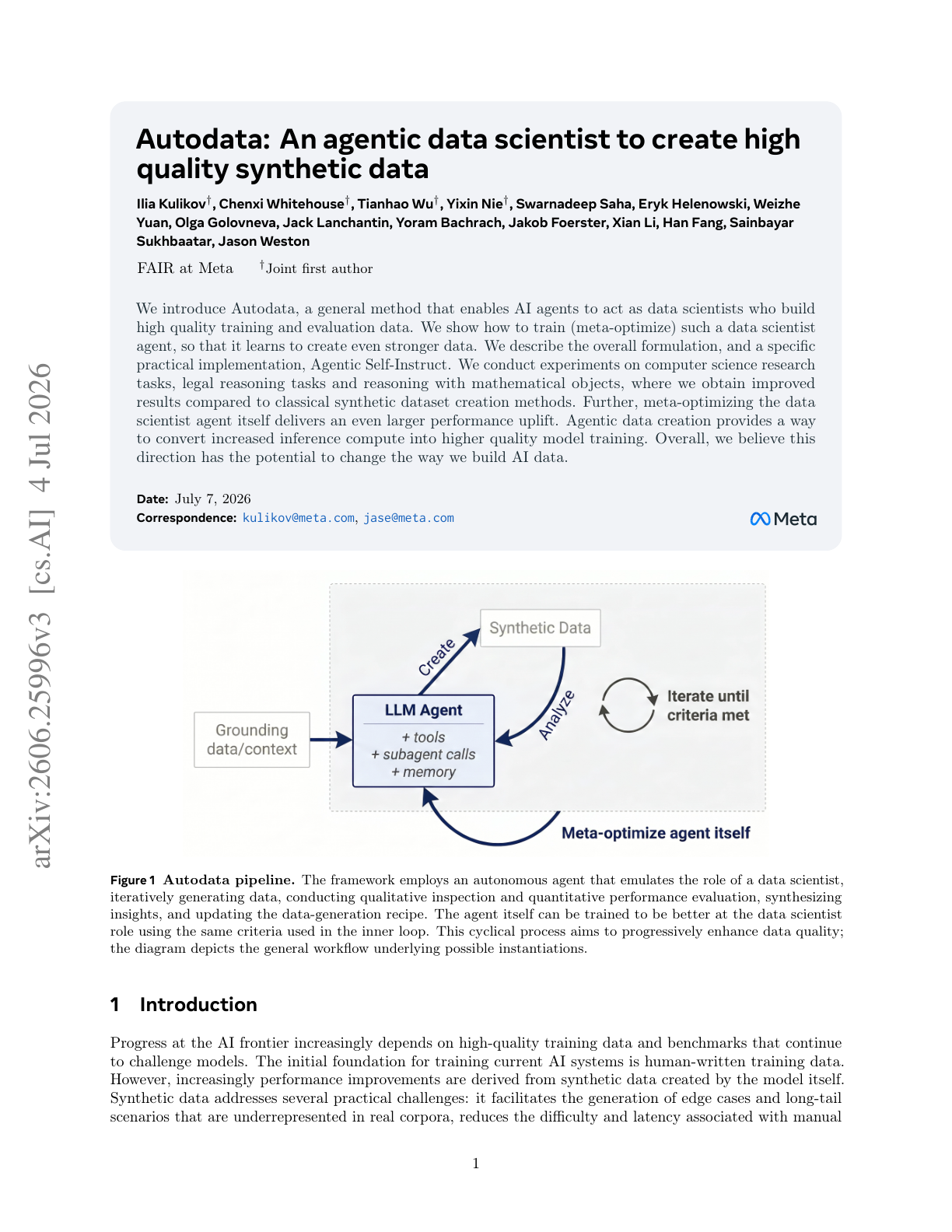
Building synthetic training data has mostly stayed a fixed pipeline that you hand-tune once and then freeze. Autodata rethinks that by casting an AI agent as a data scientist that builds high-quality training and evaluation data, then meta-optimizes that agent so it learns to create even stronger data over time.
Ask this paper
An agent as data scientist: Autodata is a general formulation in which an AI agent plays the role of a data scientist building both training and evaluation data, instantiated as a concrete, practical implementation the authors call Agentic Self-Instruct.
Meta-optimization compounds the gains: Beyond using the agent to generate data, they train (meta-optimize) the data scientist agent itself, and this self-improvement step delivers a larger performance uplift than base agentic data creation alone.
Consistent across domains: On computer science research tasks, legal reasoning, and reasoning with mathematical objects, Autodata beats classical synthetic dataset creation methods, showing the approach is not tied to a single problem type.
Why it matters: Agentic data creation turns increased inference compute into higher-quality training data, offering a path that could change how teams build datasets rather than freezing a pipeline and hoping it generalizes.