AiScientist
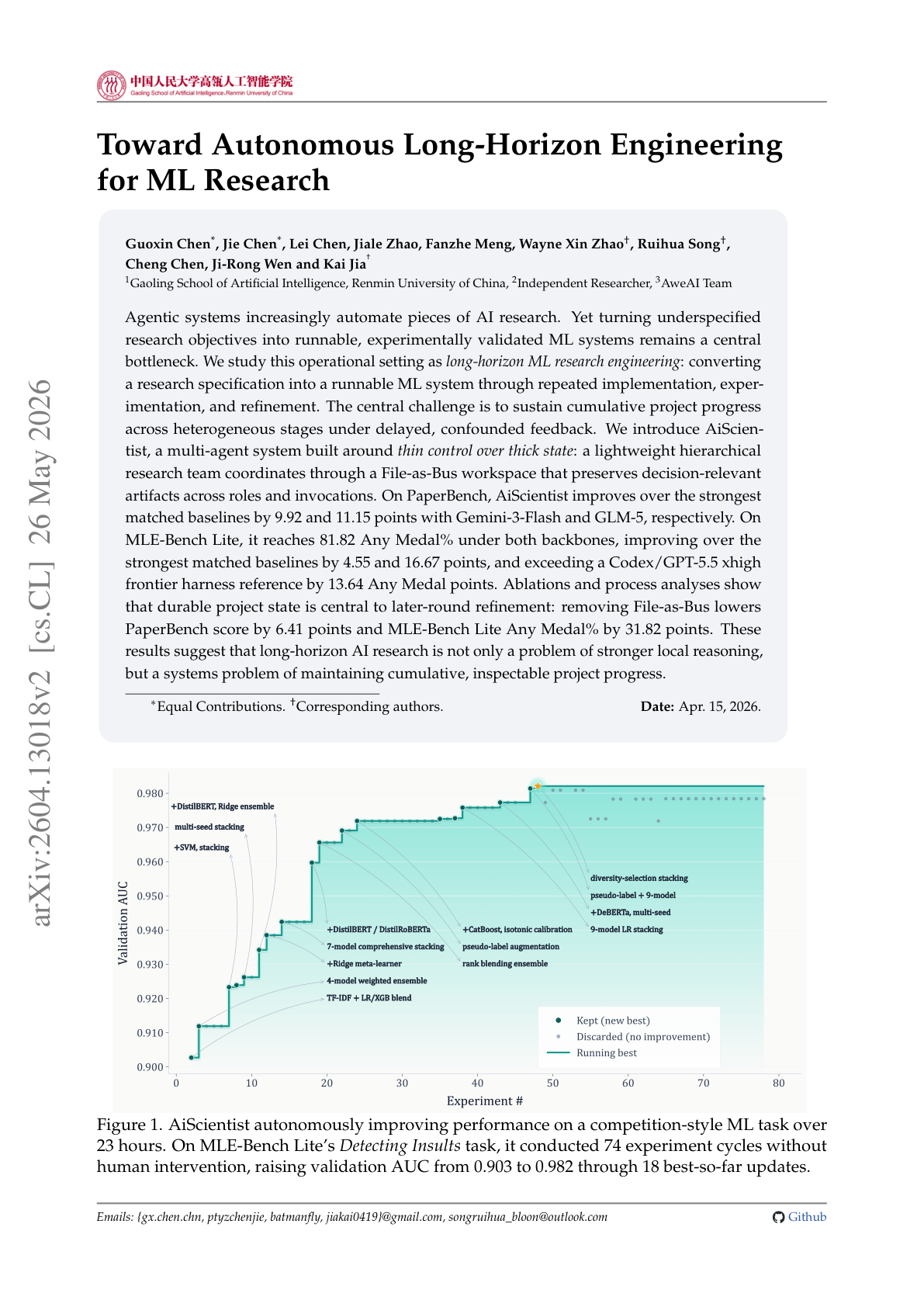
Long-horizon AI research agents are mostly a state-management problem. Reasoning well for the next turn is not enough when ML research demands task setup, implementation, experiments, debugging, and evidence tracking over hours or days. This paper introduces AiScientist, a system for autonomous long-horizon engineering built around the principle of thin control and thick state. A top-level orchestrator manages stage-level progress while specialized agents repeatedly ground themselves in durable workspace artifacts.
Ask this paper
File-as-Bus coordination: AiScientist's core design choice is to route coordination through durable filesystem artifacts rather than in-context message passing. Analyses, plans, code, logs, and experimental evidence all live as versioned files in a permission-scoped workspace, allowing specialists and subagents to reconstruct context from scratch without replaying entire conversations.
Thin control, thick state: A Tier-0 orchestrator issues only stage-level directives, while Tier-1 specialists and optional Tier-2 subagents operate on shared artifacts. This keeps the control channel narrow and the state channel rich, giving agents the space to run long experiments without losing track of prior decisions and evidence.
Strong benchmark results: The system improves PaperBench by 10.54 points over the best matched baseline and reaches 81.82 Any Medal% on MLE-Bench Lite. Removing File-as-Bus drops PaperBench by 6.41 points and MLE-Bench Lite by 31.82 points, isolating the artifact-mediated design as the primary driver of gains.
Durable project memory over longer chats: The work argues that autonomous research agents need persistent project memory, not just longer context windows. The results generalize the emerging pattern that environments carrying state on behalf of agents outperform architectures that rely solely on in-context reasoning for multi-hour workflows.